 Back
BackFluids: Density, Pressure, Buoyancy, and Fluid Dynamics
Study Guide - Smart Notes
 Tailored notes based on your materials, expanded with key definitions, examples, and context.
Fluids: Density and Pressure
Definition of a Fluid
A fluid is a substance that can flow, including both liquids and gases. Fluids are distinguished from solids by their lack of long-range order, allowing them to conform to the shape of their container.
Density
The density (\( \rho \)) of a fluid is defined as the mass per unit volume:
If the density is uniform throughout the fluid, then \( \rho = \frac{m}{V} \).
Pressure
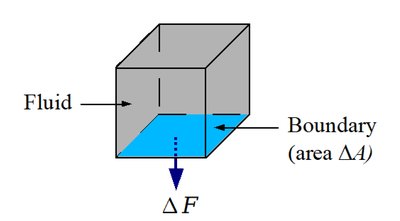
Pressure is the force exerted per unit area, acting normal to the surface and outward from the fluid:
The SI unit of pressure is the Pascal (Pa): 1 Pa = 1 N/m2. Other common units include the atmosphere (atm), torr (mm Hg), and pounds per square inch (lb/in2).
Pressure Variation with Depth
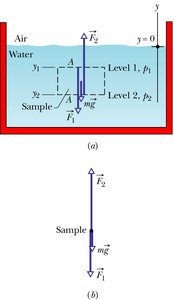
In a fluid at rest, the pressure increases with depth due to the weight of the fluid above. For two depths \( y_1 \) and \( y_2 \):
If \( y_1 = 0 \) (surface) and \( y_2 = -h \) (depth \( h \)), then:
where \( p_0 \) is the pressure at the surface (atmospheric pressure if open to air).
Archimedes' Principle and Buoyancy
Archimedes' Principle
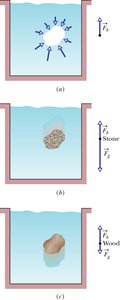
When a body is fully or partially submerged in a fluid, the fluid exerts an upward buoyant force equal to the weight of the fluid displaced:
where \( m_f \) is the mass of the displaced fluid. The buoyant force acts through the center of gravity of the displaced fluid.
Apparent Weight
The apparent weight of a body immersed in a fluid is less than its actual weight:
where \( W = mg \) is the actual weight and \( F_b \) is the buoyant force.
Example: Floating Iceberg
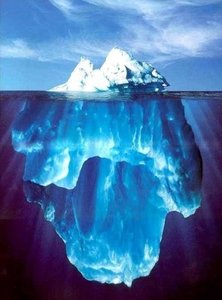
To find the fraction of an iceberg visible above water, use the densities of ice (\( \rho_i \)) and seawater (\( \rho_f \)):
The fraction visible is:
For ice (917 kg/m3) and seawater (1024 kg/m3):
Thus, about 10% of the iceberg is visible above water.
Pascal's Principle
Statement of Pascal's Principle
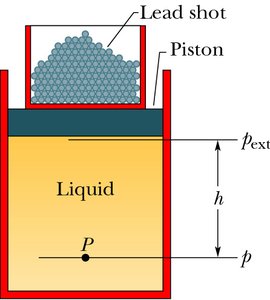
Pascal's principle states that the pressure applied to an enclosed incompressible fluid is transmitted undiminished to every portion of the fluid and to the walls of its container.
If the external pressure at the surface is increased by \( \Delta p_{\text{ext}} \), the pressure at any depth increases by the same amount:
Ideal Fluids in Motion
Properties of Ideal Fluids
Incompressible: Density is constant.
Nonviscous: No internal friction (viscous drag is neglected).
Steady (Laminar) Flow: Velocity at each point is constant in time.
Irrotational Flow: Fluid elements do not rotate about their own center of mass.
Streamlines and Tubes of Flow
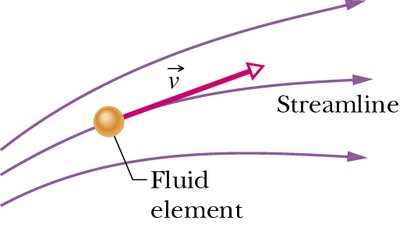
A streamline is the path traced by a fluid element, with the velocity vector tangent at every point. Streamlines never intersect. A tube of flow is a bundle of streamlines forming an imaginary boundary; fluid cannot cross the sides of this tube.
Equation of Continuity
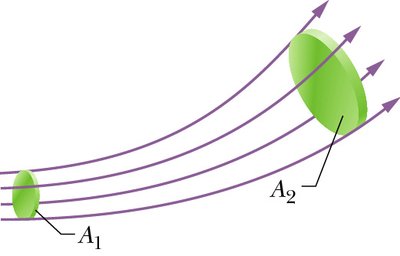
The equation of continuity expresses conservation of mass for an incompressible fluid:
where \( A \) is the cross-sectional area and \( v \) is the fluid velocity. This means that where the tube narrows, the velocity increases, and vice versa.
Bernoulli's Equation
Statement and Interpretation
Bernoulli's equation relates pressure, velocity, and height for an ideal fluid along a streamline:
This is a statement of conservation of energy for flowing fluids. If the pipe is horizontal (\( y = \text{constant} \)), then:
Thus, an increase in velocity results in a decrease in pressure, and vice versa.
Application Example: Flow in a Pipe
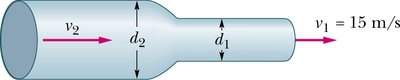
Consider water flowing through a horizontal pipe with varying diameter. If the velocity at the narrow end is 15 m/s, and the diameters are 5.0 cm and 3.0 cm, the equation of continuity gives:
Solving for \( v_2 \):
Bernoulli's equation can be used to find the pressure difference between the two ends.
Additional info: The notes above cover the main concepts of fluid statics and dynamics, including density, pressure, buoyancy, Pascal's principle, the equation of continuity, and Bernoulli's equation, as relevant to a college-level physics course.
