 Back
BackFluids: Pascal’s Principle and Archimedes’ Principle- lecture 21
Study Guide - Smart Notes
 Tailored notes based on your materials, expanded with key definitions, examples, and context.
Fluids
Pascals Principle
Pascal’s Principle is a fundamental concept in fluid mechanics, describing how pressure applied to an enclosed fluid is transmitted undiminished throughout the fluid and to the walls of its container. This principle is the basis for many hydraulic systems and devices.
Definition: When a force is applied to a confined fluid, the resulting increase in pressure is transmitted equally to all parts of the fluid and the walls of the container.
Applications: Hydraulic lifts, brakes, and presses utilize Pascal’s Principle to multiply force.
Mathematical Expression: If two pistons are connected by an enclosed fluid, and are at the same height, then: Using the definition of pressure: Solving for the output force:
Force Multiplication: The output force can be increased by increasing the area of the output piston relative to the input piston.
Example: Hydraulic Car Lift
Input piston radius:
Output piston radius:
Output force (weight of car and plunger):
Since pistons are at the same level (), Area of a circle:
Conclusion: A small input force can lift a much heavier object using a hydraulic system.
Archimedes' Principle
Archimedes’ Principle explains the buoyant force experienced by objects submerged in a fluid. This principle is essential for understanding why objects float or sink and is widely used in engineering and science.
Buoyant Force: A submerged object experiences an upward force equal to the weight of the fluid it displaces.
Mathematical Expression: The buoyant force is: Using the pressure-depth relationship: Where is the fluid density, is acceleration due to gravity, is the depth, and is the area. Since is the mass of displaced fluid:
Archimedes’ Principle: The buoyant force on a submerged object is equal to the weight of the fluid displaced by the object.
Volume Displacement: The volume of fluid displaced is equal to the volume of the submerged part of the object (1-to-1 correspondence).

Buoyancy and Floating
Whether an object floats or sinks in a fluid depends on the relationship between the object’s density and the fluid’s density.
If : The object floats.
If : The object sinks.
If : The object is neutrally buoyant (neither sinks nor floats).
Example: Pinewood Raft
Raft dimensions:
Density of pine:
Density of water:
Since , the raft floats.
To find the submerged depth : Buoyant force balances the weight of the raft:
Conclusion: 0.17 m of the raft is submerged when floating in water.
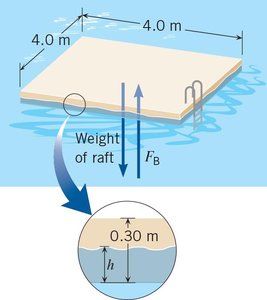
Additional info: The first image (image_1) is a humorous meme and does not directly reinforce the academic explanation of Archimedes’ Principle or volume displacement in a physics context, so it is not included. Only image_2, which visually supports the raft buoyancy example, is included as per instructions.
