 Back
BackFluids: Properties, Pressure, and Applications in Physics
Study Guide - Smart Notes
 Tailored notes based on your materials, expanded with key definitions, examples, and context.
Fluids
Definition and Characteristics
Fluids are substances that flow and take the shape of their container. Both liquids and gases are classified as fluids because they are easily deformed by external forces. The molecular structure of fluids allows them to move freely, unlike solids, which retain a fixed shape.
Fluid: Any substance that can flow, including liquids and gases.
Liquids: Have definite volume but no definite shape.
Gases: Have neither definite volume nor shape.
Key property: Ability to flow and adapt to the shape of their container.
Fluid Pressure
Origin and Definition
Fluid pressure arises from the collisions of fast-moving atoms or molecules within the fluid. These collisions exert force on the surfaces they contact, resulting in pressure.
Pressure (P): The force exerted per unit area by a fluid.
Formula: , where is force and is area.
Units: Pascals (Pa), where .
Scalar quantity: Pressure has magnitude but no direction.
Hydrostatics
Static Fluids and Pressure
Hydrostatics is the study of fluids at rest. In static fluids, both the fluid and any solid objects in contact with it are at rest. However, the molecules within the fluid are still in motion, colliding and exerting pressure.
Static fluid: Fluid that is not flowing.
Hydrostatics: Branch of physics dealing with fluids at rest.
Pressure in static fluids: Results from molecular motion and is exerted equally in all directions.
Pressure Calculations and Examples
Pressure on Surfaces
Pressure can be calculated by measuring the force exerted on a small area within the fluid. This is especially useful for understanding how pressure varies in different situations.
Formula:
Example: Calculating the pressure exerted by a person wearing different types of shoes.
Example Calculation
Tennis Shoe: Area = , Weight = , Pressure =
Dress Shoe: Area = , Weight = , Pressure =
Atmospheric Pressure
Definition and Variation
Atmospheric pressure is the pressure exerted by the layer of air surrounding the Earth. It decreases with altitude and varies with weather conditions.
Sea level atmospheric pressure: or
Pressure decreases: As altitude increases, atmospheric pressure decreases.
Pascal's Experiment
Pascal demonstrated the decrease in atmospheric pressure with altitude by sending a barometer and balloon up a mountain. The balloon expanded as the climbers gained elevation, showing lower external pressure.
Pascal’s Principle
Pressure Transmission in Fluids
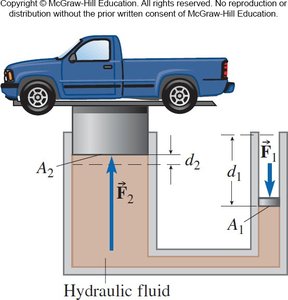
Pascal’s Principle states that a change in pressure at any point in a confined fluid is transmitted undiminished throughout the fluid. This principle is fundamental to hydraulic systems.
Pressure equality: In a static fluid, pressure is the same at all points if the fluid's weight is negligible.
Formula:
Hydraulic systems: Use Pascal’s Principle to multiply force.
Application in Hydraulic Lift
Force multiplication:
Example: If the radius of the smaller piston is and the larger is , then
Density
Definition and Calculation
Density is a measure of how much mass is contained in a given volume. It is a fundamental property of matter and is represented by the Greek letter ρ (rho).
Formula:
Units:
Uniform substances: Density is constant throughout.
Non-uniform substances: Average density is used.
Buoyant Force and Archimedes’ Principle
Buoyancy in Fluids
When an object is immersed in a fluid, it experiences an upward force called the buoyant force. This force is due to the pressure difference between the top and bottom of the object.
Buoyant force: Upward force exerted by a fluid on a submerged object.
Pressure increases with depth: Causes greater force at the bottom than at the top.
Archimedes’ Principle
Archimedes’ Principle states that the buoyant force on a submerged object is equal to the weight of the fluid displaced by the object.
Formula:
Floating and sinking: If an object is denser than the fluid, it sinks; if less dense, it floats; if equal, it remains submerged.
Flowing Fluids and Viscosity
Viscous Forces
Moving fluids can exert forces parallel to surfaces, known as viscous forces. These forces oppose the flow and are analogous to friction in solids.
Viscous force: Opposes fluid flow, similar to kinetic friction.
Static vs. moving fluids: Only moving fluids exert parallel forces.
Ideal Fluids and Flow Principles
Ideal Fluid Assumptions
An ideal fluid is incompressible, undergoes laminar flow, and has no viscosity. Under certain conditions, real fluids can be approximated as ideal.
Incompressible: Density remains constant.
Laminar flow: Smooth, orderly flow.
No viscosity: No internal resistance to flow.
Continuity Equation
The continuity equation describes the relationship between the velocity and cross-sectional area of a flowing fluid. As the area increases, the velocity decreases, and vice versa.
Formula:
Conservation of mass: The mass flow rate is constant along the flow.
Bernoulli’s Principle
Bernoulli’s Principle states that in a horizontal flow, the speed of the fluid is higher where the pressure is lower. This is a consequence of the conservation of energy in fluid flow.
Formula:
Work-Energy Theorem: Bernoulli’s Principle is a restatement of this theorem for fluids.
Applications: How Airplanes Fly
Lift and Wing Design
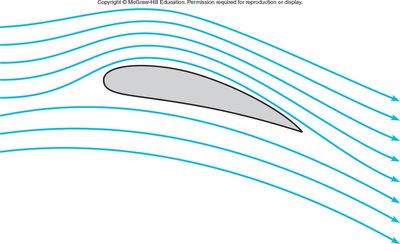
The shape and tilt of an airplane wing cause air to move faster across the top than the bottom, resulting in lower pressure above the wing. The pressure difference produces a net upward force, or lift, which allows the airplane to fly.
Lift: Upward force balancing the airplane's weight.
Pressure difference: Created by wing shape and airflow.
Bernoulli’s Principle: Explains the origin of lift.
Additional info: Academic context and formulas have been expanded for completeness and clarity. Only images directly relevant to the explanation have been included.
