 Back
BackFluids: Properties, Pressure, and Buoyancy
Study Guide - Smart Notes
 Tailored notes based on your materials, expanded with key definitions, examples, and context.
Fluids and Their Properties
Definition and Phases of Matter
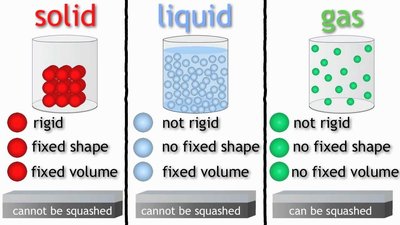
Fluids are substances that can flow and take the shape of their container. They include both liquids and gases, which are distinct from solids due to their ability to move freely and adapt to the shape of their environment.
Solids: Rigid, fixed shape, fixed volume, cannot be squashed.
Liquids: Not rigid, no fixed shape, fixed volume, cannot be squashed.
Gases: Not rigid, no fixed shape, no fixed volume, can be squashed (compressible).
Density
Density (\( \rho \)) is a measure of how much mass is contained in a given volume. It is a fundamental property of fluids and is defined as:
SI Unit: kg/m3
Typical values: \( \rho_{air} = 1.29\ \mathrm{kg/m^3} \), \( \rho_{water} = 1000\ \mathrm{kg/m^3} \)
Example: To find the mass of water in a reservoir with a surface area of 50.0 km2 and an average depth of 40.0 m, use the formula above.
Key Concept: The density of a substance does not depend on the amount of substance present; it is an intrinsic property.
Pressure in Fluids
Definition of Pressure
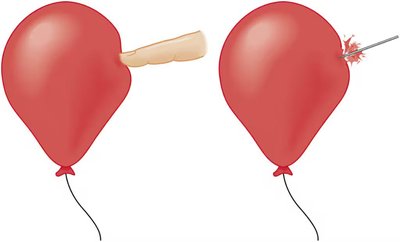
Pressure (P) is defined as the force applied per unit area. In fluids, pressure acts equally in all directions and at right angles to any surface.
SI Unit: Pascal (Pa) = N/m2
Example: Pressing a balloon with a finger versus a needle demonstrates how pressure increases as the area decreases for the same force.
Gauge Pressure and Absolute Pressure
There are two main types of pressure measurements:
Gauge Pressure (\( P_g \)): The pressure in excess of atmospheric pressure.
Absolute Pressure (\( P \)): The total pressure, including atmospheric pressure.
Relationship:
Example: Tire pressure is usually measured as gauge pressure, which is the pressure above atmospheric pressure.
Atmospheric Pressure
Atmospheric pressure is the pressure exerted by the weight of the Earth's atmosphere at sea level. It is approximately:
Example: The force exerted on the palm of your hand by atmospheric pressure can be calculated using the area of your hand and the value above.
Pressure at Different Depths
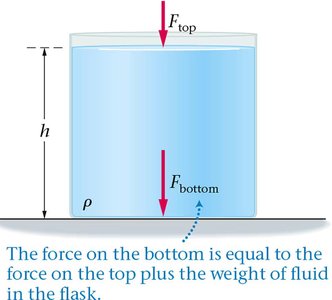
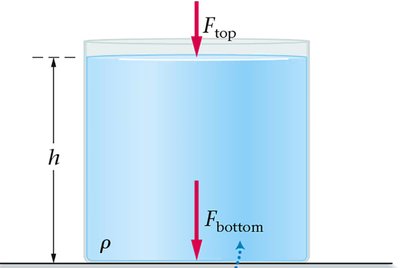
In a fluid at rest, pressure increases with depth due to the weight of the fluid above. The pressure at a depth \( h \) below the surface is given by:
\( P_0 \): Pressure at the surface (often atmospheric pressure)
\( \rho \): Density of the fluid
\( g \): Acceleration due to gravity
\( h \): Depth below the surface
Fluid Statics: Pascal's Principle and Applications
Pascal's Principle
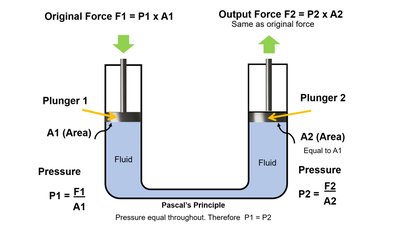
Pascal's Principle states that an external pressure applied to an enclosed fluid is transmitted undiminished to every part of the fluid and to the walls of its container. This principle is the basis for hydraulic systems, such as car lifts.
Example: A mechanic uses a hydraulic lift to raise a truck. The force required on the small piston can be calculated using the ratio of the areas of the pistons.
Buoyancy and Archimedes' Principle
Buoyant Force
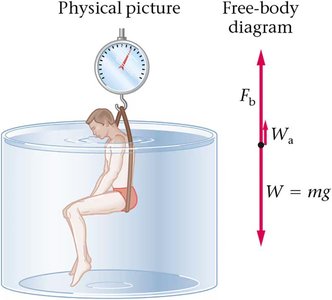
When an object is immersed in a fluid, it experiences an upward force called the buoyant force. This force is equal to the weight of the fluid displaced by the object.
Archimedes' Principle: An object immersed in a fluid experiences a buoyant force equal to the weight of the fluid it displaces.
Example: A person submerged in water appears to weigh less due to the upward buoyant force.
Floating and Sinking
Whether an object floats or sinks depends on the relationship between its weight and the buoyant force:
If the weight of the object is less than the buoyant force, it floats.
If the weight is greater, it sinks.
If the weight equals the buoyant force, the object is neutrally buoyant and remains suspended.
Fraction Submerged and Density
The fraction of an object submerged in a fluid is determined by the ratio of the object's density to the fluid's density:
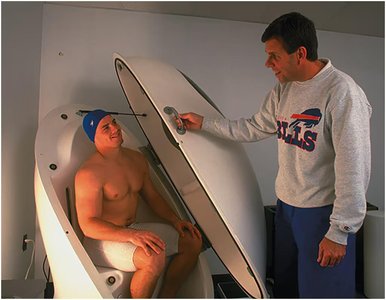
Example: A woman floats in freshwater with 97% of her volume submerged. Her average density can be found using the formula above.
Conceptual Applications and Real-World Examples
Pressure and Buoyancy in Everyday Life
Submarines: Experience immense pressure at great depths due to the weight of the water above.
Ice on Lakes: Distributing weight over a larger area (e.g., lying flat) reduces pressure and helps prevent breaking through thin ice.
Hydraulic Lifts: Used in automotive repair shops to lift heavy vehicles with relatively small input forces.
Summary Table: Properties of Solids, Liquids, and Gases
Property | Solid | Liquid | Gas |
|---|---|---|---|
Rigidity | Rigid | Not rigid | Not rigid |
Shape | Fixed | No fixed shape | No fixed shape |
Volume | Fixed | Fixed | No fixed volume |
Compressibility | Cannot be squashed | Cannot be squashed | Can be squashed |
Key Equations Summary
Density:
Pressure:
Pressure at depth:
Buoyant force:
Pascal's Principle:
