 Back
BackFluids: Properties, Pressure, and Depth in Physics- lecture 20
Study Guide - Smart Notes
 Tailored notes based on your materials, expanded with key definitions, examples, and context.
Introduction to Fluids
What are Fluids?
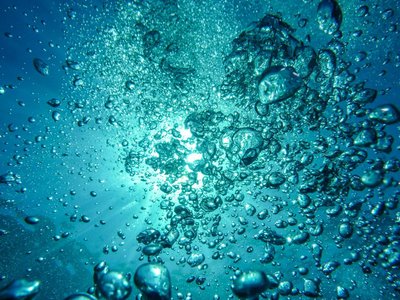
Fluids are materials that can flow and take the shape of their container. This category includes liquids, gases, and plasmas. In some cases, amorphous solids are also considered fluids due to their ability to deform under stress. The most common fluids encountered in physics are air and water, as they are abundant in everyday life.
Mass Density
Definition and Concept
Density (symbol: \( \rho \)) is a measure of how much mass is contained in a given volume. It is mathematically defined as the mass (m) of an object divided by its volume (V):
The SI unit of density is kilograms per cubic meter (kg/m3). Environmental factors such as temperature and pressure can affect the density of materials, especially gases.

Examples of Mass Density
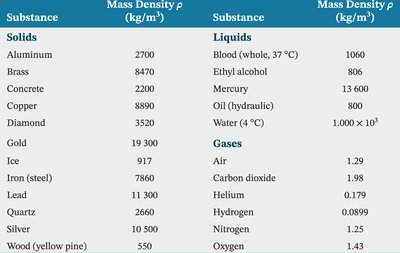
The table below lists the mass densities of various common substances, including solids, liquids, and gases. This helps in comparing how tightly matter is packed in different materials.
Substance | Mass Density \( \rho \) (kg/m3) |
|---|---|
Aluminum | 2700 |
Brass | 8470 |
Concrete | 2200 |
Copper | 8890 |
Diamond | 3520 |
Gold | 19,300 |
Ice | 917 |
Iron (steel) | 7860 |
Lead | 11,300 |
Quartz | 2660 |
Silver | 10,500 |
Wood (yellow pine) | 550 |
Blood (whole, 37°C) | 1060 |
Ethyl alcohol | 806 |
Mercury | 13,600 |
Oil (hydraulic) | 800 |
Water (4°C) | 1.000 × 10³ |
Air | 1.29 |
Carbon dioxide | 1.98 |
Helium | 0.179 |
Hydrogen | 0.0899 |
Nitrogen | 1.25 |
Oxygen | 1.43 |
Specific Gravity
Definition and Application
Specific gravity is a dimensionless quantity that compares the density of a material to the density of water at 4°C. It is useful for quickly assessing whether a substance will float or sink in water.
Where \( \rho_{\text{water @ 4^\circ C}} = 1.000 \times 10^3 \; \text{kg/m}^3 \).
Example: If a material has a density of 2,000 kg/m3, its specific gravity is 2.0.
Pressure in Fluids
Definition of Pressure
Pressure (symbol: P) is defined as the magnitude of the average force (F) applied perpendicularly over a given area (A):
The SI unit of pressure is the pascal (Pa), where 1 Pa = 1 N/m2. Atmospheric pressure at sea level is approximately 101,300 Pa (1 atm).
Pressure in Everyday Life
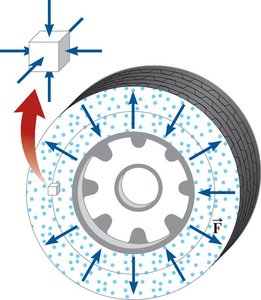
When inflating a tire, air molecules inside the tire collide with the walls, exerting a force perpendicular to the surface. This is an example of how pressure is generated in a fluid (gas) and acts equally in all directions.
Pressure is Not a Vector
While the force due to pressure acts in a specific direction (perpendicular to the surface), pressure itself is a scalar quantity and does not have a direction.
Pressure Example: Swimmer's Hand
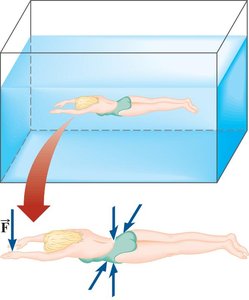
Suppose the pressure acting on the back of a swimmer’s hand is 1.2 × 10⁵ Pa, and the surface area is 8.4 × 10⁻³ m2.
Magnitude of Force:
Direction of Force: The force acts perpendicular to the surface area on the back of the swimmer’s hand.
Depth and Pressure in Fluids
Pressure Variation with Depth
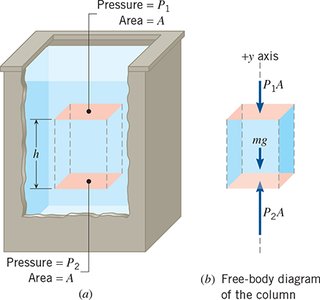
As you go deeper below the surface of a fluid, the pressure increases due to the weight of the fluid above. This relationship is fundamental in fluid statics and is derived using Newton’s Second Law.
Derivation: Pressure at Depth
Consider a column of fluid with cross-sectional area A and height h. The equilibrium of forces gives:
Where m is the mass of the liquid. Using the density equation and the geometry of the column:
Substituting into the force equation:
This shows that the pressure at depth h is the sum of the pressure at the surface and the pressure due to the weight of the fluid above.
Pressure is Independent of Container Shape
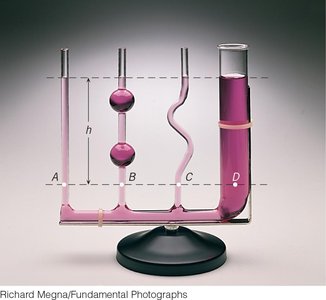
Pressure at a given depth in a connected fluid is the same, regardless of the shape of the container. Points at the same depth experience the same pressure.
Example: Pressure at Depth in Water
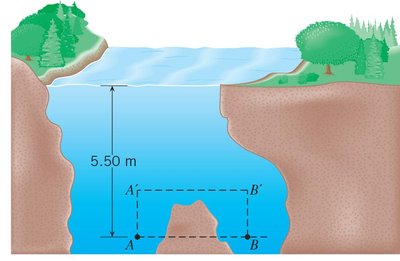
Given:
Atmospheric pressure at the surface: \( P_1 = 1.01 \times 10^5 \; \text{Pa} \)
Density of water: \( \rho = 1.000 \times 10^3 \; \text{kg/m}^3 \)
Depth: \( h = 5.50 \; \text{m} \)
Calculate the pressure at point A, 5.50 m below the surface:
Key Takeaway: The deeper you go in a fluid, the greater the pressure, and this increase is linear with depth for incompressible fluids like water.
