 Back
Force and Motion: Newton’s Laws and Types of Forces
Study Guide - Smart Notes
 Tailored notes based on your materials, expanded with key definitions, examples, and context.
Force and Motion
Introduction to Force
Force is a fundamental concept in mechanics, describing the interaction that causes an object to accelerate, change direction, or deform. Understanding force is essential for predicting and explaining motion in physics.
Definition: A force is a push or a pull acting on an object.
Agent: Every force requires an agent, the entity that exerts the force.
Vector Nature: Force is a vector quantity, meaning it has both magnitude and direction.
Types: Forces can be contact (requiring physical touch) or long-range (acting at a distance, such as gravity).
Identifying Forces
Forces are classified based on their origin and how they act on objects. Recognizing the type of force is crucial for solving physics problems.
Contact Forces: Occur at the point of contact between objects (e.g., normal force, friction, tension).
Long-Range Forces: Act without direct contact (e.g., gravitational, electric, and magnetic forces).
Free-Body Diagrams
Free-body diagrams are visual tools used to represent all forces acting on an object. Each force is drawn as a vector originating from the object.
Purpose: Helps in identifying and analyzing forces for problem-solving.
Components: All forces (pushes and pulls) are shown with their tails on the particle.
Newton’s Laws of Motion
Newton’s laws form the foundation of classical mechanics, describing the relationship between force and motion.
Newton’s First Law (Law of Inertia): An object at rest remains at rest, and an object in motion continues in a straight line at constant speed unless acted upon by a net force.
Newton’s Second Law: The acceleration of an object is directly proportional to the net force acting on it and inversely proportional to its mass.
Newton’s Zeroth Law: An object responds only to forces acting on it at the current instant; it has no memory of past forces.
Types of Forces
Several specific forces commonly appear in physics problems:
Gravitational Force: The pull of a planet on an object near its surface, always directed downward.
Spring Force: Exerted by elastic objects when compressed or stretched.
Tension Force: Exerted by strings, ropes, or wires pulling on an object.
Normal Force: The perpendicular contact force exerted by a surface.
Kinetic Friction: The force opposing the motion of an object sliding on a surface.
Static Friction: The force preventing an object from moving relative to a surface.
Drag: The resistive force experienced by objects moving through fluids.
Thrust: The force produced by engines expelling gas, pushing objects forward.
Electric and Magnetic Forces: Long-range forces due to electric charges and magnetic fields.
Superposition of Forces and Net Force
When multiple forces act on an object, their vector sum is called the net force. The net force determines the object's acceleration.
Superposition Principle: Forces combine by vector addition.
Net Force:
Mechanical Equilibrium
An object is in mechanical equilibrium if the net force acting on it is zero. In this state, the object remains at rest or moves with constant velocity.
Condition:
Result: No acceleration occurs.
Inertial Reference Frames
Newton’s laws are valid only in inertial reference frames, which are not accelerating. Accelerating frames are non-inertial and require additional considerations.
Definition: An inertial reference frame is one in which objects obey Newton’s laws without fictitious forces.
Examples: A stationary or uniformly moving vehicle is inertial; an accelerating vehicle is not.
Summary Table: Types of Forces
Force Type | Agent | Direction | Contact/Long-Range |
|---|---|---|---|
Gravitational | Planet | Downward | Long-Range |
Normal | Surface | Perpendicular to surface | Contact |
Tension | String/Rope | Along string/rope | Contact |
Friction (Kinetic/Static) | Surface | Tangent to surface | Contact |
Spring | Elastic object | Along spring | Contact |
Drag | Fluid | Opposite to motion | Contact |
Thrust | Engine | Opposite to exhaust | Contact |
Electric/Magnetic | Charges/Fields | Varies | Long-Range |
Example Applications
Bungee Jumper: Forces include gravity and tension from the cord.
Skier: Forces include gravity, normal force, friction, and tension from the tow rope.
Rocket: Forces include gravity, thrust, and drag.
Newton’s First Law in Context
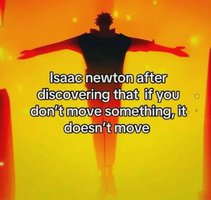
Newton’s first law, also known as the law of inertia, states that objects remain at rest or in uniform motion unless acted upon by a net force. This principle is foundational for understanding equilibrium and motion.
Mechanical Equilibrium: Occurs when net force is zero.
Inertia: The tendency of objects to resist changes in motion.
Key Skills
Identifying Forces: Locate points of contact and recognize long-range interactions.
Drawing Free-Body Diagrams: Represent all forces as vectors from the object.
Summary of Important Equations
Newton’s Second Law:
Mechanical Equilibrium:
Additional info: The humorous image included reinforces the concept of Newton’s First Law (inertia), which is a central topic in this chapter.
