 Back
BackForce on Electric Charge Moving in a Magnetic Field (Chapter 20 Study Notes)
Study Guide - Smart Notes
 Tailored notes based on your materials, expanded with key definitions, examples, and context.
Force on Electric Charge Moving in a Magnetic Field
Introduction to Magnetic Force on Moving Charges
The interaction between electric charges and magnetic fields is a fundamental concept in electromagnetism. When a charged particle moves through a magnetic field, it experiences a force that is always perpendicular to both its velocity and the magnetic field direction. This force is described by the Lorentz force law and is crucial for understanding phenomena such as the motion of particles in cyclotrons, auroras, and the operation of many electrical devices.
Definition and Direction of Magnetic Force
Magnetic Force Formula: The force \( \vec{F} \) on a charge q moving with velocity \( \vec{v} \) in a magnetic field \( \vec{B} \) is given by the vector cross product:
Magnitude: The magnitude of the force is: where \( \theta \) is the angle between \( \vec{v} \) and \( \vec{B} \).
Direction: The direction of \( \vec{F} \) is given by the right-hand rule for positive charges; for negative charges, the force is in the opposite direction.
Perpendicularity: The force is always perpendicular to both the velocity and the magnetic field vectors.
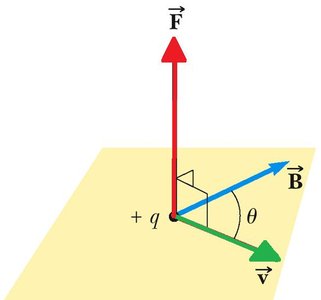
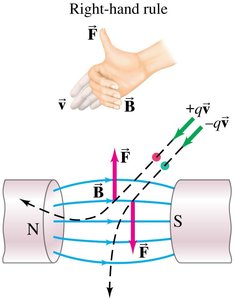
Right-Hand Rule for Magnetic Force
The right-hand rule is a mnemonic for determining the direction of the magnetic force on a positive charge:
Point your fingers in the direction of the velocity \( \vec{v} \).
Curl your fingers toward the direction of the magnetic field \( \vec{B} \).
Your thumb points in the direction of the force \( \vec{F} \) for a positive charge; for a negative charge, the force is in the opposite direction.
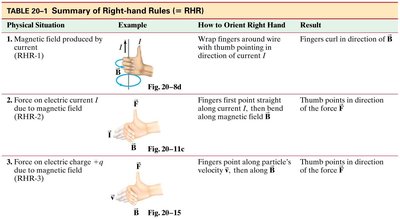
Summary Table: Right-Hand Rules (RHR)
The right-hand rule can be applied in several physical situations involving currents and moving charges. The table below summarizes the main cases:
Physical Situation | How to Orient Right Hand | Result |
|---|---|---|
Magnetic field produced by current (RHR-1) | Wrap fingers around wire with thumb pointing in direction of current | Fingers curl in direction of B |
Force on electric current due to magnetic field (RHR-2) | Fingers point straight along current, then bend along B | Thumb points in direction of force F |
Force on electric charge +q due to magnetic field (RHR-3) | Fingers point along particle's velocity v, then along B | Thumb points in direction of force F |
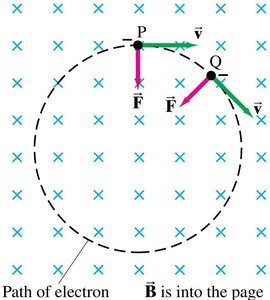
Circular and Helical Motion in a Magnetic Field
When a charged particle moves perpendicular to a uniform magnetic field, it undergoes uniform circular motion due to the constant perpendicular force. If the velocity has a component parallel to the field, the path becomes helical.
Radius of Circular Path: where m is the mass, v is the speed, q is the charge, and B is the magnetic field strength.
Period of Revolution:
Helical Motion: If the velocity is not perpendicular to B, the particle spirals along the field lines, combining circular and linear motion.
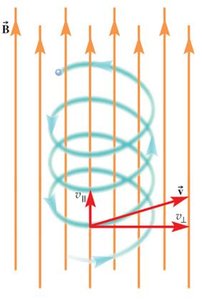
Work Done by Magnetic Fields
No Work Done: The magnetic force is always perpendicular to the displacement of the particle, so it does no work on the particle.
Consequences:
Kinetic energy of the particle does not change.
Speed remains constant; only the direction of motion changes.
Path is circular or helical, depending on the velocity components.
Special Cases: Velocity Parallel to Magnetic Field
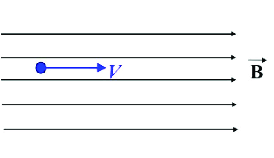
If \( \vec{v} \) is parallel (or antiparallel) to \( \vec{B} \), then \( \sin \theta = 0 \) and the force is zero.
The particle moves in a straight line, unaffected by the magnetic field.
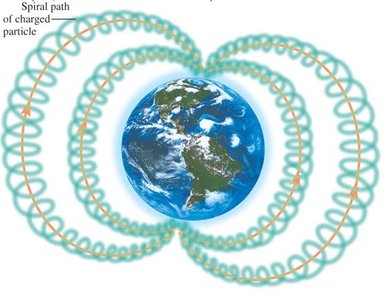
Cosmic Rays and Earth's Magnetic Field
Charged particles from space (cosmic rays) spiral around Earth's magnetic field lines, following helical paths. This phenomenon helps protect the planet from harmful solar and cosmic radiation.
Example Problems
Example 1: A particle with mass m = 2.0\,\mathrm{g}, charge q = -2\,\mu\mathrm{C}, and velocity v = 2000\,\mathrm{m/s} enters a B field of 2.5\,\mathrm{T} at an angle of 30^\circ. Find its acceleration.
Calculate force:
Find acceleration:
Example 2: An electron travels at perpendicular to a field. Its path is a circle. If B increases, the radius decreases.
Example 3: An electron moving northward at experiences an upward force of . Find the magnitude and direction of B:
Problem-Solving Tips
Use the right-hand rule for directions (reverse for negative charges).
Apply the cross product for force calculations.
Remember: Magnetic force does not change the speed, only the direction of motion.
