 Back
BackForces and Friction on an Inclined Rod (Window Washer Problem)
Study Guide - Smart Notes
 Tailored notes based on your materials, expanded with key definitions, examples, and context.
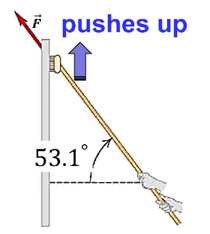
Q19. A window washer pushes his scrub brush up a vertical window at constant speed by applying a force \( \vec{F} \) as shown in the figure. The brush weighs 12.0 N and the coefficient of kinetic friction is 0.150. The rod is very light, so its mass is ignored. The magnitude of the force \( \vec{F} \) is closest to:
Background
Topic: Newton's Laws, Friction, and Forces on an Inclined Plane
This question tests your understanding of how to resolve forces acting on an object moving at constant speed, including friction and the components of applied force at an angle.
Key Terms and Formulas
Kinetic Friction (\( f_k \)): The force opposing motion, given by \( f_k = \mu_k N \), where \( \mu_k \) is the coefficient of kinetic friction and \( N \) is the normal force.
Constant Speed: Implies net force in the direction of motion is zero (Newton's First Law).
Force Components: The applied force \( \vec{F} \) can be broken into horizontal and vertical components using trigonometry.
Weight (\( W \)): The gravitational force acting downward, here \( W = 12.0 \) N.
Step-by-Step Guidance
Draw a free-body diagram for the brush at the point of contact with the window. Identify all forces: the applied force \( \vec{F} \) at 53.1°, the weight \( W \) downward, the normal force \( N \) perpendicular to the window, and the kinetic friction force \( f_k \) opposing the motion.
Resolve the applied force \( \vec{F} \) into its components: \( F_x = F \cos(53.1^\circ) \) (horizontal, into the window) \( F_y = F \sin(53.1^\circ) \) (vertical, upward along the window)
Write the force balance equations. Since the brush moves at constant speed, the net force in both the vertical (along the window) and horizontal (perpendicular to the window) directions must be zero.
Set up the vertical (along the window) force balance: The upward component of \( \vec{F} \) must balance the weight and friction: \( F_y = W + f_k \)
Set up the horizontal (perpendicular to the window) force balance: The horizontal component of \( \vec{F} \) must balance the normal force: \( F_x = N \)
Express the friction force in terms of the normal force: \( f_k = \mu_k N = \mu_k F_x \)
Try solving on your own before revealing the answer!
Final Answer: 16.9 N
By substituting the known values and solving the system of equations, you find that the required force is approximately 16.9 N. This ensures the brush moves at constant speed, overcoming both gravity and friction.
