 Back
BackForces and Newton's Laws: Foundations of Dynamics
Study Guide - Smart Notes
 Tailored notes based on your materials, expanded with key definitions, examples, and context.
Forces and Newton's Laws
Introduction to Forces
In dynamics, we study the causes of motion, focusing on forces—the interactions that cause acceleration. Forces are vector quantities, meaning they have both magnitude and direction. The SI unit of force is the Newton (N).
Contact forces: Forces that arise from physical contact between objects (e.g., friction, tension, normal force).
Long-range forces: Forces that act over a distance without direct contact (e.g., gravity).
Contact Forces
Normal Force
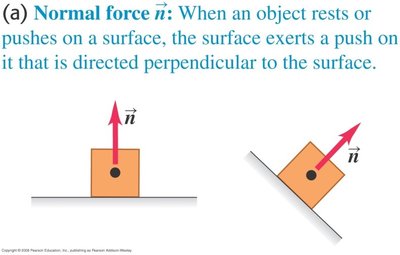
The normal force (\( \vec{n} \)) is the force exerted by a surface to support the weight of an object resting on it. It acts perpendicular to the surface.
For a block on a flat surface, the normal force points directly upward.
For a block on an inclined plane, the normal force is perpendicular to the plane.
Friction Force
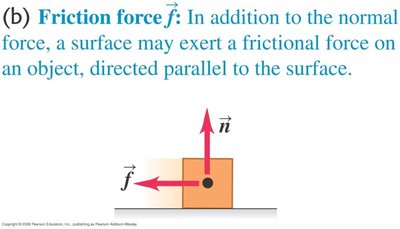
The friction force (\( \vec{f} \)) opposes the relative motion or attempted motion of two surfaces in contact. It acts parallel to the surface and opposite to the direction of sliding.
Friction arises due to microscopic interactions between surfaces.
It is always directed to oppose motion.
Tension Force
Tension is the pulling force transmitted by a string, rope, or cable when it is pulled tight by forces acting from opposite ends. The force acts along the length of the rope and away from the object.
Long-Range Forces
Weight (Gravitational Force)
The weight of an object is the gravitational force that the Earth exerts on it. It acts vertically downward toward the center of the Earth.
Weight is calculated as \( w = mg \), where \( m \) is mass and \( g \) is the acceleration due to gravity (\( 9.8\, \mathrm{m/s^2} \) on Earth).
Drawing and Decomposing Force Vectors
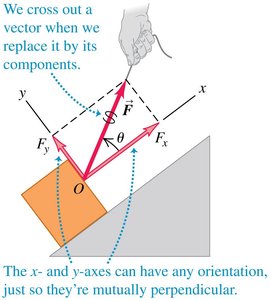
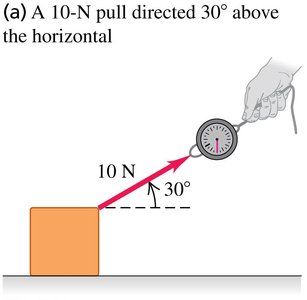
Forces are represented as arrows (vectors) whose length indicates magnitude and whose direction shows the direction of the force. When multiple forces act on a body, their vector sum (resultant) determines the net force.
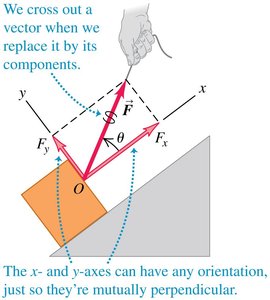
Forces can be decomposed into perpendicular components, typically along the x- and y-axes.
Use trigonometry to find components: \( F_x = F \cos \theta \), \( F_y = F \sin \theta \).
Superposition of Forces
When several forces act at a point, their combined effect is the same as the effect of their vector sum. This is known as the principle of superposition.
The net force \( \vec{R} \) is given by the sum of all individual forces:
Component form:
Newton's Laws of Motion
Newton's First Law (Law of Inertia)
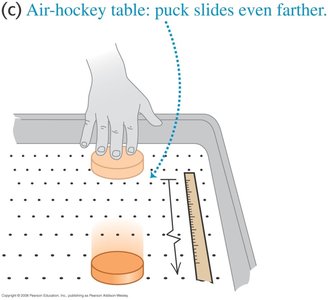
Newton's First Law states: A body acted on by no net force moves with constant velocity (which may be zero) and zero acceleration. This property is called inertia.
A body at rest remains at rest unless acted upon by a net force.
A body in motion continues in motion with constant velocity unless acted upon by a net force.
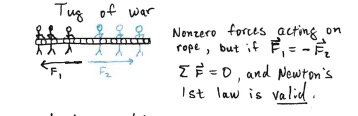
Equilibrium: When the net force is zero, \( \sum \vec{F} = 0 \).
Newton's Second Law
Newton's Second Law quantifies the relationship between force, mass, and acceleration: The acceleration of an object is directly proportional to the net force acting on it and inversely proportional to its mass.
Mathematical form:
The direction of acceleration is the same as the direction of the net force.
SI unit of force: Newton (N), where .
Newton's Third Law
Newton's Third Law states: For every action, there is an equal and opposite reaction. If object A exerts a force on object B, then B exerts an equal and opposite force on A.
This law applies to both contact and long-range forces (e.g., gravity).
Mass and Weight
Definitions and Differences
Mass | Weight |
|---|---|
Scalar quantity (amount of matter) | Vector quantity (force due to gravity) |
Independent of location | Depends on gravitational field (g) |
SI unit: kilogram (kg) | SI unit: Newton (N) |
Example: A 1 kg mass has a weight of 9.8 N on Earth, but only 1.6 N on the Moon.
Applying Newton's Laws: Problem-Solving Steps
Draw a free-body diagram for each object, showing all forces acting on it.
Choose axes and decompose all forces and accelerations into components.
Write Newton's Second Law for each object (in component form if necessary).
Apply Newton's Third Law for action-reaction pairs.
Use geometric or physical constraints as needed (e.g., ropes, pulleys).
Check that the number of equations matches the number of unknowns.
Solve the equations for the desired quantities.
Check units and physical reasonableness of your answer.
Examples and Applications
Block on an Inclined Plane
Consider a block of mass m sliding down an incline at angle \( \alpha \), experiencing friction force \( F \).
The normal force:
The acceleration along the incline:
Hanging Block with Two Ropes
For a block suspended by two ropes at equal angles \( \alpha \):
Each rope tension:
Practice Problem: Parachute Jump
Before opening parachutes, both parent and child fall with the same acceleration (gravity), but the heavier person experiences a greater force due to larger mass.
At terminal velocity, net force is zero for both.
When decelerating with parachutes, the force exerted by the parachute is proportional to mass: .
Summary Table: Mass vs. Weight
Property | Mass | Weight |
|---|---|---|
Nature | Scalar | Vector |
Depends on g? | No | Yes |
SI Unit | kg | N |
Formula |
Additional info: For more complex systems (e.g., pulleys, multiple objects), apply constraints such as massless ropes and frictionless pulleys, and use trigonometry for force components as needed.
