 Back
BackForces and Newton's Laws: Foundations of Dynamics
Study Guide - Smart Notes
 Tailored notes based on your materials, expanded with key definitions, examples, and context.
Force and Motion
Introduction – What is a Force?
A force is a push or pull that describes an interaction between two or more objects. In physics, a force acts on an object (the object) and is exerted by something else (the agent). Forces are vector quantities, meaning they have both magnitude and direction. Understanding forces is essential for analyzing motion and predicting how objects respond to their environment.
Contact force: Requires physical contact between agent and object (e.g., a bat hitting a baseball).
Long-range force: Acts at a distance without physical contact (e.g., gravity, magnetism).
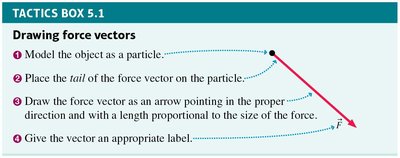
Tactics: Drawing Force Vectors
Force vectors are graphical representations of forces acting on objects. Properly drawing these vectors is crucial for analyzing physical situations.
Model the object as a particle.
Place the tail of the force vector on the particle.
Draw the vector as an arrow in the correct direction, with length proportional to the force's magnitude.
Label the vector appropriately.
Examples of Force Vectors
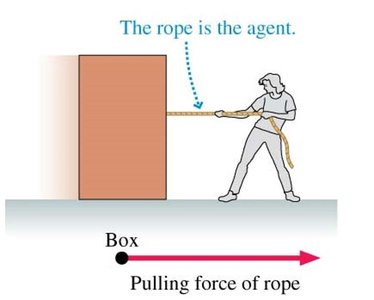
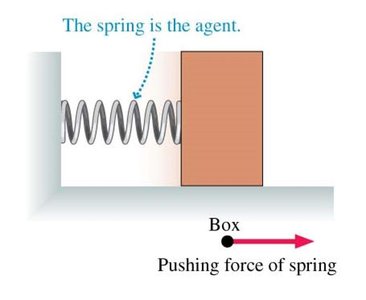
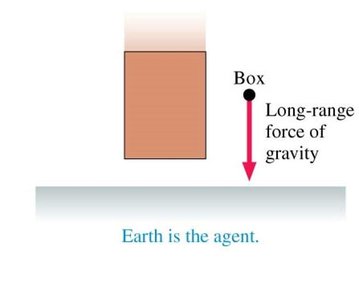
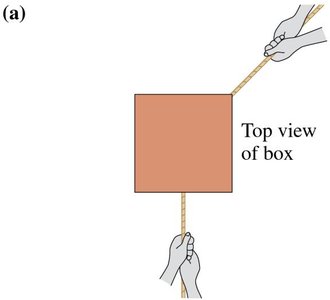
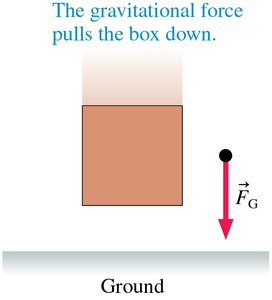
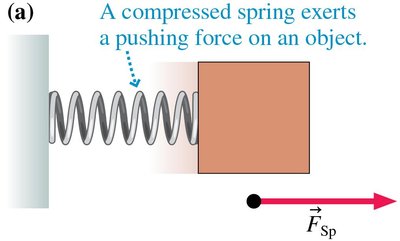
Force vectors can represent various interactions, such as pulling a box with a rope, pushing with a spring, or the force of gravity acting on an object.
Combining Forces: The Net Force
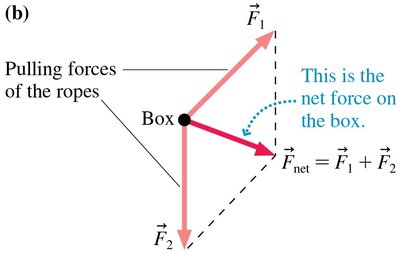
When multiple forces act on an object, they combine to form a net force, which is the vector sum of all individual forces. This process is called superposition of forces:
Example: A box pulled by two ropes experiences a net force found by vector addition of the individual rope forces.
Common Forces in Physics
Gravitational Force
The gravitational force is a long-range force exerted by a planet (the agent) on objects with mass. It always points downward toward the center of the planet and acts on all objects, whether moving or at rest.
Gravity is always attractive.
Symbol:
Spring Force
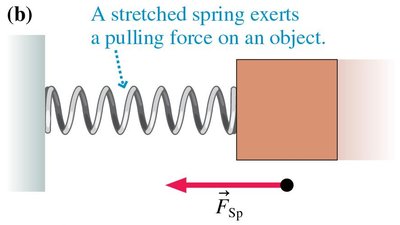
The spring force is exerted by a spring or any elastic object when it is compressed or stretched. It can act as a push or pull, depending on the deformation.
Symbol:
Any elastic object (not just metal coils) can act as a spring.
Tension Force
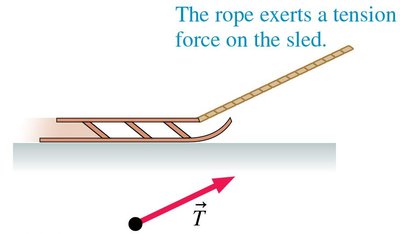
The tension force is a contact force exerted by a string, rope, or wire when it pulls on an object. Tension always acts along the direction of the string and can only pull, not push.
Symbol:
Ball-and-Spring Model of Solids
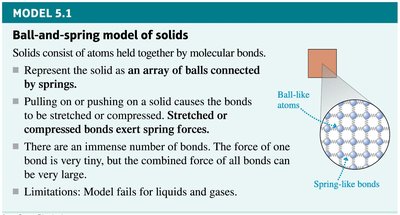
Solids can be modeled as arrays of atoms (balls) connected by molecular bonds (springs). When a solid is deformed, these bonds stretch or compress, generating spring-like forces that resist deformation.
This model explains the origin of normal and friction forces in solids.
Limitations: Does not apply to liquids and gases.
Normal Force
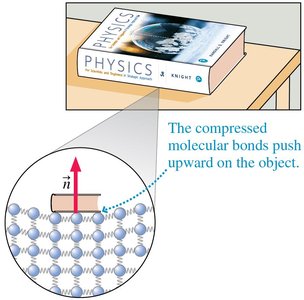
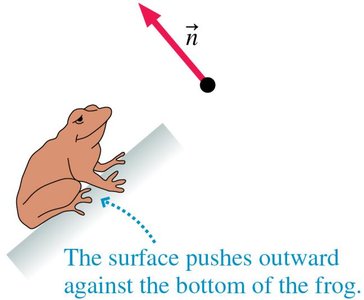
The normal force is the perpendicular contact force exerted by a surface on an object resting on it. It arises from the compression of molecular bonds in the surface material.
Symbol:
Always acts perpendicular to the surface, not necessarily vertical.
Kinetic Friction
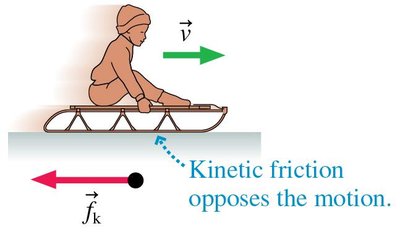
Kinetic friction is a contact force that opposes the motion of an object sliding along a surface. It acts tangent to the surface and opposite to the direction of velocity.
Symbol:
Kinetic friction slows down sliding objects.
Static Friction
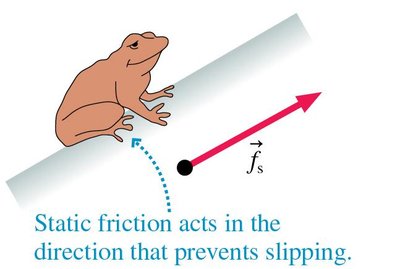
Static friction is the contact force that prevents an object from starting to move relative to a surface. It acts tangent to the surface and opposite to the direction in which the object would move if friction were absent.
Symbol:
Static friction adjusts up to a maximum value to prevent slipping.
Drag Force
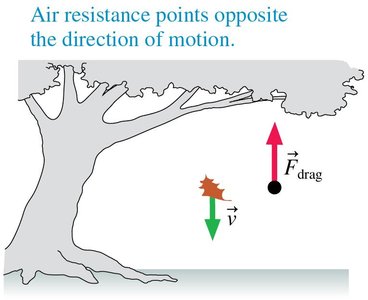
Drag is a resistive force experienced by objects moving through fluids (liquids or gases). It acts opposite to the direction of motion and is often called air resistance when the fluid is air.
Symbol:
Drag is usually negligible for heavy, compact objects unless stated otherwise.
Thrust Force
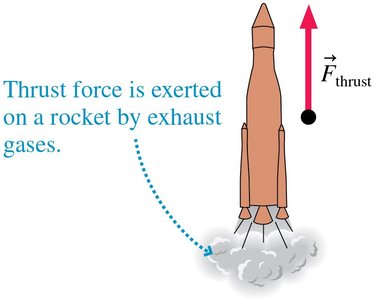
Thrust is the force that propels rockets and jet engines forward. It is generated when an engine expels gas molecules at high speed, and the reaction force pushes the engine (and vehicle) in the opposite direction.
Symbol:
Identifying and Analyzing Forces
Tactics: Identifying Forces
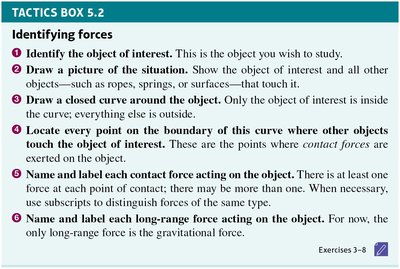
To analyze a physical situation, systematically identify all forces acting on the object of interest:
Identify the object of interest.
Draw a picture showing the object and all agents in contact or exerting long-range forces.
Draw a closed curve around the object to focus on it.
Locate all points of contact and label each contact force.
Label each long-range force (e.g., gravity).
Example: Forces on a Bungee Jumper
When analyzing a bungee jumper nearing the bottom of her fall, consider all forces: gravity (downward), tension in the bungee cord (upward), and possibly air resistance (upward, if significant).
What Do Forces Do?
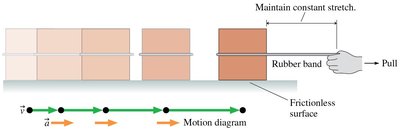
Force and Acceleration
Applying a force to an object causes it to accelerate. The acceleration is directly proportional to the net force and inversely proportional to the object's mass:
The SI unit of force is the newton (N):
Inertial Mass and Inertia
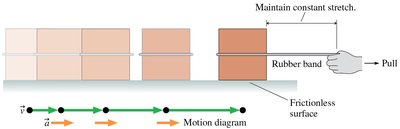
Inertial mass measures an object's resistance to acceleration when a force is applied. The more massive an object, the less it accelerates for a given force. This property is called inertia.
Inertial mass is used in Newton's laws unless otherwise specified.
Newton's Laws of Motion
Newton's Zeroth Law
An object responds only to forces acting on it at that moment. Once a force stops, the object no longer responds to it.
Newton's First Law (Law of Inertia)
An object at rest remains at rest, and an object in motion continues in a straight line at constant velocity, unless acted upon by a net external force. If the net force is zero, the object is in mechanical equilibrium.
Newton's Second Law
The acceleration of an object is proportional to the net force acting on it and inversely proportional to its mass:
or equivalently,
Newton's Third Law
For every action, there is an equal and opposite reaction. Forces always occur in pairs: if object A exerts a force on object B, then B exerts an equal and opposite force on A.
Applying Newton's Laws
Example: An arrow shot from a bow accelerates due to the force from the bowstring (Newton's 2nd Law). Once in flight, the force from the bow no longer acts, and the arrow continues due to inertia (Newton's 1st Law).
Inertial Reference Frames
An inertial reference frame is one in which Newton's First Law holds. In such frames, objects not acted on by a net force move at constant velocity. Accelerating frames (e.g., a car braking or a plane taking off) are not inertial reference frames.
Example: A ball at rest on the floor of a cruising airplane remains at rest (inertial frame).
Example: A ball on the floor of an accelerating airplane rolls (non-inertial frame).
Free-Body Diagrams (FBDs)
Purpose and Construction
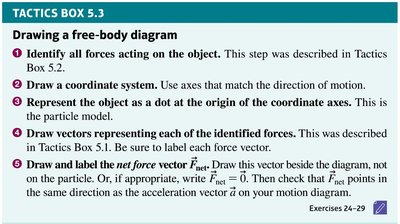
A free-body diagram is a simplified representation showing all forces acting on an object. It is essential for applying Newton's laws to solve problems.
Identify all forces acting on the object.
Draw a coordinate system.
Represent the object as a dot at the origin.
Draw vectors for each force, with tails at the dot.
Draw and label the net force vector beside the diagram.
Example: Forces on a Skier
When a skier is towed up a hill, three types of diagrams can be drawn: a motion diagram, a force identification diagram, and a free-body diagram. Each helps visualize and analyze the forces acting on the skier.
Force | Type | Direction | Agent |
|---|---|---|---|
Gravitational () | Long-range | Downward | Earth |
Normal () | Contact | Perpendicular to surface | Surface |
Tension () | Contact | Along rope | Rope |
Kinetic Friction () | Contact | Opposite motion | Surface |
Static Friction () | Contact | Opposes slipping | Surface |
Drag () | Contact (fluid) | Opposite motion | Fluid (air/water) |
Thrust () | Contact (engine) | Opposite exhaust | Engine/gas |
