 Back
Forces and Newton’s Laws of Motion: Structured Study Notes
Study Guide - Smart Notes
 Tailored notes based on your materials, expanded with key definitions, examples, and context.
Forces and Newton’s Laws of Motion
Newton’s First Law and the Concept of Motion
Newton’s first law states that an object will remain at rest or move in a straight line at constant speed unless acted upon by a net external force. This principle is foundational for understanding why objects change their state of motion.
Key Point 1: Objects resist changes in their motion unless a force acts upon them.
Key Point 2: Inertia is the property of matter that maintains its state of rest or uniform motion.
Example: In a car crash, the car stops due to a force, but a crash dummy continues moving until it hits the steering wheel, demonstrating inertia and the need for a force to change motion.

What Is a Force?
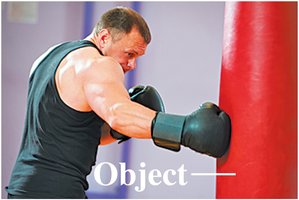
A force is defined as a push or a pull acting on an object. Forces are responsible for changes in the motion of objects and are always associated with an agent (the source of the force).
Key Point 1: Forces act on objects and are characterized by both magnitude and direction (they are vectors).
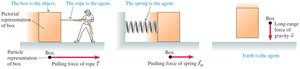
Key Point 2: The agent is the entity that exerts the force, while the object is the recipient.
Example: Throwing a shot put, punching a bag, or throwing a football all involve forces exerted by an agent on an object.


Force as a Vector Quantity
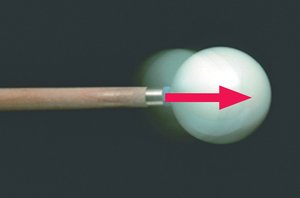
Forces are vector quantities, meaning they have both magnitude and direction. The vector symbol for force is typically \( \vec{F} \), and the magnitude is denoted as F.
Key Point 1: The direction of the force vector is crucial in determining the resulting motion.
Key Point 2: Forces can be classified as contact forces (require physical contact) or long-range forces (act at a distance).
Example: A cue stick pushing a billiard ball demonstrates a contact force.
Types of Forces
Forces can be categorized based on their nature and the way they act on objects. The main types include contact forces and long-range forces.
Contact Forces: Act by touching the object at a point of contact (e.g., tension, spring force, normal force, friction).
Long-Range Forces: Act without physical contact (e.g., gravity, electric, and magnetic forces).
Example: Tension in a rope, spring force, and weight are common force vectors.

Combining Forces: Net Force
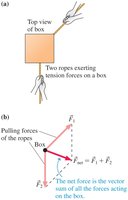
When multiple forces act on an object, they combine to form a net force, which is the vector sum of all individual forces. The net force determines the object's acceleration.
Key Point 1: Net force is not a new force but the resultant of all acting forces.
Key Point 2: The net force is calculated using vector addition.
Example: Two ropes pulling a box combine their forces to produce a net force.
Catalog of Common Forces
Weight (Gravitational Force)
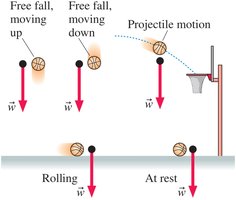
Weight is the gravitational pull of the Earth on an object. It always acts vertically downward, regardless of the object's motion.
Key Point 1: The agent for weight is the entire Earth.
Key Point 2: Weight is a long-range force.
Formula: (where m is mass, g is acceleration due to gravity)
Example: A basketball in free fall, rolling, or at rest always has its weight vector pointing downward.
Spring Force
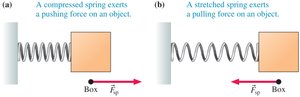
Springs exert forces when compressed or stretched. The direction of the spring force depends on whether the spring is compressed (pushes) or stretched (pulls).
Key Point 1: Spring force is a contact force.
Formula: (Hooke's Law; k is spring constant, x is displacement)
Example: A compressed spring pushes, while a stretched spring pulls.
Tension Force
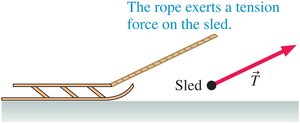
Tension is the force exerted by a string, rope, or wire when it pulls on an object. The direction of tension is always along the string or rope.
Key Point 1: Tension is a contact force.
Key Point 2: The magnitude of tension is the same throughout a massless rope.
Example: A rope pulling a sled exerts a tension force.
Normal Force
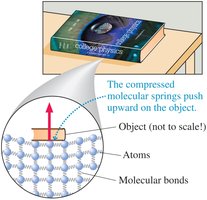
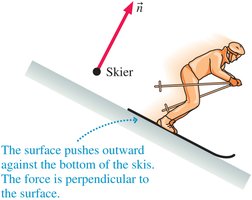
The normal force is the force exerted by a surface perpendicular to the object pressing against it. It is responsible for the 'solidness' of solids.
Key Point 1: Normal force acts perpendicular to the surface.
Key Point 2: It prevents objects from passing through solid surfaces.
Example: A book resting on a table experiences an upward normal force.
Friction
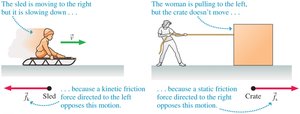
Friction is a force exerted by a surface, always parallel to the surface. It opposes motion or prevents motion between surfaces in contact.
Kinetic Friction: Acts when an object slides across a surface, always opposing motion.
Static Friction: Prevents motion, acting in the direction necessary to prevent movement.
Formula: (kinetic), (static)
Example: A sled slowing down due to kinetic friction; a crate resisting movement due to static friction.
Drag
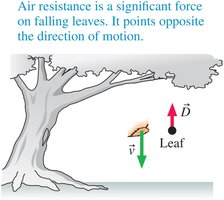
Drag is the resistive force of a fluid (such as air or water) on a moving object. It acts opposite to the direction of motion.
Key Point 1: Drag is significant for objects moving at high speeds or with large surface areas.
Key Point 2: Often neglected unless specified in problems.
Example: Air resistance acting on a falling leaf.
Thrust
Thrust is a force generated when a jet or rocket engine expels gas molecules at high speed. The thrust acts opposite to the direction of the expelled gases.
Key Point 1: Thrust is essential for propulsion in rockets and jets.
Key Point 2: The direction of thrust is opposite to the exhaust.
Example: Rocket engines expelling gases to move forward.
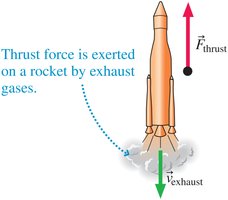
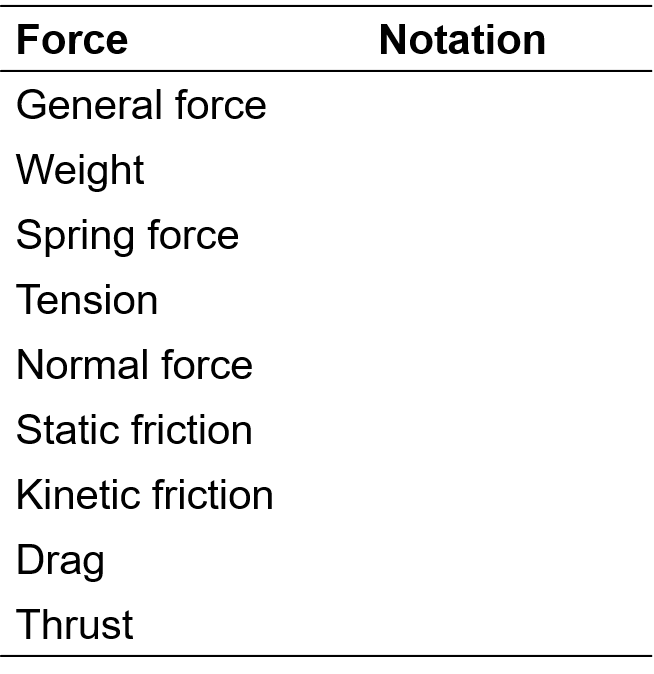
Table: Common Forces and Their Notation
This table summarizes the main types of forces encountered in introductory physics and their standard notation.
Force | Notation |
|---|---|
General force | \( \vec{F} \) |
Weight | \( \vec{w} \) |
Spring force | \( \vec{F}_{\text{spring}} \) |
Tension | \( \vec{T} \) |
Normal force | \( \vec{n} \) |
Static friction | \( \vec{f}_s \) |
Kinetic friction | \( \vec{f}_k \) |
Drag | \( \vec{D} \) |
Thrust | \( \vec{F}_{\text{thrust}} \) |
Newton’s Second Law
Newton’s Second Law: Relationship Between Force, Mass, and Acceleration
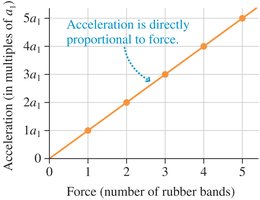
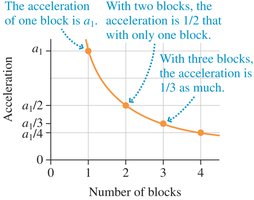
Newton’s second law quantifies the effect of forces on an object’s motion. The acceleration of an object is directly proportional to the net force and inversely proportional to its mass.
Key Point 1: The direction of acceleration is the same as the direction of the net force.
Formula:
Alternate Form:
Example: Increasing the force increases acceleration; increasing mass decreases acceleration.
Units of Force
The SI unit of force is the newton (N). One newton is the force required to accelerate a 1 kg mass by 1 m/s².
Key Point 1: 1 N = 1 kg·m/s²
Key Point 2: 1 pound (lb) = 4.45 N
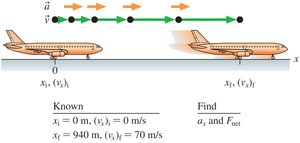
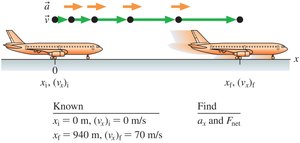
Example: Racing Down the Runway
This example demonstrates the application of Newton’s second law to determine the thrust required for a jet to reach takeoff speed.
Key Point 1: Use kinematics to find acceleration, then apply Newton’s second law to find force.
Formula: (for constant acceleration)
Formula:
Example: A Boeing 737 accelerates down a runway; the thrust of each engine is calculated based on the net force required.
Free-Body Diagrams
Constructing Free-Body Diagrams
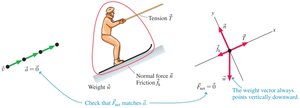
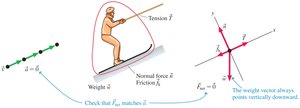
Free-body diagrams are essential tools for analyzing forces acting on an object. They represent the object as a particle and show all forces acting on it.
Key Point 1: Identify all forces acting on the object.
Key Point 2: Draw a coordinate system and represent the object as a dot at the origin.
Key Point 3: Draw vectors for each force and label them.
Example: A skier being towed up a hill at constant speed has a free-body diagram showing tension, normal force, weight, and friction.
Newton’s Third Law
Newton’s Third Law: Action and Reaction
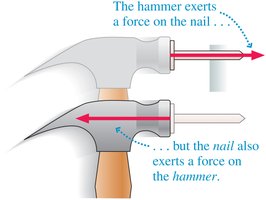
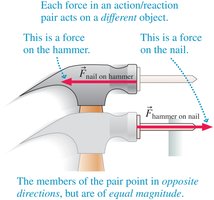
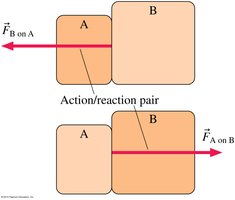
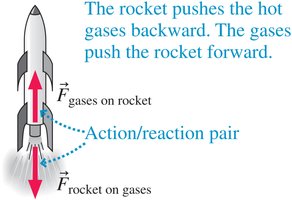
Newton’s third law states that every force occurs as one member of an action/reaction pair. The two forces are equal in magnitude, opposite in direction, and act on different objects.
Key Point 1: Action/reaction pairs exist as pairs or not at all.
Key Point 2: The forces do not cancel because they act on different objects.
Example: A hammer hitting a nail; the nail pushes back on the hammer with equal force.
Applications: Walking and Rockets
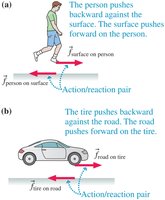
Static friction enables walking by providing a forward force as the foot pushes backward. Rockets move forward by expelling gases backward, creating thrust.
Key Point 1: Static friction prevents slipping and enables forward motion.
Key Point 2: Thrust is generated by the action/reaction between rocket and expelled gases.
Example: Walking and rocket propulsion are practical demonstrations of Newton’s third law.
Equilibrium and Applying Newton’s Laws
Equilibrium
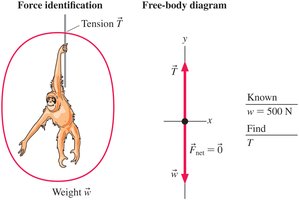
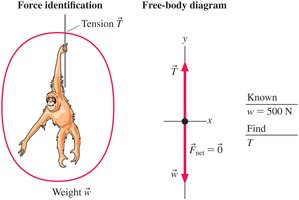
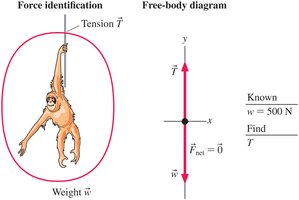
An object is in equilibrium if the net force acting on it is zero. Static equilibrium refers to objects at rest, while dynamic equilibrium refers to objects moving at constant speed in a straight line.
Key Point 1: In equilibrium, the sum of forces in each direction is zero.
Formula: ,
Example: An orangutan hanging from a rope is in static equilibrium; the tension equals its weight.
Conceptual Example: Forces in Static Equilibrium
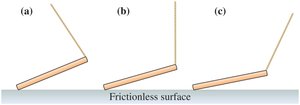
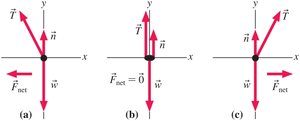
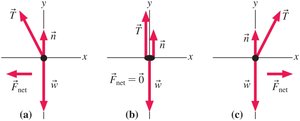
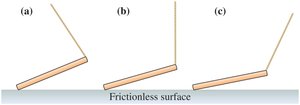
When a rod is lifted by a string on frictionless ice, only a vertical string orientation can maintain equilibrium, as horizontal components would cause motion.
Key Point 1: Tension acts along the string; weight acts downward; normal force acts upward.
Key Point 2: Without friction, only vertical forces can balance.
Example: Only a vertical string orientation keeps the rod at rest.
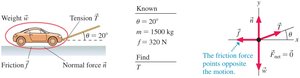
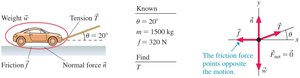
Example: Tension in a Rope While Towing a Car
When towing a car at constant speed, the tension in the rope must balance the friction force and the vertical component must support part of the car’s weight.
Key Point 1: Equilibrium requires the sum of forces in both x and y directions to be zero.
Key Point 2: Pulling at an angle increases the required tension.
Example: Towing a car with a rope at a 20° angle; tension is calculated using force components.
Dynamics and Newton’s Second Law in Problem Solving
Problem-Solving Approach for Dynamics
Solving dynamics problems involves identifying all forces, constructing free-body diagrams, and applying Newton’s second law in component form.
Key Point 1: Use kinematics to find acceleration or use Newton’s second law to find unknown forces.
Key Point 2: Choose coordinate axes aligned with the direction of acceleration.
Example: Putting a golf ball, towing a car with acceleration, and sled sliding on snow are typical problems.
Example: Putting a Golf Ball
A golfer putts a ball, and friction slows it down. Newton’s second law is used to find acceleration, and kinematics determines if the ball reaches the hole.
Key Point 1: The net force is due to friction, causing negative acceleration.
Formula:
Formula:
Example: The ball just reaches the hole if the calculated distance matches the hole’s location.
Example: Towing a Car with Acceleration
When a car is towed and accelerates, the tension in the rope must overcome both friction and provide the net force for acceleration.
Key Point 1: Use kinematics to find acceleration, then apply Newton’s second law to solve for tension.
Formula:
Formula: (horizontal component)
Example: Tension is greater when accelerating than when moving at constant speed.
Summary Table: Common Forces and Their Notation
Force | Notation |
|---|---|
General force | \( \vec{F} \) |
Weight | \( \vec{w} \) |
Spring force | \( \vec{F}_{\text{spring}} \) |
Tension | \( \vec{T} \) |
Normal force | \( \vec{n} \) |
Static friction | \( \vec{f}_s \) |
Kinetic friction | \( \vec{f}_k \) |
Drag | \( \vec{D} \) |
Thrust | \( \vec{F}_{\text{thrust}} \) |
Additional info: These notes expand on the original content by providing definitions, formulas, and examples for each force type, as well as structured problem-solving approaches for Newton’s laws. All images included are directly relevant to the explanation of the adjacent paragraph, visually reinforcing the concepts discussed.
