 Back
BackForces and Newton’s Laws of Motion: Study Notes
Study Guide - Smart Notes
 Tailored notes based on your materials, expanded with key definitions, examples, and context.
Forces and Newton’s Laws of Motion
Introduction to Forces and Motion
Understanding the relationship between forces and motion is fundamental in physics. Forces are responsible for changes in the motion of objects, and Newton’s laws provide the framework for analyzing these interactions.
Section 1: What is a Force?
Definition and Nature of Force
Force is a push or a pull exerted on an object by another object (the agent).
Forces can be contact forces (requiring physical contact) or long-range forces (acting at a distance, such as gravity).
Force is a vector quantity, meaning it has both magnitude and direction. The general symbol is , and its magnitude is .

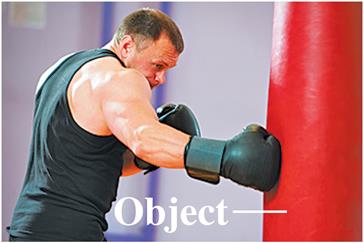

Visualizing Forces
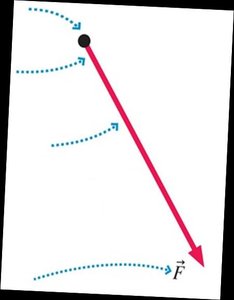
Forces are represented as arrows (vectors) in diagrams, with the tail at the object and the arrow pointing in the direction of the force.
Contact forces include tension, spring force, normal force, friction, and thrust.
Long-range forces include gravity, electric, and magnetic forces.
Section 2: Newton’s Laws of Motion
Newton’s First Law (Law of Inertia)
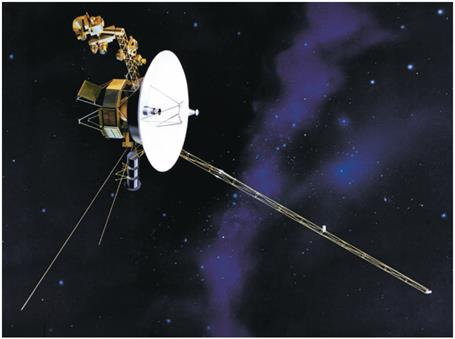
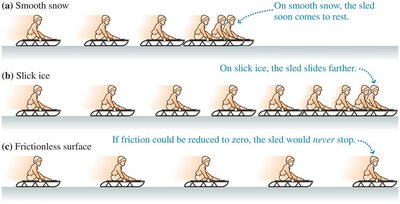
If no net force acts on an object, it remains at rest or moves with constant velocity in a straight line. This law introduces the concept of inertia—the tendency of objects to resist changes in their state of motion.
Mathematically: If , then .

Newton’s Second Law
The acceleration of an object is directly proportional to the net force acting on it and inversely proportional to its mass. The direction of acceleration is the same as the direction of the net force.
Equation:
Or, equivalently:
Example: If a 1.0 kg block is pulled with a constant force and accelerates at , and another block with unknown mass accelerates at under the same force, the unknown mass is kg.
Newton’s Third Law
For every action, there is an equal and opposite reaction. Forces always occur in pairs, acting on two different objects.
Equation:
Action/reaction pairs are always equal in magnitude and opposite in direction.

Section 3: Types of Forces
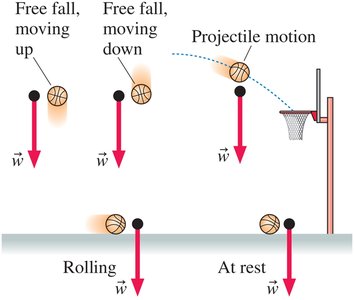
Weight (Gravitational Force)
The gravitational pull of the Earth on an object is called its weight.
Always points vertically downward.
Equation:
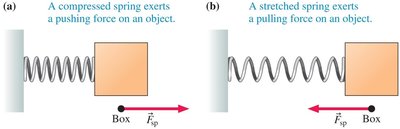
Spring Force
Springs exert a force when compressed or stretched, described by Hooke’s Law: , where is the spring constant and is the displacement from equilibrium.
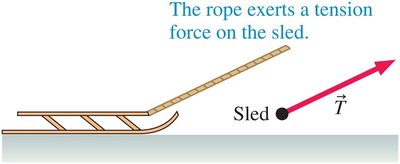
Tension Force
Exerted by strings, ropes, or cables when they pull on objects.
Always directed along the string or rope.
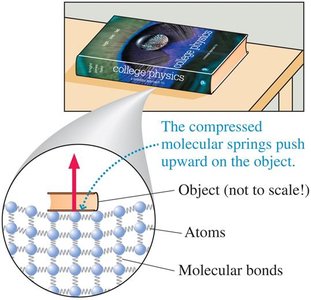
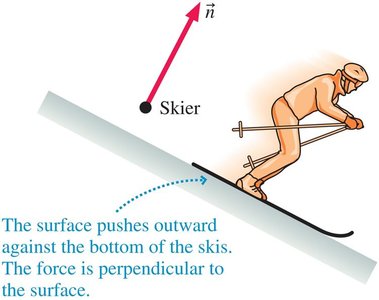
Normal Force
The force exerted by a surface perpendicular to the object pressing against it.
Responsible for the sensation of solidity.
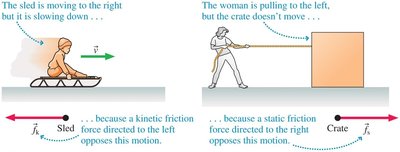
Friction
Kinetic friction (): Acts when objects slide across a surface, always opposing motion.
Static friction (): Prevents motion between surfaces in contact, points in the direction needed to prevent motion.
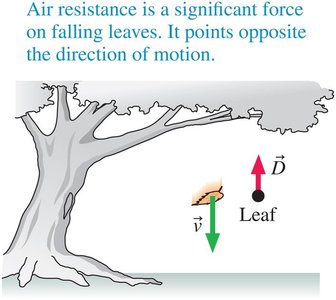
Drag
The resistive force of a fluid (air or water) on a moving object, always opposite to the direction of motion.
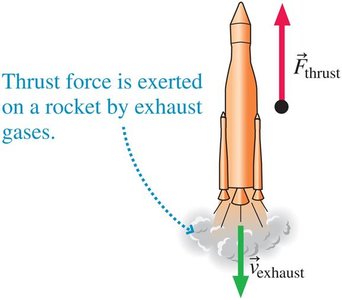
Thrust
Produced when a jet or rocket engine expels gas molecules at high speed, resulting in a force opposite to the exhaust direction.
Section 4: Combining and Identifying Forces
Net Force and Vector Addition
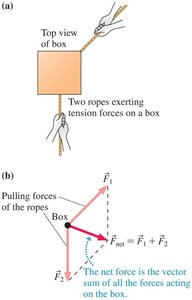
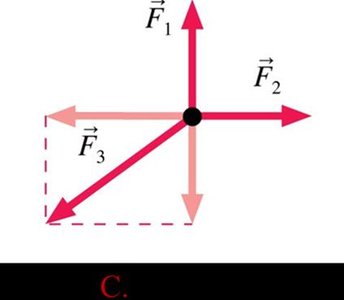
When multiple forces act on an object, the net force is the vector sum of all individual forces: .
The net force determines the object’s acceleration according to Newton’s second law.
Identifying Forces in Problems
Identify the object of interest and all points of contact with other objects (contact forces).
Include long-range forces such as gravity.
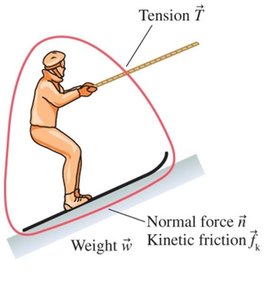
Draw a closed curve around the object to help identify all forces acting on it.
Common Forces and Notation
Force | Notation |
|---|---|
General force | |
Weight | |
Spring force | |
Tension | |
Normal force | |
Static friction | |
Kinetic friction | |
Drag | |
Thrust |
Section 5: Free-Body Diagrams
Drawing Free-Body Diagrams
Represent the object as a dot at the origin of a coordinate system.
Draw vectors for each force acting on the object, with tails at the dot and arrows pointing in the direction of the force.
Label each force clearly.
Draw the net force vector beside the diagram, not on the particle.
Section 6: Applications and Examples
Example: Forces on a Towed Skier
Forces acting: Tension (along the rope), normal force (perpendicular to the slope), kinetic friction (opposing motion), and weight (vertically downward).
If the skier moves at constant speed, the net force is zero: .
Example: Elevator in Motion
Forces acting: Tension (upward, from the cable) and weight (downward).
If the elevator accelerates upward, tension is greater than weight; if moving at constant speed, tension equals weight.
Section 7: Summary of Key Concepts
Newton’s First Law: Objects remain at rest or in uniform motion unless acted on by a net force.
Newton’s Second Law:
Newton’s Third Law: For every force, there is an equal and opposite force on another object.
Force is a vector and can be contact or long-range.
Free-body diagrams are essential tools for analyzing forces in physics problems.
