 Back
BackForces and Newton’s Laws of Motion: Comprehensive Study Notes
Study Guide - Smart Notes
 Tailored notes based on your materials, expanded with key definitions, examples, and context.
Forces and Newton’s Laws of Motion
Introduction to Forces and Newton’s Laws
This chapter explores the fundamental concepts of forces and Newton’s laws of motion, which form the basis for understanding classical mechanics. The study of forces explains how objects interact and move under various influences.
Force: A vector quantity describing the mechanical interaction between two objects, causing acceleration.
SI unit: Newton (N), where .
US Customary unit: Pound-force (lbf), where .
Key concepts: Mass, inertia, net force, friction, weight, normal force, tension, free-body diagrams.

4.1 Motion and Forces
Definition and Nature of Force
A force is any interaction that, when unopposed, will change the motion of an object. Forces are vectors, meaning they have both magnitude and direction. The net force is the vector sum of all external forces acting on an object.
Vector addition: Forces combine according to the rules of vector addition.
Example: If and are perpendicular, the net force .
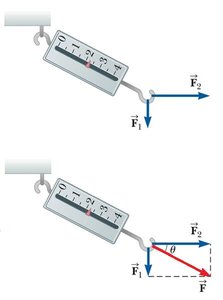
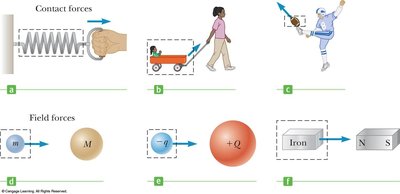
Types of Forces: Contact and Field Forces
Forces can be classified as contact forces (arising from physical contact) or field forces (acting at a distance).
Contact forces: Friction, tension, normal force, applied force.
Field forces: Gravitational, electromagnetic, strong nuclear, weak nuclear.
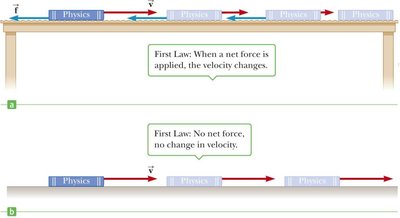
4.2 Newton’s First Law and Inertia
Newton’s First Law (Law of Inertia)
Newton’s First Law states that an object remains at rest or in uniform motion in a straight line unless acted upon by a net external force. This property is called inertia.
Inertia: The tendency of an object to resist changes in its state of motion. Greater mass means greater inertia.
Mass: A scalar quantity measuring an object’s resistance to acceleration.
4.3 Identifying Forces
Common Forces in Mechanics
Weight (Gravitational Force): The force of gravity acting on an object, .
Normal Force: The perpendicular contact force exerted by a surface on an object.
Frictional Force: The force resisting relative motion between surfaces.
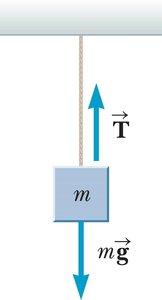
Tension: The force transmitted through a string, rope, or cable when pulled tight.

4.4 What Do Forces Do?
Normal Force and Friction
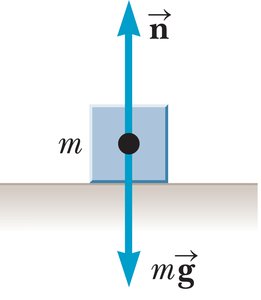
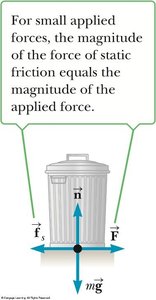
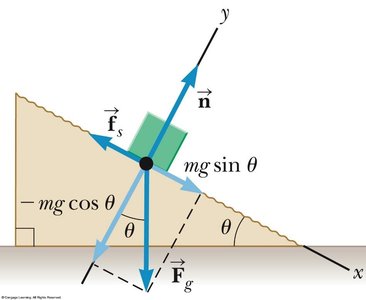
The normal force acts perpendicular to the surface of contact, balancing the component of weight perpendicular to the surface. Friction opposes the motion or attempted motion of an object relative to a surface.
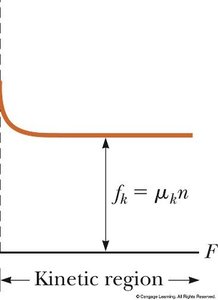
Kinetic friction:
Static friction:
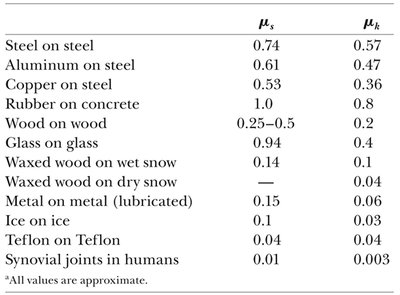
Coefficients of friction: Depend on the materials in contact.
Friction: Static and Kinetic
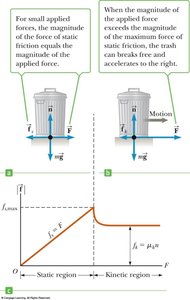
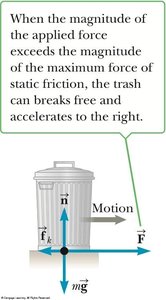
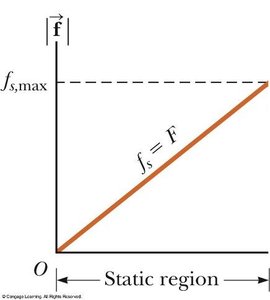
Frictional forces are proportional to the normal force and depend on the nature of the surfaces in contact. Static friction prevents motion up to a maximum value; kinetic friction acts during motion.
Static friction:
Kinetic friction:
Direction: Always opposes relative motion.
Surface Pair | \( \mu_s \) | \( \mu_k \) |
|---|---|---|
Steel on steel | 0.74 | 0.57 |
Aluminum on steel | 0.61 | 0.47 |
Copper on steel | 0.53 | 0.36 |
Rubber on concrete | 1.0 | 0.8 |
Wood on wood | 0.25–0.5 | 0.2 |
Glass on glass | 0.94 | 0.4 |
Waxed wood on wet snow | 0.14 | 0.1 |
Waxed wood on dry snow | — | 0.04 |
Metal on metal (lubricated) | 0.15 | 0.06 |
Ice on ice | 0.1 | 0.03 |
Teflon on Teflon | 0.04 | 0.04 |
Synovial joints in humans | 0.01 | 0.003 |
Static Friction
Static friction adjusts to match the applied force up to a maximum value. When the applied force exceeds this maximum, the object begins to move and kinetic friction takes over.
Maximum static friction:
Example: Block on a Ramp
For a block of mass on a ramp with angle and coefficient of static friction , the maximum angle before slipping is given by .
Tension Forces
Tension is the force transmitted through a string, rope, or cable when it is pulled tight by forces acting from opposite ends. The tension is the same throughout an ideal (massless, frictionless) rope.
4.5 Newton’s Second Law
Newton’s Second Law of Motion
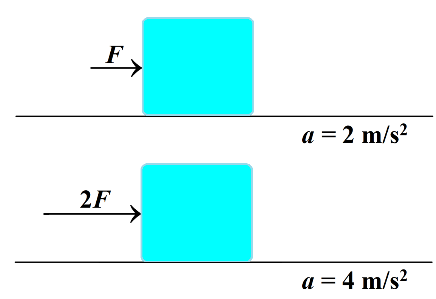
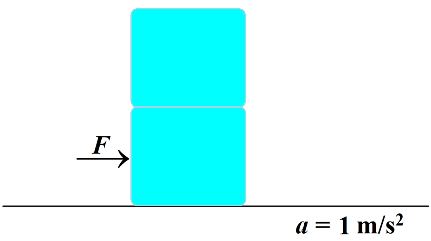
Newton’s Second Law states that the acceleration of an object is directly proportional to the net force acting on it and inversely proportional to its mass:
Equation:
Component form: , ,
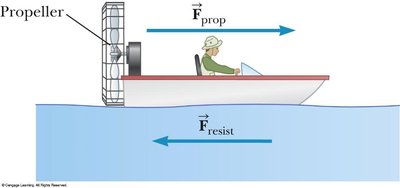
Example: Airboat
An airboat of mass with a net force of has an acceleration .
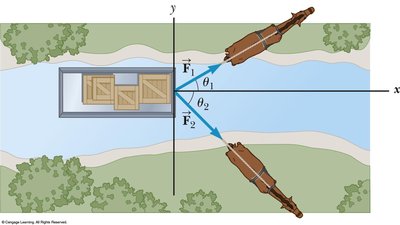
Example: Horses Pulling a Barge
Two horses pull a barge at different angles. The net force is found by vector addition, and the acceleration is calculated using Newton’s second law.
4.6 Free-Body Diagrams
Constructing Free-Body Diagrams
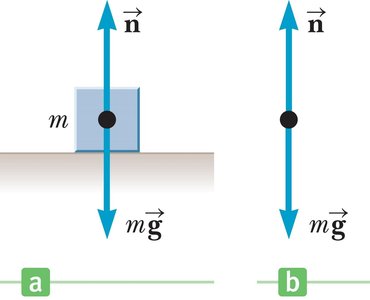
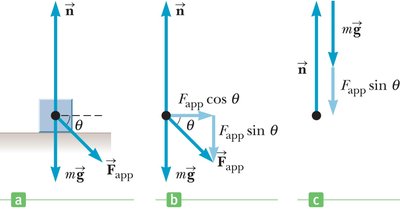
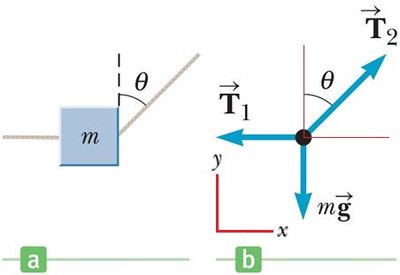
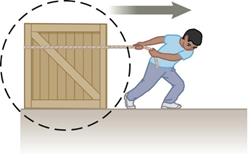
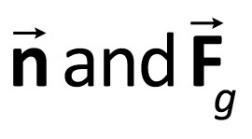
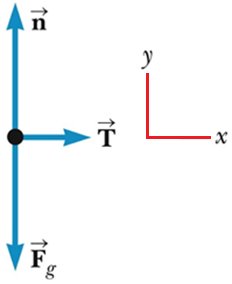
A free-body diagram is a graphical representation used to visualize the forces acting on a single object. Only forces acting directly on the object are included.
Identify all forces (gravity, normal, friction, tension, applied, etc.).
Choose an appropriate coordinate system.
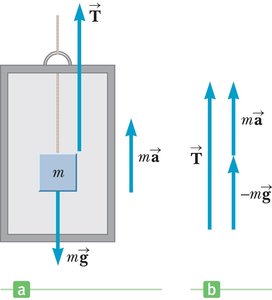
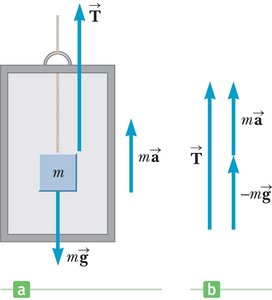
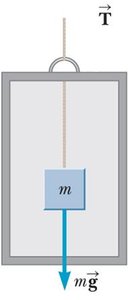
Elevator Free-Body Diagrams
Free-body diagrams are essential for analyzing forces in systems such as elevators, where tension and gravity interact.
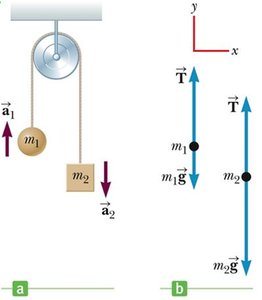
Example: Atwood’s Machine
Two masses connected by a string over a pulley accelerate due to gravity. The acceleration and tension are found by applying Newton’s second law to each mass and solving the system of equations.
4.7 Newton’s Third Law
Newton’s Third Law of Motion
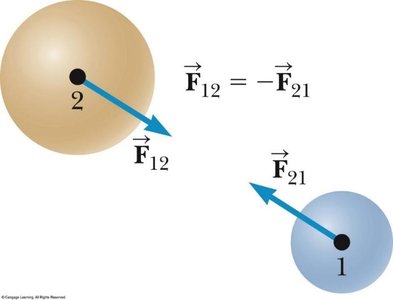
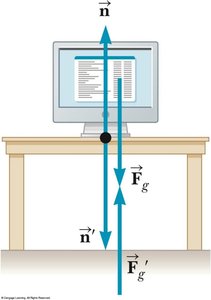
Newton’s Third Law states that for every action, there is an equal and opposite reaction. Forces always occur in pairs, acting on different objects.
Action-reaction pair:
These forces are equal in magnitude and opposite in direction.
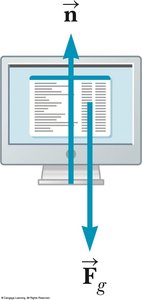
Normal Force and Action-Reaction Pairs
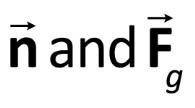
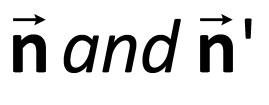
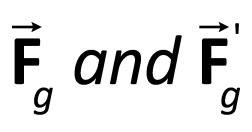
The normal force is the reaction force to the weight of an object resting on a surface. The table exerts an upward normal force on the object, while the object exerts an equal and opposite force on the table.
Universal Gravitation
Newton’s Law of Universal Gravitation
Every particle in the universe attracts every other particle with a force directly proportional to the product of their masses and inversely proportional to the square of the distance between them:
Equation:
Universal gravitational constant:
Summary: This chapter provides a comprehensive overview of forces, Newton’s laws, friction, tension, free-body diagrams, and universal gravitation, forming the foundation for further study in classical mechanics.
