 Back
Forces and Newton's Laws: Structured Study Notes for Physics with Calculus
Study Guide - Smart Notes
 Tailored notes based on your materials, expanded with key definitions, examples, and context.
Forces and Newton's Laws
Identifying Forces
Understanding the forces acting on an object is fundamental to analyzing its motion. Forces can be categorized as contact or non-contact, and are labeled to clarify their type and the objects involved.
Key Point 1: If the Earth or a planet-sized object is nearby, weight (gravitational force) acts on the object.
Key Point 2: Any object in contact can exert a contact force (e.g., normal, friction, tension).
Key Point 3: Forces are labeled by type and the objects involved, e.g., tension exerted by a rope on a block is Trb.
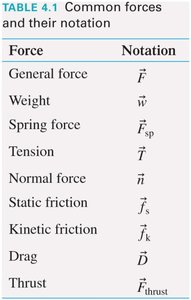
Common Forces and Their Notation
The table below summarizes the most common forces and their standard notation used in physics:
Force | Notation |
|---|---|
General force | 𝒫 |
Weight | |
Spring force | 𝒫sp |
Tension | 𝒫T |
Normal force | |
Static friction | s |
Kinetic friction | k |
Drag | D |
Thrust | 𝒫thrust |
Inertia and Mass
Inertia is the tendency of an object to resist changes in its velocity. Mass quantifies an object's resistance to acceleration and is an intrinsic property.
Key Point 1: Inertia explains why objects continue moving unless acted upon by a force.
Key Point 2: Mass is a measure of inertia; higher mass means greater resistance to changes in motion.
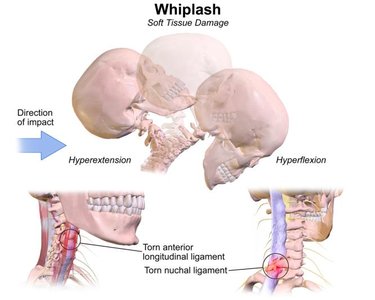
Example: Whiplash injuries occur because the head resists sudden changes in motion during a car accident.
Newton's Second Law
Newton's second law relates the net force acting on an object to its acceleration. It is a fundamental cause-and-effect relationship in mechanics.
Key Point 1: The net force is the vector sum of all forces acting on an object.
Key Point 2: Acceleration occurs only when the net force is nonzero.
Formula:
Formula:
Free-Body Diagrams
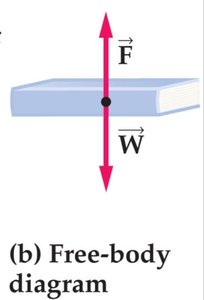
A free-body diagram is a pictorial representation showing all forces acting on a single object, helping to analyze the net force and predict motion.
Key Point 1: Forces are labeled by type and the objects involved (e.g., normal force nhb for hand on book).
Key Point 2: Only forces acting on the object are shown; internal forces are not included.
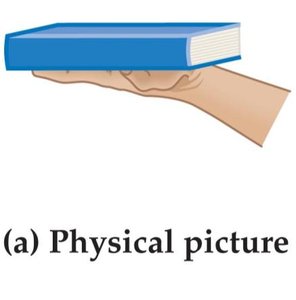
Example: A book held by a hand experiences a normal force from the hand and weight due to gravity.
Newton's Third Law
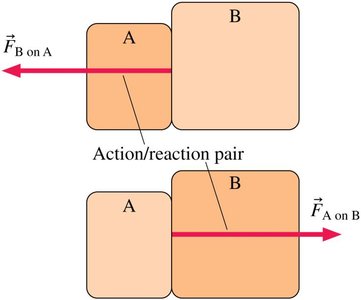
Newton's third law states that for every action, there is an equal and opposite reaction. Forces always come in pairs, acting on different bodies.
Key Point 1: If object A exerts a force on object B, then B exerts an equal and opposite force on A.
Key Point 2: Action-reaction pairs do not cancel because they act on different objects.
Formula:
Example: When two blocks are in contact, the force each exerts on the other forms an action-reaction pair.
Equilibrium
An object is in equilibrium when the net force acting on it is zero. This can be static (at rest) or dynamic (moving at constant velocity).
Key Point 1: In equilibrium, the sum of forces in each direction is zero.
Formula:
Formula:
Mass and Weight
Mass is an intrinsic property of matter, independent of location. Weight is the gravitational force exerted by a planet, and varies with location.
Key Point 1: Mass is constant everywhere; weight depends on gravitational acceleration.
Formula:
Key Point 2: Apparent weight is the sensation of weight, affected by forces that balance gravity.
Key Point 3: Weightlessness occurs in free-fall, where apparent weight is zero.
Example: An astronaut's mass remains the same on the Moon, but their weight is reduced due to lower gravity.

Apparent Weight in Elevators
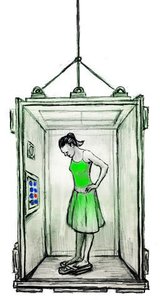
The reading on a scale in an elevator depends on the elevator's acceleration. If the elevator accelerates downward, the apparent weight decreases; if upward, it increases.
Key Point 1: In a descending elevator coming to a stop, the scale reads less than the true weight.
Key Point 2: In free-fall, the scale reads zero (weightlessness).

Summary Table: Forces and Their Effects
Force | Effect |
|---|---|
Weight | Causes acceleration toward Earth |
Normal force | Supports object against gravity |
Friction | Opposes motion |
Tension | Transmits force through rope/string |
Drag | Opposes motion through fluid |
Thrust | Propels object forward |
Additional info: These notes expand on brief lecture points to provide a comprehensive, exam-ready summary of forces and Newton's laws, including definitions, formulas, and relevant examples.
