Back
BackForces in Mechanics: Hooke’s Law and Friction
Study Guide - Smart Notes
 Tailored notes based on your materials, expanded with key definitions, examples, and context.
Hooke’s Law and Elastic Force
Introduction to Hooke’s Law
Hooke’s Law describes the relationship between the force exerted by a spring and its displacement from equilibrium. This law is fundamental in understanding elastic behavior in materials and is widely used in physics and engineering.
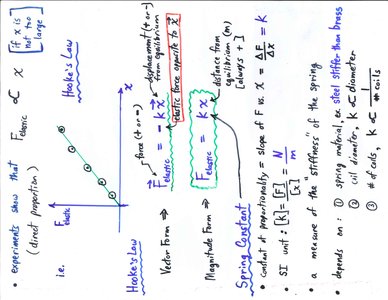
Direct Proportionality: Experiments show that the elastic force (Felastic) is directly proportional to the displacement (x) from the equilibrium position.
Mathematical Form:
Vector Form:
Magnitude Form:
Displacement: , where is the equilibrium position.
Spring Constant (k):
Represents the stiffness of the spring.
SI Unit:
Determined by the slope of the force vs. displacement graph:
Depends on material, diameter, and number of coils of the spring.
Stiffer springs have larger k values.
Applications: Used in measuring forces, designing suspension systems, and understanding oscillatory motion.
Physical Explanation of Friction
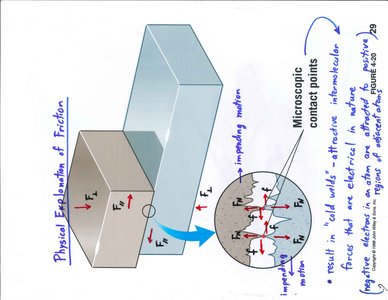
Microscopic Origin of Friction
Friction is a resistive force that opposes the relative motion of two surfaces in contact. Its origin can be explained by examining the microscopic interactions at the contact points between surfaces.
Contact Points: Surfaces are rough at the microscopic level, leading to multiple points of contact.
Microscopic Forces: At these contact points, attractive and repulsive forces arise due to electrical interactions between atoms and molecules.
Direction: Frictional force (Ffr) acts opposite to the direction of impending or actual motion.
Physical Effects: Friction results in energy dissipation as heat and is essential for walking, driving, and many mechanical processes.
Example: When a block slides over a surface, friction arises from the microscopic contact points, resisting the motion and depending on the nature of the surfaces.