Back
BackForces, Newton's Laws, and Circular Motion: Study Notes
Study Guide - Smart Notes
 Tailored notes based on your materials, expanded with key definitions, examples, and context.
Chapter 4: Forces and Newton's Laws of Motion
Important Concepts
This chapter introduces the foundational principles of classical mechanics, focusing on the nature of forces and Newton's three laws of motion.
Newton's First Law: An object remains at rest or in uniform motion unless acted upon by a net external force.
Newton's Second Law: The net force on an object is equal to the mass of the object multiplied by its acceleration. Equation:
Newton's Third Law: For every action, there is an equal and opposite reaction.
Short Catalogue of Forces
Weight (\( \vec{w} \)): The gravitational force acting on an object.
Tension (\( \vec{T} \)): The pulling force transmitted by a string, rope, or cable.
Normal Force (\( \vec{N} \)): The perpendicular contact force exerted by a surface on an object.
Friction (\( \vec{f} \)): The force that opposes the relative motion or tendency of such motion of two surfaces in contact.
Drag (\( \vec{D} \)): The resistive force experienced by objects moving through a fluid (air or water).
Spring Force (\( \vec{F}_s \)): The restoring force exerted by a compressed or stretched spring, given by Hooke's Law:
Free Body Diagrams: Diagrams used to show all the forces acting on a single object, essential for solving force problems.
Chapter 5: Applying Newton's Laws
Newton's Second Law in Practice
This chapter applies Newton's laws to solve problems involving equilibrium, dynamics, and forces in various contexts.
Newton's Second Law:
Equilibrium:
Static Equilibrium: The object is at rest (), so .
Dynamic Equilibrium: The object moves with constant velocity (), so .
Dynamics and Newton's Second Law: When , the object accelerates.
Apparent Weight: The normal force experienced by an object, which can differ from the actual weight in non-inertial frames. Equation:
Friction
Static Friction:
Kinetic Friction:
Rolling Friction: (typically much less than static or kinetic friction)
Interesting Cases
Ropes and Pulleys: Analyze tension and force transmission in systems involving ropes and pulleys.
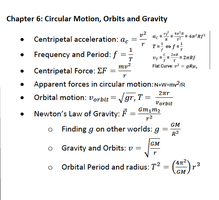
Chapter 6: Circular Motion, Orbits, and Gravity
Key Concepts in Circular Motion and Gravitation
This chapter explores the physics of objects moving in circular paths and the gravitational forces that govern planetary motion and orbits.
Centripetal Acceleration: The acceleration directed toward the center of a circular path. Equation:
Frequency and Period:
Frequency (f): Number of revolutions per second.
Period (T): Time for one complete revolution.
Centripetal Force: The net force required to keep an object moving in a circle. Equation:
Apparent Forces in Circular Motion: In a rotating frame, fictitious forces such as the centrifugal force may appear. Equation:
Orbital Motion: The velocity required for a stable circular orbit. Equation: or
Newton's Law of Gravity: The universal law describing the gravitational attraction between two masses. Equation:
Finding g on Other Worlds: The acceleration due to gravity on a planet of mass M and radius R. Equation:
Gravity and Orbits: The velocity for a circular orbit at radius r. Equation:
Orbital Period and Radius: The period of revolution for a circular orbit. Equation: