 Back
BackForces, Newton's Laws, and Equilibrium: Study Notes for Physics with Calculus
Study Guide - Smart Notes
 Tailored notes based on your materials, expanded with key definitions, examples, and context.
Forces and the Catalog of Forces
Introduction to Forces
In physics, a force is defined as a push or pull exerted on an object by an agent. Forces are vectors, meaning they have both magnitude and direction. Forces can be classified as either contact forces (requiring physical contact) or long-range forces (acting at a distance).
Contact forces: Examples include friction, tension, normal force, spring force, and thrust.
Long-range forces: The primary example is gravity; others include electric and magnetic forces (covered in later courses).

Types of Contact Forces
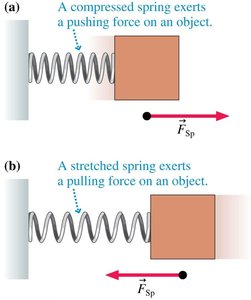
Spring Force (Fsp): A spring can exert a pushing force when compressed or a pulling force when stretched. The force is directed along the axis of the spring.
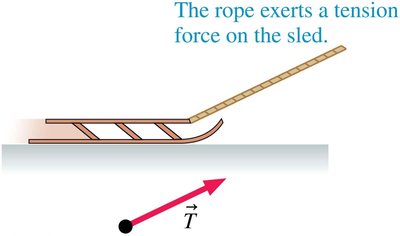
Tension (T): The force exerted by a string, rope, or wire when it pulls on an object. The direction of the tension force is always along the string or rope.
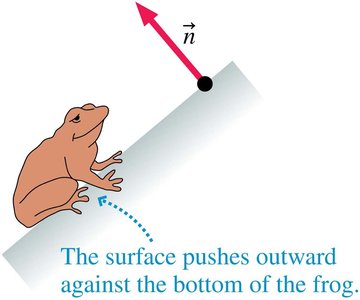
Normal Force (n): The force exerted by a surface perpendicular to an object in contact with it. It is not always directed straight up; its direction depends on the orientation of the surface.
Friction: A resistive force exerted by a surface, always parallel to the surface and opposite to the direction of motion (kinetic friction) or impending motion (static friction).
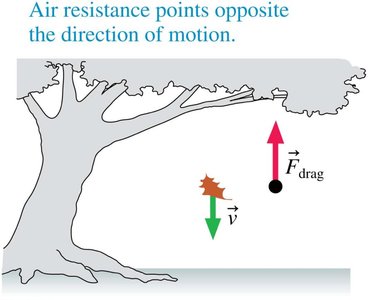
Drag: A resistive force experienced by objects moving through fluids (gases or liquids), always opposite to the direction of motion.
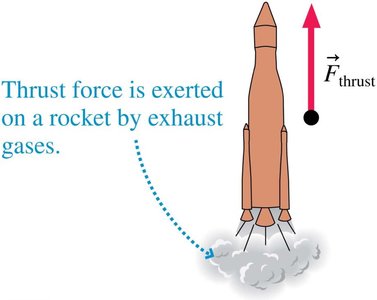
Thrust: The force exerted by expelling mass, such as exhaust gases from a rocket engine. Thrust acts opposite to the direction in which the exhaust is expelled.
Long-Range Forces
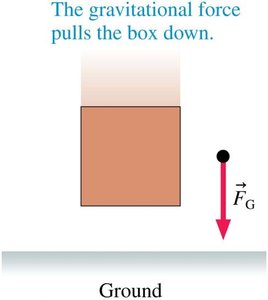
Gravity (FG): The attractive force between any two masses. On Earth, gravity always points downward toward the center of the planet.
Free-Body Diagrams (FBDs)
Constructing Free-Body Diagrams
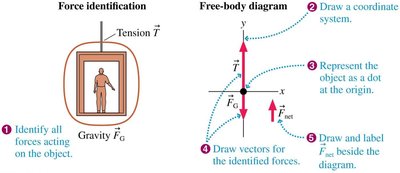
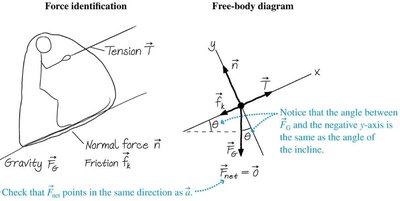
A free-body diagram is a visual tool used to represent all the forces acting on a single object. It is essential for analyzing force problems and applying Newton's laws.
Identify all forces acting on the object.
Draw a coordinate system.
Represent the object as a dot at the origin (particle model).
Draw vectors for each identified force, labeling them appropriately.
Draw and label the net force vector (Fnet), if applicable.
Newton's Laws of Motion
Newton's First Law (Law of Inertia)
Newton's First Law states that an object at rest remains at rest, and an object in motion continues in motion with constant velocity unless acted upon by a net external force. This is also known as the Law of Inertia.
Inertia: The tendency of an object to resist changes in its state of motion.
Static Equilibrium: The object is at rest; all forces balance.
Dynamic Equilibrium: The object moves at constant velocity; all forces balance.
Newton's Second Law
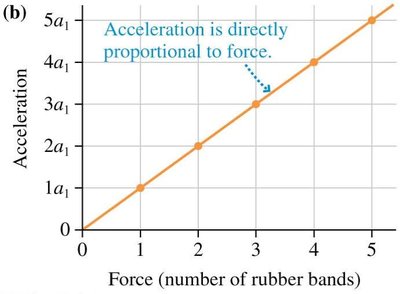
Newton's Second Law quantifies the relationship between force, mass, and acceleration:
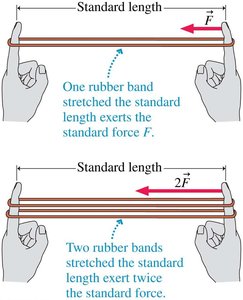
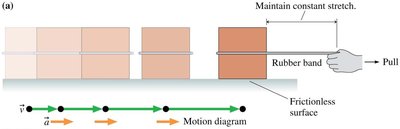
The net force on an object is equal to the mass of the object multiplied by its acceleration.
Force and acceleration are vectors and point in the same direction.
The unit of force is the Newton (N):
Newton's Third Law
Newton's Third Law states: For every action, there is an equal and opposite reaction. Forces always occur in pairs, acting on different objects.
If object A exerts a force on object B, then object B exerts an equal and opposite force on object A.
These forces are equal in magnitude and opposite in direction, but act on different objects.
Equilibrium Model
Conditions for Equilibrium
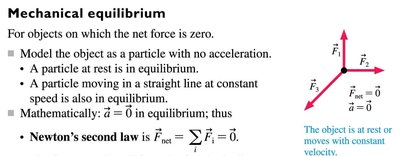
An object is in equilibrium if the net force acting on it is zero. This can be either static (at rest) or dynamic (constant velocity).
In equilibrium, acceleration is zero:
All forces balance in both the x and y directions.
Mass and Weight
Definitions and Differences
Mass (m): A measure of an object's inertia; intrinsic property measured in kilograms (kg).
Weight (W): The gravitational force acting on an object; .
Weight depends on the local gravitational field, but mass does not.
Newton's Law of Universal Gravitation
Gravitational Force Between Two Masses
Newton's Law of Universal Gravitation describes the attractive force between any two masses:
G is the gravitational constant:
m1 and m2 are the masses of the two objects
r is the distance between the centers of the two masses

Worked Examples
Example: Sled on Frictionless Surface
A sled of mass 1000 kg is pulled at constant velocity across a frictionless lake. Since there is no friction and the velocity is constant, the net force is zero and the tension in the rope is zero.
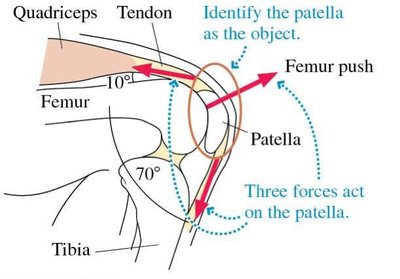
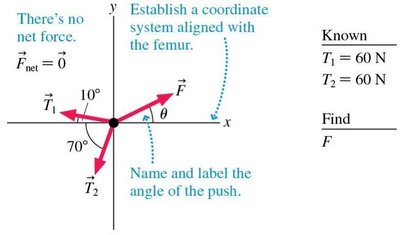
Example: Forces on the Patella
The patella (kneecap) is acted on by three forces: the quadriceps tendon, the patellar tendon, and the femur. By resolving forces into components and applying equilibrium conditions, the force exerted by the femur can be determined.
Summary Table: Types of Forces
Type of Force | Agent | Direction | Contact/Long-range |
|---|---|---|---|
Spring Force | Spring | Along spring axis | Contact |
Tension | Rope/String | Along rope | Contact |
Normal Force | Surface | Perpendicular to surface | Contact |
Friction | Surface | Parallel to surface | Contact |
Drag | Fluid | Opposite to motion | Contact |
Thrust | Exhaust gases | Opposite to expelled mass | Contact |
Gravity | Earth/Other mass | Toward center of mass | Long-range |
Key Vocabulary
Mechanics: Study of motion, force, and energy.
Kinematics: Describes how objects move.
Dynamics: Describes why objects move.
Inertia: Resistance to change in motion.
Equilibrium: State where net force is zero.
