 Back
BackFriction and Circular Motion: Physics Study Notes
Study Guide - Smart Notes
 Tailored notes based on your materials, expanded with key definitions, examples, and context.
Friction and Circular Motion
Introduction to Friction and Circular Motion
This chapter explores the concepts of friction and circular motion, fundamental to understanding dynamics in physics. Frictional forces arise when two surfaces interact, and circular motion involves objects moving along a curved path, requiring centripetal force.
Friction: Exists in static, kinetic, and rolling forms; acts parallel to surfaces in contact.
Circular Motion: Described using angular coordinates, velocity, and acceleration.
Relationship: Linear and angular motion are interconnected in physical systems.
Types of Friction
Friction is a resistive force that opposes motion between two surfaces. It is classified as static, kinetic, or rolling friction, each with distinct characteristics and applications.
Static Friction: Prevents motion when surfaces are at rest relative to each other.
Kinetic Friction: Acts when surfaces slide past each other.
Rolling Friction: Occurs when an object rolls over a surface.
Formula: for kinetic friction; for static friction.
Coefficient of Friction: (kinetic) and (static) depend on material pairs.
Frictional Force and Normal Force
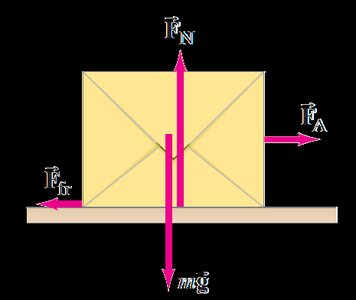
The magnitude of frictional force is proportional to the normal force, which is the perpendicular force exerted by a surface.
Normal Force (): Acts perpendicular to the contact surface.
Frictional Force (): Acts parallel to the surface.
Units: Newtons (N).
Coefficients of Friction
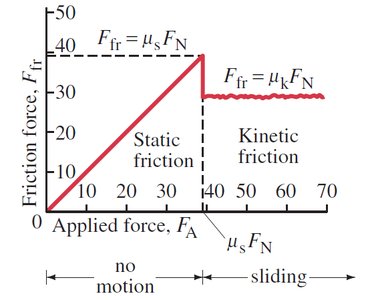
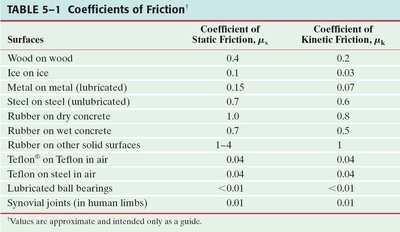
The coefficient of friction quantifies the interaction between surfaces. Static friction is generally greater than kinetic friction.
Static Friction (): Maximum value before motion starts.
Kinetic Friction (): Value during sliding motion.
Material Dependence: Each surface pair has unique coefficients.
Examples: Friction Calculations
Frictional force calculations involve determining the maximum static friction and kinetic friction for given scenarios.
Example: A 10 kg box on a floor with , .
Static Friction: ; maximum N.
Kinetic Friction: N when sliding.
Pulling vs. Pushing: Effect on Friction
The direction of applied force affects the normal force and thus the friction experienced. Pulling at an angle reduces the normal force, making it easier to move an object.
Pulling: Decreases normal force, reduces friction.
Pushing: Increases normal force, increases friction.
Friction in Systems: Two Boxes and a Pulley
When multiple objects are connected, frictional forces and tension must be considered in both vertical and horizontal directions.
System: Two boxes connected by a cord over a pulley.
Forces: Tension, gravity, normal force, and friction.
Newton's Second Law: Used to solve for acceleration and tension.
Inclined Plane and Friction
Objects on inclined planes experience components of gravity, normal force, and friction. The range of masses and coefficients determines whether motion occurs.
Static Friction: Prevents motion up to a threshold.
Kinetic Friction: Governs motion once sliding begins.
Equations: and .
Uniform Circular Motion: Kinematics
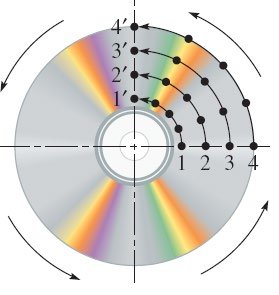
Uniform circular motion describes objects moving in a circle at constant speed. Velocity is tangent to the circle, and acceleration is directed toward the center (centripetal).
Velocity: Tangent to the circle.
Centripetal Acceleration: , points toward center.
Period (): Time for one revolution.
Frequency (): Number of revolutions per second.
Angular Velocity (): .
Dynamics of Uniform Circular Motion
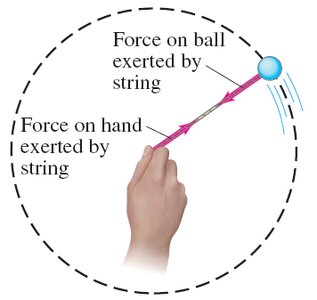
For an object to maintain uniform circular motion, a net force (centripetal force) must act toward the center. Newton's Second Law applies in the radial direction.
Centripetal Force: .
Source: Can be tension, gravity, friction, or normal force.
Nonuniform Circular Motion
When speed changes along a circular path, acceleration has both radial (centripetal) and tangential components.
Radial Acceleration (): Points toward center, .
Tangential Acceleration (): Points tangent to path, .
Total Acceleration: .
Highway Curves: Banked and Unbanked
Vehicles rounding curves require centripetal force, often supplied by friction. Banking the curve can reduce reliance on friction.
Flat Curve: Friction provides centripetal force.
Banked Curve: Normal force's horizontal component provides centripetal force.
Banking Angle Formula: .
Summary of Key Concepts
Kinetic Friction: .
Static Friction: .
Uniform Circular Motion: Radial acceleration .
Centripetal Force: .
Nonuniform Motion: Tangential and radial components in acceleration and force.
