 Back
BackFriction and Drag: Static & Kinetic Friction, Drag Forces, and Terminal Speed
Study Guide - Smart Notes
 Tailored notes based on your materials, expanded with key definitions, examples, and context.
Friction and Drag
Introduction
Friction and drag are resistive forces that oppose the motion of objects. Friction acts between solid surfaces, while drag acts on objects moving through fluids (liquids or gases). Understanding these forces is essential for analyzing motion in real-world systems, from sliding blocks to falling objects and biological locomotion.
Friction
Static Friction
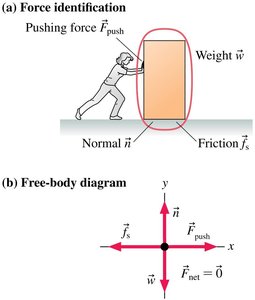
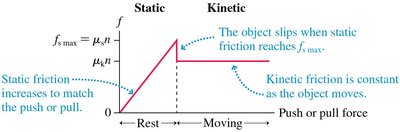
Static friction is the force that prevents an object from moving when a force is applied. It acts in the direction opposite to the impending motion and adjusts up to a maximum value to prevent slipping.
Maximum static friction:
is the coefficient of static friction, dependent on the materials in contact.
is the normal force (perpendicular contact force between surfaces).
Static friction force points opposite to the direction the object would move if friction were absent.
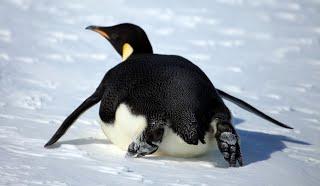
Example: Penguins sliding on ice experience very low static friction, allowing them to travel long distances efficiently.
Comparing Static Friction on Different Surfaces
When identical blocks rest on ramps with different surface materials but the same angle, the magnitude of static friction is the same for each block, as it balances the component of gravity parallel to the ramp. The coefficient of static friction only determines the maximum possible value, not the actual value unless the block is on the verge of sliding.
Critical Angle and Coefficient of Static Friction
The critical angle is the angle at which a block just begins to slide down an incline. At this point, the maximum static friction is reached:
Decompose gravity: ,
At the threshold of motion: and
So,
Example: If a block starts sliding at , .
Kinetic Friction
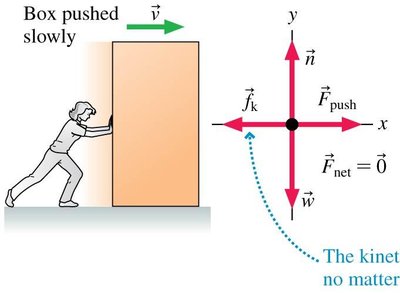
Kinetic friction acts when two surfaces are sliding past each other. It is generally less than the maximum static friction for the same materials.
Kinetic friction force:
is the coefficient of kinetic friction.
Once motion starts, friction drops from its maximum static value to the kinetic value.
Key Properties
Kinetic friction does not depend on the speed of sliding or the contact area (for most practical cases).
For identical blocks moving at different speeds, the kinetic friction force is the same if the normal force is unchanged.
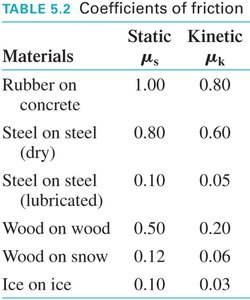
Coefficients of Friction for Common Materials
Materials | Static () | Kinetic () |
|---|---|---|
Rubber on concrete | 1.00 | 0.80 |
Steel on steel (dry) | 0.80 | 0.60 |
Steel on steel (lubricated) | 0.10 | 0.05 |
Wood on wood | 0.50 | 0.20 |
Wood on snow | 0.12 | 0.06 |
Ice on ice | 0.10 | 0.03 |
Friction in Human Joints
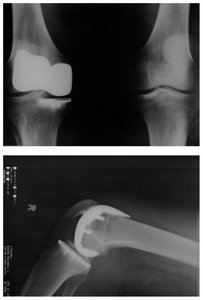
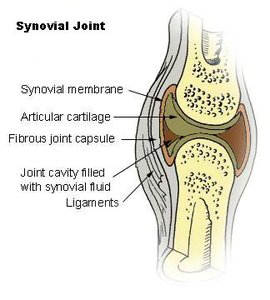
Human joints are covered by cartilage and lubricated by synovial fluid, resulting in extremely low coefficients of friction (, ). Artificial joints have higher friction, but still much lower than most engineering materials.
Drag
Introduction to Drag
Drag is a resistive force experienced by objects moving through fluids. It acts opposite to the direction of motion and increases with speed. The nature of drag depends on the flow regime, characterized by the Reynolds number.
Reynolds Number
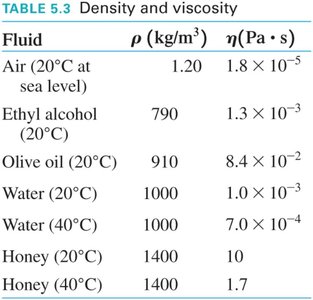
The Reynolds number () is a dimensionless quantity that predicts flow patterns in different fluid flow situations:
= fluid density, = object speed, = characteristic length, = fluid viscosity
High (): Inertial forces dominate (turbulent flow)
Low (): Viscous forces dominate (laminar flow)
Drag at High Reynolds Number (Quadratic Drag)
For high Reynolds numbers, drag force is proportional to the square of the speed:
= drag coefficient (depends on shape), = cross-sectional area
Direction is opposite to motion
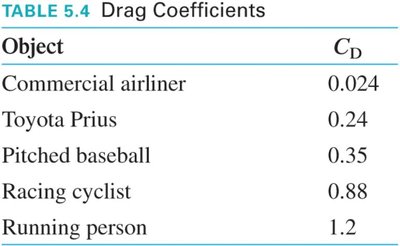
Object | |
|---|---|
Commercial airliner | 0.024 |
Toyota Prius | 0.24 |
Pitched baseball | 0.35 |
Racing cyclist | 0.88 |
Running person | 1.2 |

Drag at Low Reynolds Number (Viscous Drag)
For low Reynolds numbers, drag force is proportional to speed (Stokes' Law):
= viscosity, = radius of sphere, = speed
Direction is opposite to motion
Terminal Speed
Terminal speed is reached when the drag force equals the gravitational force, resulting in zero net acceleration and constant velocity.
At terminal speed:
For high :
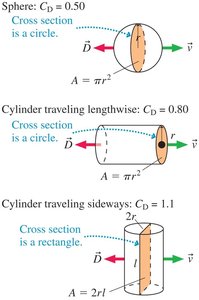
Example: Parachutists and gliding animals reach terminal speed when the upward drag balances their weight.

Comparing Terminal Speeds
For spheres of different sizes and masses, terminal speed depends on both mass and cross-sectional area. For example, if Sphere 1 has twice the radius and eight times the mass of Sphere 2, its terminal speed is twice as large ().
Summary Table: Key Equations
Force | Equation | Variables |
|---|---|---|
Static friction (max) | = static friction coefficient, = normal force | |
Kinetic friction | = kinetic friction coefficient, = normal force | |
Quadratic drag (high ) | = drag coefficient, = fluid density, = area, = speed | |
Viscous drag (low ) | = viscosity, = radius, = speed | |
Terminal speed (high ) | = mass, = gravity, = drag coefficient, = fluid density, = area |
Additional info: The notes above expand on the original lecture content by providing definitions, formulas, and examples for each concept, as well as relevant tables and diagrams to reinforce understanding.
