 Back
BackFriction Forces and Applications in Classical Mechanics
Study Guide - Smart Notes
 Tailored notes based on your materials, expanded with key definitions, examples, and context.
Friction Forces in Classical Mechanics
Introduction to Friction Forces
Friction forces are a fundamental aspect of classical mechanics, arising from the interactions between the atoms and molecules of contacting surfaces. These forces oppose the relative motion or the tendency of such motion between two surfaces in contact. Understanding friction is essential for analyzing real-world systems, from simple blocks on surfaces to complex machinery.
Origin and Nature of Friction
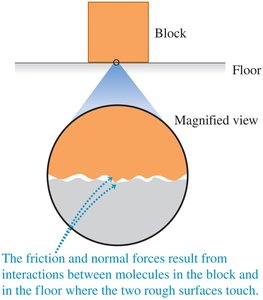
Microscopic Origin: Friction results from the electromagnetic interactions between the molecules of the surfaces in contact. The roughness at the microscopic level leads to interlocking and bonding, which resists motion.
Normal Force: The force perpendicular to the contact surface, called the normal force (n), plays a crucial role in determining the magnitude of friction.
Types of Friction
Static Friction
Static friction is the force that prevents the initiation of motion between two surfaces. It acts when the surfaces are at rest relative to each other and adjusts up to a maximum value to oppose applied forces.
Magnitude: The static friction force can vary from zero up to a maximum value, depending on the applied external force.
Maximum Static Friction: The maximum value is given by the equation:
Coefficient of Static Friction (\(\mu_s\)): A dimensionless constant that depends on the materials in contact.
Direction: Always opposes the direction of the applied force attempting to initiate motion.
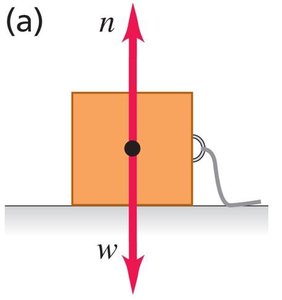
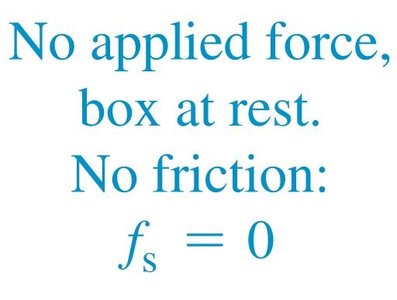
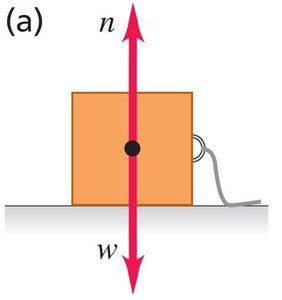
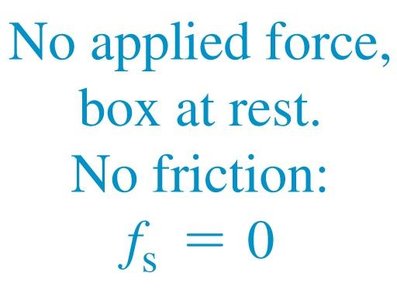
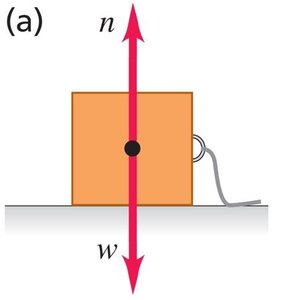
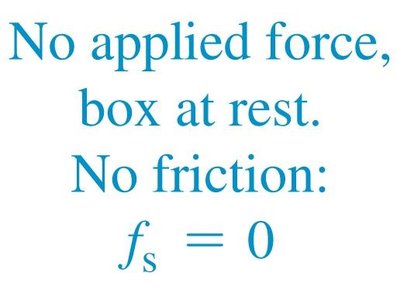
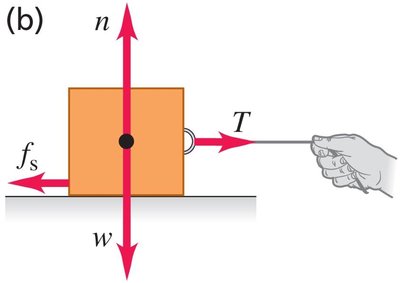
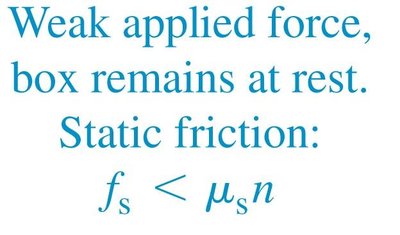
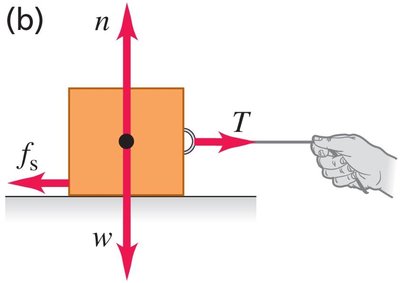
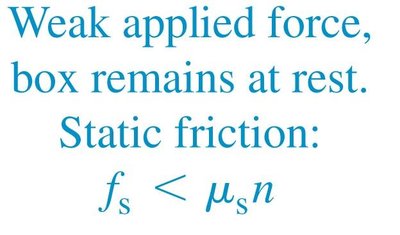
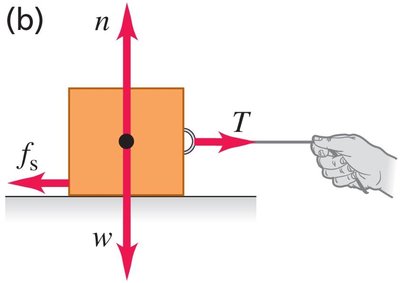
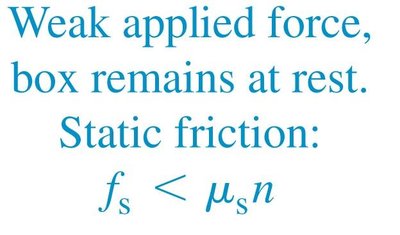
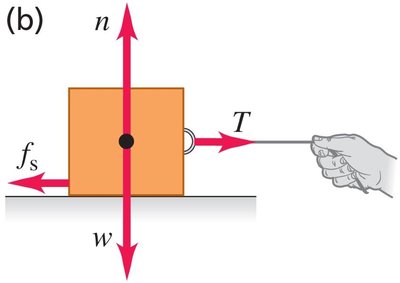
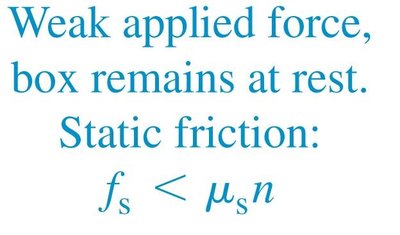
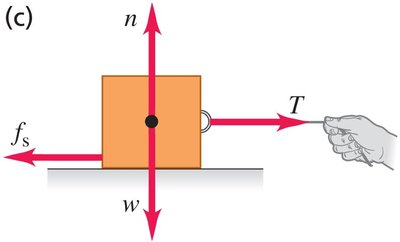
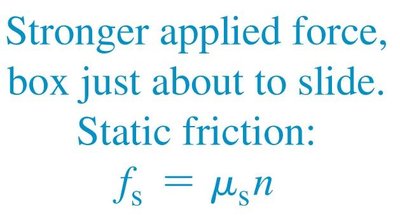
When the applied force exceeds \(f_{s,\text{max}}\), motion begins and kinetic friction takes over.
Kinetic Friction
Kinetic friction acts when two surfaces are sliding past each other. It is generally less than the maximum static friction and remains approximately constant for a given pair of surfaces and normal force.
Magnitude: The kinetic friction force is given by:
Coefficient of Kinetic Friction (\(\mu_k\)): A dimensionless constant, typically less than \(\mu_s\).
Direction: Always opposes the direction of relative motion.
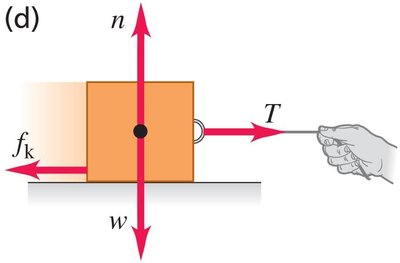
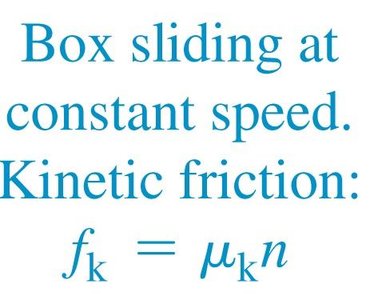
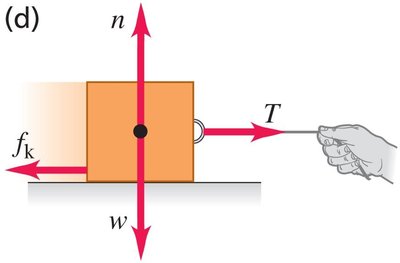
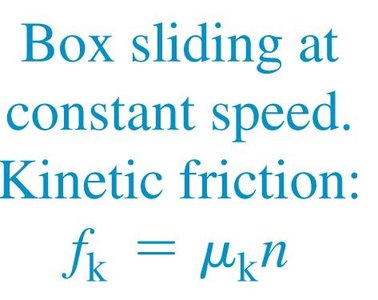
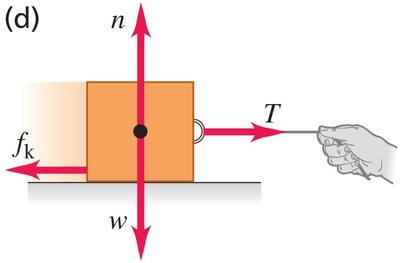
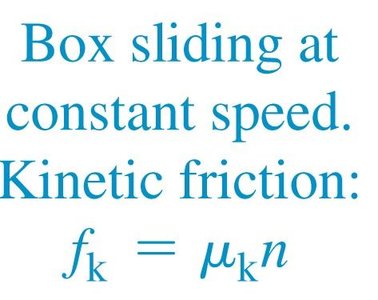
Physical Basis: Kinetic friction arises as intermolecular bonds form and break during sliding.
Comparison of Static and Kinetic Friction
Type | Equation | Typical Value | When It Acts |
|---|---|---|---|
Static Friction | Greater than kinetic | Before motion starts | |
Kinetic Friction | Less than static | During sliding |
Coefficients of Friction for Common Materials
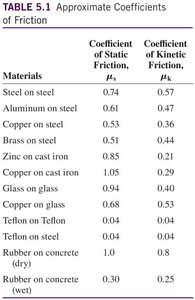
The coefficients of static and kinetic friction depend on the materials in contact. The following table provides typical values for various material pairs:
Materials | Coefficient of Static Friction, \(\mu_s\) | Coefficient of Kinetic Friction, \(\mu_k\) |
|---|---|---|
Steel on steel | 0.74 | 0.57 |
Aluminum on steel | 0.61 | 0.47 |
Copper on steel | 0.53 | 0.36 |
Brass on steel | 0.51 | 0.44 |
Zinc on cast iron | 0.85 | 0.21 |
Copper on cast iron | 1.05 | 0.29 |
Glass on glass | 0.94 | 0.40 |
Teflon on glass | 0.04 | 0.04 |
Rubber on concrete (dry) | 1.0 | 0.80 |
Rubber on concrete (wet) | 0.30 | 0.25 |
Fluid Resistance (Drag)
Introduction to Fluid Resistance
When an object moves through a fluid (liquid or gas), it experiences a resistive force called fluid resistance or drag. This force acts opposite to the direction of motion and depends on the speed of the object and properties of the fluid and object.
Low-Speed Regime: For small velocities, the resistive force is proportional to velocity:
High-Speed Regime (Air Drag): For higher velocities, especially in air, the resistive force is proportional to the square of velocity:
Constants: The constants k and D depend on the shape of the object and the properties of the medium.
Direction: Always opposite to the direction of motion.
Terminal Velocity
Terminal velocity is the constant speed that a falling object reaches when the force of gravity is balanced by the resistive force of the medium. At this point, the net force is zero and the object moves at a constant velocity.
For Low-Speed (Linear Drag): Terminal velocity can be found by setting the drag force equal to the gravitational force:
For High-Speed (Quadratic Drag): Terminal velocity is found by:
Applications: Skydivers, raindrops, and objects falling through fluids all experience terminal velocity.
Worked Example: Two-Box System on a Ramp
Problem Statement
You are lowering two boxes, one on top of the other, down a ramp by pulling on a rope parallel to the surface. Both boxes move together at a constant speed of 15.0 cm/s. The coefficient of kinetic friction between the ramp and the lower box is 0.444, and the coefficient of static friction between the two boxes is 0.800. What force do you need to exert to accomplish this?
Step 1: Draw Free-Body Diagrams for each box, identifying all forces (gravity, normal, friction, tension).
Step 2: Apply Newton's Second Law in the direction parallel and perpendicular to the ramp.
Step 3: Use the friction equations to relate the frictional forces to the normal forces and coefficients.
Step 4: Solve for the required tension (force) in the rope.
Note: Since the boxes move at constant speed, the net force along the ramp is zero (dynamic equilibrium).
Example Solution Outline:
Calculate the normal force on each box.
Determine the frictional force using for the lower box.
Sum forces parallel to the ramp and set equal to zero to solve for the tension.
Additional info: The static friction between the boxes ensures they move together without slipping. If the force required to move the upper box exceeds the maximum static friction, slipping will occur.
Summary Table: Friction Types and Equations
Friction Type | Equation | When Used |
|---|---|---|
Static Friction | Object at rest, resists motion | |
Kinetic Friction | Object sliding at constant speed | |
Fluid Resistance (low speed) | Object moving slowly through fluid | |
Fluid Resistance (high speed) | Object moving quickly through fluid |
