 Back
BackFundamental Concepts in Mechanics: Motion, Forces, Energy, and Rotational Dynamics
Study Guide - Smart Notes
 Tailored notes based on your materials, expanded with key definitions, examples, and context.
Representing Motion
Displacement, Velocity, and Acceleration
Understanding motion begins with the concepts of displacement, velocity, and acceleration. These quantities describe how an object's position changes over time.
Displacement (Δx, Δy): The change in position of an object.
Time Interval (Δt): The difference between the final and initial time.
Constant Velocity: If velocity is constant, displacement is given by:
Motion in One and Two Dimensions
Kinematic Equations for Constant Acceleration
When acceleration is constant, the following kinematic equations describe the motion:
Similarly for the y-direction:
Acceleration due to gravity:
Vectors and Trigonometry in Physics
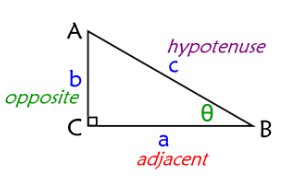
Right Triangle Relationships
Trigonometric functions relate the sides of a right triangle to its angles, which is essential for resolving vectors into components.
Pythagoras Theorem:
Sine:
Cosine:
Tangent:
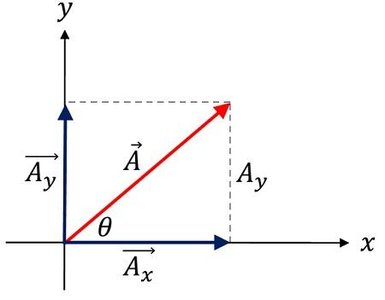
Vector Components
Any vector can be broken into perpendicular components, typically along the x and y axes.
Forces and Newton's Laws of Motion
Net Force and Free Body Diagrams
Forces are vector quantities that can be combined to produce a net force. Newton's Second Law relates net force to acceleration:
Net Force:
Newton's Second Law:
Free Body Diagrams: Diagrams that show all forces acting on an object, represented as a point.
Action-Reaction Pairs: Forces always come in pairs, equal in magnitude and opposite in direction, but act on different bodies.
Friction
Static friction:
Kinetic friction:
Rolling friction:
Circular Motion, Orbits, and Gravity
Circular Motion
Centripetal Acceleration:
Centripetal Force:
Period:
Frequency:
Speed in terms of frequency:
Universal Gravitation
Gravitational acceleration at a planet's surface:
For satellites in circular orbits:
Orbital period:
Rotational Motion
Angular Quantities and Kinematics
Rotational motion is described using angular displacement, velocity, and acceleration, analogous to linear motion.
Arc length: (θ in radians)
Angular velocity:
Angular acceleration:
Linear velocity:
Linear acceleration:
Rotational kinematic equations: Same as linear, with and
Torque and Moment of Inertia
Torque:
Newton's Second Law (Rotational):
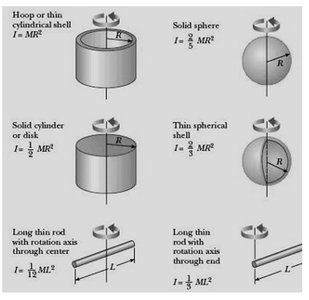
Moment of Inertia:
Equilibrium and Elasticity
Conditions for Equilibrium
(no net force in x-direction)
(no net force in y-direction)
(no net torque)
Hooke's Law and Young's Modulus
Hooke's Law:
Stress:
Strain:
Young's Modulus:
Momentum
Impulse and Conservation of Momentum
Impulse: (also area under F vs. t curve)
Linear momentum:
Angular momentum:
Conservation of momentum: or
In 2D: and
Energy and Work
Work, Energy, and Power
Work:
Gravitational potential energy:
Spring potential energy:
Kinetic energy (translation):
Kinetic energy (rotation):
Energy conservation:
For an isolated system:
Thermal energy (friction):
Thermal energy (drag):
Work-energy theorem:
Elastic collisions (object 2 initially at rest):
Power: (energy transformed), (work done)
