 Back
BackFundamental Kinematic Equations and Applications in Physics
Study Guide - Smart Notes
 Tailored notes based on your materials, expanded with key definitions, examples, and context.
Kinematics in One Dimension
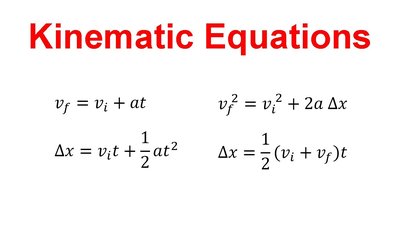
Basic Kinematic Equations
Kinematics is the study of motion without considering its causes. The fundamental kinematic equations describe the relationships between displacement, velocity, acceleration, and time for objects moving with constant acceleration.
Final velocity:
Displacement:
Velocity squared:
Average velocity:
These equations are valid only for constant acceleration scenarios.
Average and Instantaneous Velocity
Average velocity is defined as the total displacement divided by the total time interval:
Instantaneous velocity is the velocity at a specific moment, given by the limit as the time interval approaches zero:
Speed is the magnitude of velocity and is always positive.
Average and Instantaneous Acceleration
Average acceleration is the change in velocity over the change in time:
Units:
Instantaneous acceleration is the rate of change of velocity at a specific instant.
Position Equations for Uniform and Non-Uniform Motion
For uniform motion (constant velocity):
For non-uniform motion (variable velocity):
Kinematics in Two Dimensions
Range of a Projectile
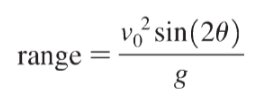
The range equation describes the horizontal distance traveled by a projectile launched at an angle with initial velocity :
Where is the acceleration due to gravity.
Catch-Up Problems
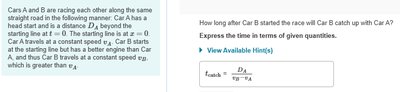
Catch-up problems involve two objects moving at different speeds, where one tries to overtake the other. The minimum required speed or time to catch up can be calculated using kinematic equations.
Example: If Car A has a head start of and Car B travels at speed (greater than ), the time for Car B to catch up is:
Dynamics: Force and Motion
Newton's Second Law
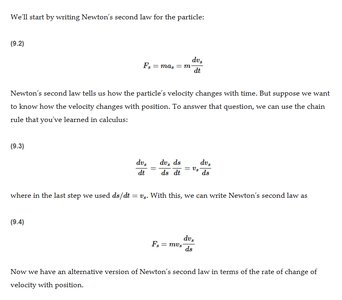
Newton's Second Law relates the net force acting on an object to its mass and acceleration:
In calculus form:
Alternative form using chain rule:
This law is fundamental for analyzing motion under the influence of forces.
Friction and Normal Force
Friction is the resistive force that opposes motion between two surfaces. The frictional force is given by:
Where is the coefficient of friction and is the normal force.
For a static object, the normal force is equal to its weight:
Rotational Motion
Angular Velocity and Acceleration
Angular velocity () and angular acceleration () describe rotational motion:
Angular velocity:
Angular acceleration:
Centripetal Acceleration and Force
Centripetal acceleration is the acceleration directed toward the center of a circular path:
Centripetal force:
Energy
Kinetic Energy
Kinetic energy is the energy of motion:
Summary Table: Kinematic Equations
Equation | Physical Meaning |
|---|---|
Final velocity after time | |
Displacement after time | |
Relates velocity and displacement | |
Displacement using average velocity |
Additional info: Academic context and explanations have been expanded for clarity and completeness.
