 Back
BackFundamentals of Mechanics: Motion, Force, Energy, and Materials
Study Guide - Smart Notes
 Tailored notes based on your materials, expanded with key definitions, examples, and context.
Introduction to Mechanics and Materials
Overview of Course Structure
This course provides a comprehensive introduction to the fundamental principles of mechanics and materials, essential for engineering and physical sciences. The curriculum is divided into two main parts: the first half focuses on the basics of measurement, motion, force, and energy, while the second half applies these principles to fluid and solid materials.
Weeks 1-7: Fundamentals of motion, force, energy, and momentum
Weeks 8-10: Fluid mechanics and hydrostatics
Weeks 11-13: Mechanical properties of materials
Measurement and Motion in One Dimension
Key Concepts and Definitions
Understanding motion requires precise measurement of space and time. The language of physics distinguishes between several key terms:
SI Units: The International System of Units (SI) is the standard for scientific measurement (e.g., meters, seconds, kilograms).
Scalar vs. Vector Quantities: Scalars have magnitude only (e.g., distance, speed), while vectors have both magnitude and direction (e.g., displacement, velocity).
Distance vs. Displacement: Distance is the total path length traveled, while displacement is the straight-line change in position.
Speed vs. Velocity: Speed is the rate of change of distance, while velocity is the rate of change of displacement.
Average vs. Instantaneous Velocity: Average velocity is calculated over a time interval; instantaneous velocity is the velocity at a specific moment.
Equations for Motion in One Dimension
The following equations are fundamental for describing straight-line motion:
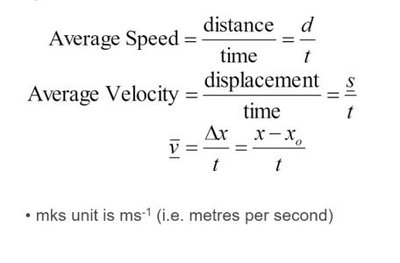
Average Speed:
Average Velocity:
Alternative Form (using position):
SI Unit: The mks (meter-kilogram-second) unit for speed and velocity is (meters per second).
Example: Calculating Average Velocity
Example: If a car travels 100 meters east in 20 seconds, its average velocity is:
\ (east)
Motion in Two and Three Dimensions
Vectors and Kinematics
Real-world motion often occurs in more than one dimension. Vectors are used to describe quantities with both magnitude and direction. The equations of motion can be extended to two and three dimensions by resolving vectors into orthogonal components.
Vector Addition and Subtraction: Can be performed graphically (using arrows) or numerically (using components).
Component Resolution: Any vector can be broken into perpendicular components, typically along the x and y axes.
Force and Newton's Laws
Explaining Motion
Newton's three laws of motion provide the foundation for understanding why objects accelerate or remain at rest:
First Law (Inertia): An object remains at rest or in uniform motion unless acted upon by a net external force.
Second Law: The net force on an object is equal to the mass times its acceleration ().
Third Law: For every action, there is an equal and opposite reaction.
Free-body diagrams are used to visualize forces acting on objects.
Dynamic Systems: Friction and Circular Motion
Forces in Everyday Contexts
Hooke's Law: Describes the force exerted by an ideal spring:
Friction: Static friction prevents motion; kinetic friction opposes motion once it starts.
Uniform Circular Motion: Objects moving in a circle experience a centripetal force directed toward the center.
Work, Energy, and Conservation of Energy
Energy Concepts
Work: The product of force and displacement in the direction of the force:
Kinetic Energy:
Potential Energy: Gravitational: ; Elastic (spring):
Conservation of Mechanical Energy: In the absence of non-conservative forces, total mechanical energy is conserved.
Momentum and Collisions
Linear Momentum
Momentum:
Conservation of Momentum: In a closed system, total momentum remains constant.
Types of Collisions: Elastic (kinetic energy conserved), inelastic (kinetic energy not conserved), completely inelastic (objects stick together).
Fluids: Properties and Hydrostatics
Fluid Properties
Density ():
Viscosity: Resistance to flow; dynamic and kinematic viscosity are key properties.
Pressure: ; varies with depth in a fluid.
Hydrostatic Forces and Buoyancy
Pressure on Submerged Surfaces: Calculated using depth and fluid density.
Buoyant Force: Equal to the weight of the displaced fluid (Archimedes' Principle).
Mechanical Properties of Materials
Stress, Strain, and Material Behavior
Normal Stress ():
Normal Strain ():
Young's Modulus ():
Stress-Strain Diagram: Used to determine material properties such as stiffness, strength, and ductility.
Shear Stress and Strain
Shear Stress (): (parallel to the surface)
Shear Strain ():
Shear Modulus ():
Exam Preparation Tips
Review all key definitions and equations.
Practice drawing and interpreting motion graphs and free-body diagrams.
Work through example problems for each topic, focusing on both conceptual understanding and calculation skills.
Understand the physical meaning behind formulas, not just their mathematical manipulation.
