Back
BackFundamentals of Superposition and Standing Waves
Study Guide - Smart Notes
 Tailored notes based on your materials, expanded with key definitions, examples, and context.
Superposition of Waves
Principle of Superposition
The superposition principle states that when two or more waves overlap in space, the resultant displacement at any point is the algebraic sum of the individual displacements. Unlike particles, waves can pass through each other and combine their effects.
Definition: Superposition is the process by which two or more waves add together when they occupy the same region.
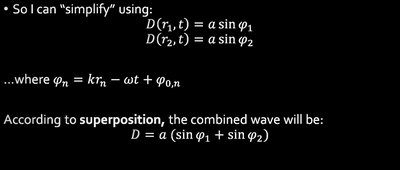
Mathematical Expression: If two waves are described by and , the total displacement is .
Example: Sound waves from two speakers combine in the air, resulting in regions of louder and softer sound.
Wave Properties
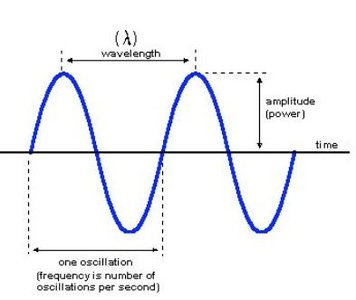
Waves are characterized by their wavelength, amplitude, and frequency. These properties are fundamental to understanding superposition and interference.
Wavelength (): The distance between two consecutive points in phase (e.g., two crests).
Amplitude: The maximum displacement from equilibrium, related to the wave's energy.
Frequency (): The number of oscillations per second.
Interference of Waves
Constructive and Destructive Interference
When two waves overlap, their amplitudes combine, resulting in interference. The type of interference depends on the alignment of the waves:
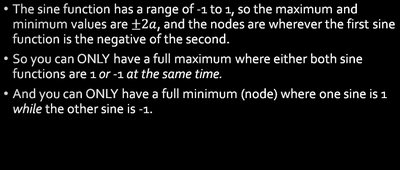
Constructive Interference: Occurs when waves are perfectly aligned (in phase), resulting in a larger amplitude.
Destructive Interference: Occurs when waves are perfectly misaligned (out of phase), resulting in cancellation.
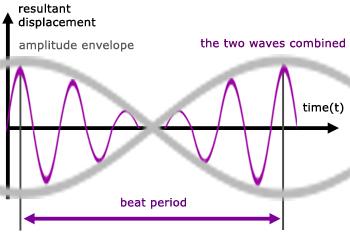
Beats: Occur when the misalignment is not perfect, producing periodic variations in amplitude.
Standing Waves
Formation of Standing Waves
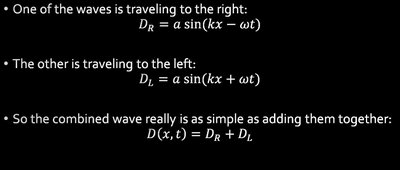
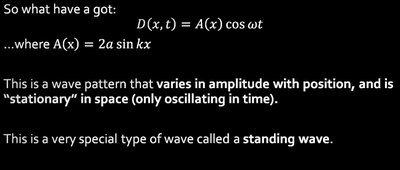
A standing wave is formed when two identical waves travel in opposite directions and interfere. The result is a wave pattern that appears stationary, with points of no displacement (nodes) and maximum displacement (antinodes).
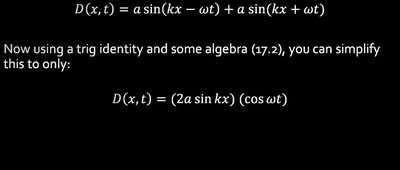
Mathematical Description: For two waves of amplitude traveling in opposite directions: Combined:
Simplified Equation: Using trigonometric identities:
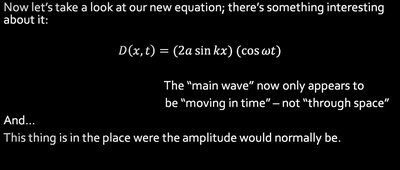
Interpretation: The amplitude varies with position, and the wave oscillates in time but is stationary in space.
Nodes and Antinodes
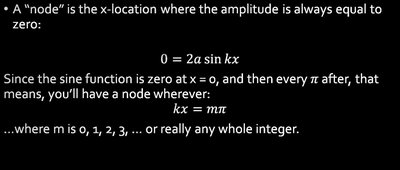
Nodes are points where the amplitude is always zero, and antinodes are points of maximum amplitude.
Node Condition:
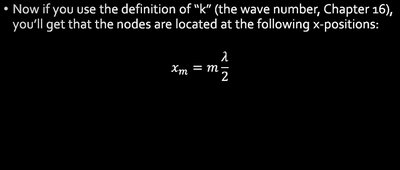
Node Locations: where is an integer.
Using wave number :
Standing Waves in a Cavity
Boundary Conditions and Resonance
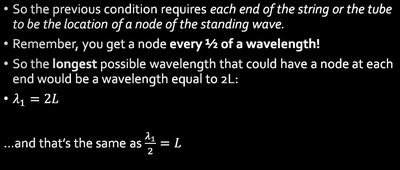
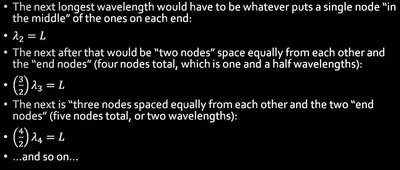
Standing waves can be established in a cavity (such as a tube or string) with fixed or sealed ends. The ends must be nodes, and the allowed wavelengths depend on the length of the cavity.
Longest Wavelength:
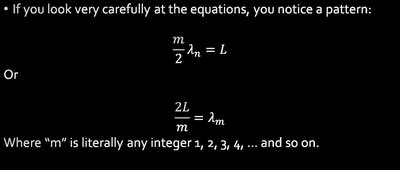
General Pattern: or
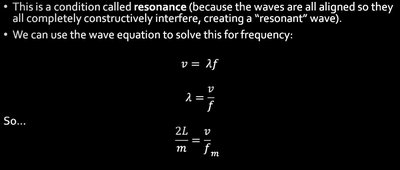
Resonance: Occurs when waves align to create maximum constructive interference.
Resonant Frequencies
The resonant frequencies of a cavity depend on its length and the speed of the wave:
Wave Equation:
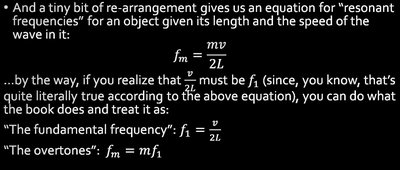
Resonant Frequency:
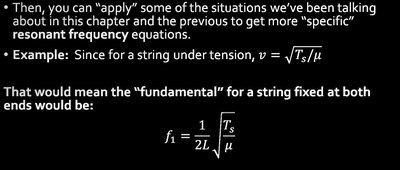
Fundamental Frequency:
Overtones:
Musical Tubes and Sound Waves
Closed and Open Tubes
Sound waves in tubes can be modeled as standing waves. The boundary conditions differ for closed and open tubes:
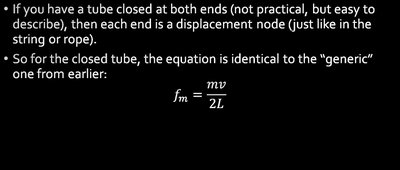
Closed Tube: Both ends are displacement nodes.
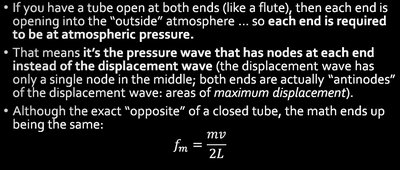
Open Tube: Both ends are pressure nodes (antinodes of displacement).
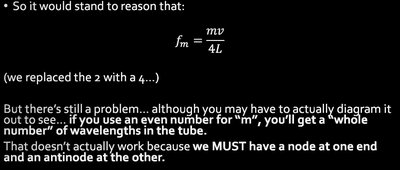
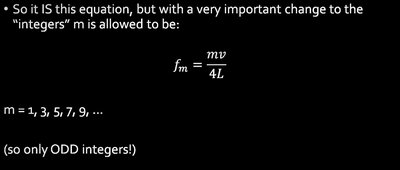
Open at One End: One end is a node, the other is an antinode. , with odd integers only.
Basic Interference Patterns
Interference from Two Sources
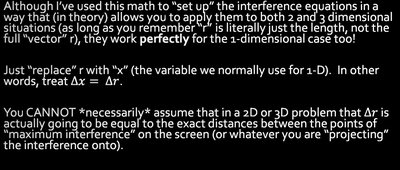
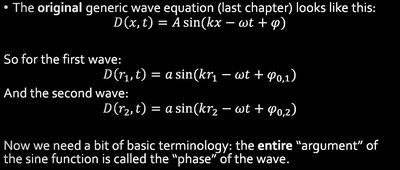
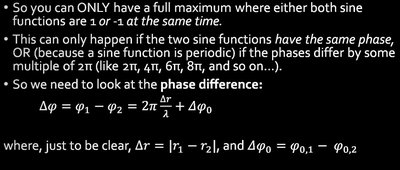
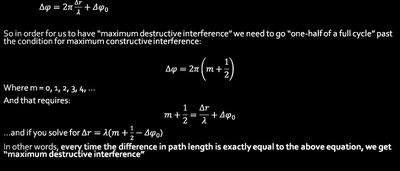
When two wave sources emit waves toward a screen, the amplitude at each point depends on the path difference between the sources.
Phase Difference:
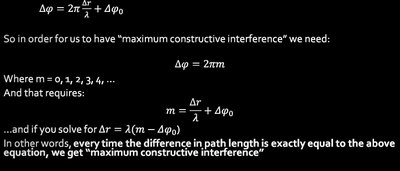
Constructive Interference:
Destructive Interference:
Summary Table: Standing Wave Boundary Conditions
Tube Type | Boundary Condition | Allowed Frequencies | Allowed m Values |
|---|---|---|---|
Closed at Both Ends | Node at each end | m = 1, 2, 3, ... | |
Open at Both Ends | Pressure node at each end | m = 1, 2, 3, ... | |
Open at One End | Node at one end, antinode at other | m = 1, 3, 5, ... (odd only) |
Final Notes
The principles of superposition, interference, and standing waves are fundamental to understanding wave phenomena in physics. These concepts are widely applicable in acoustics, optics, and other areas of physics.