 Back
BackWeek 2 Lec. 2
Study Guide - Smart Notes
 Tailored notes based on your materials, expanded with key definitions, examples, and context.
Gauss' Law
Fundamental Statement
Gauss' Law is a cornerstone of electrostatics, relating the electric flux through a closed surface to the net charge enclosed by that surface. It is mathematically expressed as:
Gauss' Law:
Electric Flux: The total electric field passing through a surface.
Permittivity of Free Space: is the constant of proportionality, fundamental to the law.
Gauss' Law is especially powerful for calculating electric fields in cases of high symmetry (spherical, cylindrical, planar).
Connection to Coulomb's Law
By applying Gauss' Law to a point charge and integrating over a spherical surface, Coulomb's Law can be derived:
This shows why Coulomb's constant is written in terms of .
Applying Gauss' Law: Problem Solving Strategies
General Steps for High Symmetry Cases
To use Gauss' Law effectively, follow these steps:
Select a Gaussian surface matching the symmetry of the charge distribution.
Draw the surface so that the electric field is constant or zero at all points on it.
Use symmetry to determine the direction of .
Evaluate the surface integral (electric flux).
Determine the charge inside the surface.
Solve for .
Gauss' Law for Multiple Charges
Net Electric Flux
For multiple charges enclosed by a surface, the total electric flux is proportional to the net charge inside:
Symmetry and Gaussian Surfaces
Spherical, Cylindrical, and Planar Symmetry
In cases with symmetry, the electric field can be pulled outside the integral, simplifying calculations. Common configurations include:
Spherical:
Cylindrical:
Planar:
Configuration | Gaussian Surface Area | Electric Field |
|---|---|---|
Spherical | ||
Cylindrical | ||
Planar | (end caps) |
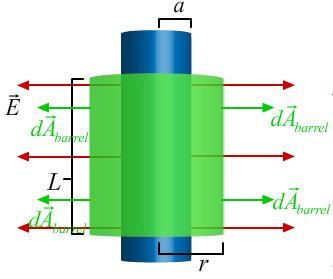
Example: For a cylindrical shell, select a coaxial cylindrical Gaussian surface. The field is perpendicular to the surface and constant by symmetry.
Electric Field of a Spherical Shell
Field Inside and Outside
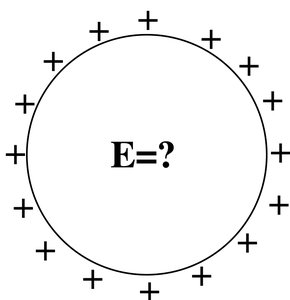
A spherical shell with uniform surface charge density exhibits unique field properties:
Inside: everywhere inside the shell (by Gauss' Law).
Outside: Field behaves as if all charge were concentrated at the center.
Electric Field of a Charged Plane
Infinite Sheet of Charge
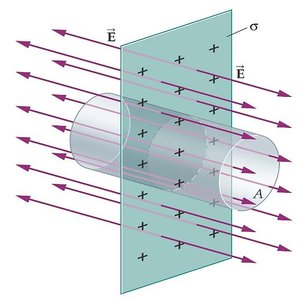
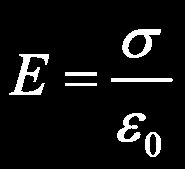
For a large, thin, nonconducting sheet with uniform charge density , the electric field is:
Field is perpendicular to the plane and does not depend on distance from the plane (for an infinite sheet).
Electric Field of a Point Charge
Derivation Using Gauss' Law
For an isolated point charge , choose a spherical Gaussian surface of radius :
By symmetry, the field is radial and perpendicular to the surface.

Electric Field of a Uniformly Charged Sphere
Field Outside and Inside
For a sphere of radius and total charge :
Outside ():
Inside (): , where is the charge density.


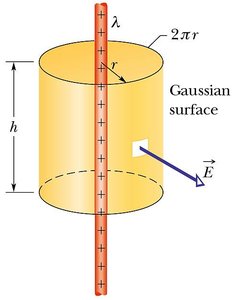
Electric Field of a Line Charge
Infinitely Long Wire
For a wire with linear charge density :
Use a cylindrical Gaussian surface.
Conductors in Electrostatic Equilibrium
Properties and Field Behavior
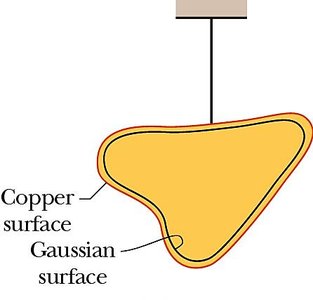
In electrostatic equilibrium:
The electric field is zero everywhere inside the conductor.
Any net charge resides on the surface.
The field just outside is perpendicular to the surface.
Cavities in Conductors
Charge and Field Behavior
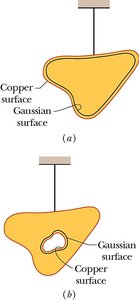
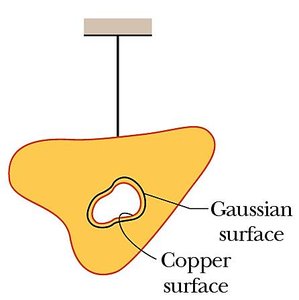
When a cavity is created inside a conductor:
No net charge can reside on the surface of the cavity unless a charge is placed inside.
If a charge is placed in the cavity, an equal and opposite charge is induced on the cavity surface.
Gauss' Law ensures inside the conductor, and the field inside the cavity depends on the enclosed charge.
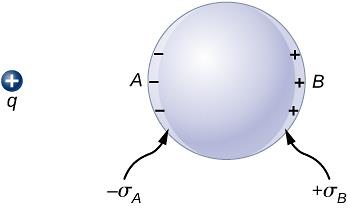
Summary Table: Gauss' Law Configurations
Configuration | Gaussian Surface | Field Expression |
|---|---|---|
Point Charge | Spherical | |
Charged Sphere (outside) | Spherical | |
Charged Sphere (inside) | Spherical | |
Infinite Line | Cylindrical | |
Infinite Plane | Pillbox | |
Conductor (inside) | Any |
Additional info: These notes expand on the original material by providing definitions, formulas, and context for each configuration, ensuring completeness and clarity for exam preparation.
