 Back
BackGauss' Law and Conductors – Study Notes
Study Guide - Smart Notes
 Tailored notes based on your materials, expanded with key definitions, examples, and context.
Gauss' Law and Conductors
Concept: Conductors and Electric Fields
Conductors are materials in which electrons are free to move. This property leads to unique behaviors when conductors are placed in electric fields or carry net charge.
Electron Mobility: Electrons are allowed to move within conductors, enabling charge redistribution.
Charge Arrangement: In the absence of an external electric field, excess charge in a conductor moves to the surface, distributing itself to minimize repulsion.
Electric Field Inside a Conductor: The net electric field inside a conductor in electrostatic equilibrium is always zero.
Surface Charge: Net charges always move to and distribute on the surface of conductors.
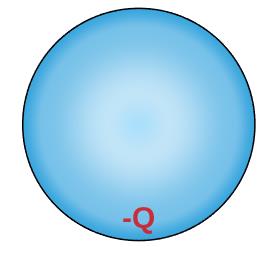
Electric Field Outside a Spherical Conductor: For a sphere of radius r carrying charge Q, the electric field outside is given by:
Example: For a spherical conductor of radius 0.5 m with net charge 2.0 μC:
a) At 0.8 m from the center: Use the formula above.
b) At 0.4 m from the center: The electric field is zero (inside the conductor).
Concept: Electric Flux
Electric flux quantifies the amount of electric field passing through a given surface. It is a key concept for applying Gauss's Law.
Definition: Electric flux through a surface A is: where is the angle between the electric field and the normal to the surface.
Normal Vector: The normal is perpendicular to the surface.
Total Flux Through Closed Surface: The total flux is the sum of the fluxes through each individual surface.
Sign of Flux:
Positive flux: and the normal point in the same direction.
Negative flux: and the normal point in opposite directions.
Units:
Example: For a cube with fluxes , , , , , (all in ):
Total flux:
Concept: Gauss's Law
Gauss's Law relates the net electric flux through a closed surface to the net charge enclosed by that surface.
Statement: The net electric flux through any closed surface is proportional to the net charge enclosed: where .
Gaussian Surface: Choose a surface with symmetry (sphere, cylinder, box) so that is constant or easily integrated.
Applications:
Finding given
Finding given
Relating flux to charge for symmetric charge distributions
Example: For a point charge at the center of a sphere of radius :
Electric Field Within a Spherical Conductor
Inside a charged spherical conductor, the electric field is always zero. This is a direct consequence of Gauss's Law and the properties of conductors.
Reason: Any excess charge resides on the surface, and the field inside cancels out.
Application of Gauss's Law: For a Gaussian surface inside the conductor: so everywhere inside.
Example: For a conductor with charge , the field inside is zero.
Electric Field Due to a Hollow Spherical Shell
The electric field produced by a conducting spherical shell depends on the region considered:
Inside the shell ():
Within the shell (): (if shell is conducting and in electrostatic equilibrium)
Outside the shell ():
Surface Charge Density on a Spherical Shell
Surface charge density () is the charge per unit area on the shell's surface.
Inner Surface:
Outer Surface:
Example: For a shell with inner radius 3 cm, outer radius 5 cm, and total charge 3 C, calculate for each surface.
Practice: Electric Field Due to a Shell with Central Charge
When a charge is placed at the center of a conducting shell, the field at different regions is determined by the superposition of the central charge and the shell's charge.
Inside the shell (): Use only the central charge for .
Outside the shell (): Use the sum of the central and shell charges for .
Example: For a shell of radius 8 cm with charge -6 C and a central charge of 4 C:
At 4 cm:
At 12 cm:
