 Back
BackGauss’s Law and Applications in Electrostatics
Study Guide - Smart Notes
 Tailored notes based on your materials, expanded with key definitions, examples, and context.
Gauss’s Law
Introduction to Gauss’s Law
Gauss’s Law is a fundamental principle in electromagnetism that relates the electric flux passing through a closed surface to the net electric charge enclosed within that surface. It provides a powerful method for calculating electric fields, especially in cases with high symmetry, and is mathematically equivalent to Coulomb’s Law.
Electric Flux (\( \Phi_E \)): The measure of the number of electric field lines passing through a given surface.
Gaussian Surface: An imaginary closed surface used to apply Gauss’s Law.
Permittivity of Free Space (\( \varepsilon_0 \)): A constant, \( \varepsilon_0 = 8.85 \times 10^{-12} \; \mathrm{C^2/N \cdot m^2} \).
Mathematical Statement of Gauss’s Law
Gauss’s Law states:
Integral Form:
\( \vec{E} \): Electric field vector
\( d\vec{A} \): Differential area vector (perpendicular to the surface)
\( Q_{\text{encl}} \): Net charge enclosed by the surface
The total electric flux through a closed surface is proportional to the total charge inside the surface.
Electric Flux
Definition and Calculation
Electric flux through a surface is defined as the product of the electric field and the area projected perpendicular to the field:
\( \theta \): Angle between the electric field and the normal to the surface
SI Unit: \( \mathrm{N \cdot m^2/C} \)
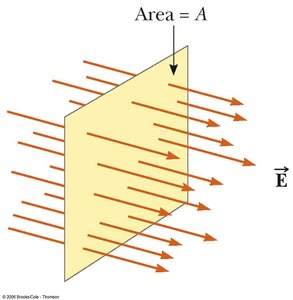
For non-uniform fields or curved surfaces, the general definition is:
Physical Interpretation
Electric flux is analogous to the flow rate of a fluid through a surface.
Flux lines entering a closed surface are considered negative; those exiting are positive.
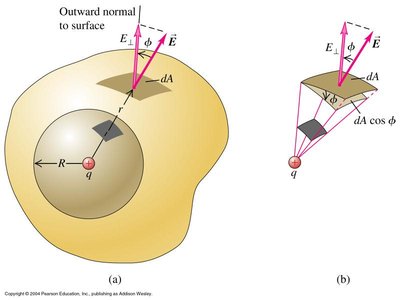
Applying Gauss’s Law
Strategy for Using Gauss’s Law
Choose a Gaussian Surface: Select a surface that matches the symmetry of the charge distribution (spherical, cylindrical, planar).
Exploit Symmetry: Use symmetry to argue that the electric field is constant in magnitude and direction over parts of the surface.
Calculate the Flux: Evaluate the surface integral, often simplified by symmetry.
Relate to Enclosed Charge: Set the calculated flux equal to \( Q_{\text{encl}}/\varepsilon_0 \) and solve for the electric field.
Example: Point Charge Inside a Sphere
For a point charge \( q \) at the center of a sphere of radius \( r \):
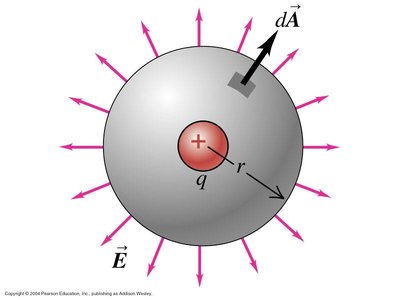
Applications of Gauss’s Law
Electric Field of a Line Charge
For an infinite line of charge with linear charge density \( \lambda \):
Choose a cylindrical Gaussian surface of radius \( r \) and length \( l \).
By symmetry, the electric field is radial and constant on the curved surface.
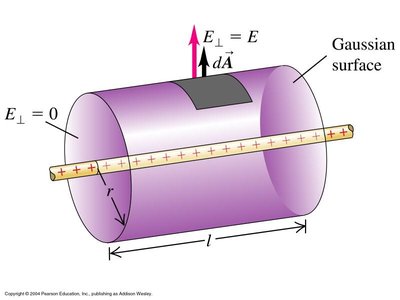
Electric Field of a Nonconducting Plane Sheet of Charge
Surface charge density: \( \sigma \)
Gaussian surface: Cylinder perpendicular to the plane
Electric field is perpendicular to the sheet and uniform
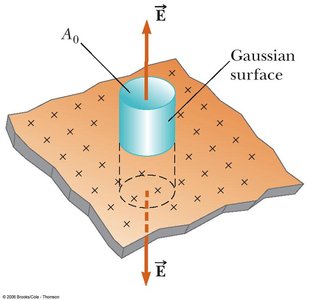
Field of an Infinite Plane of Charge
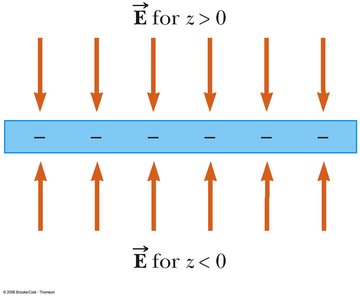
For an infinite plane, the field is uniform and perpendicular to the surface.
Direction: Away from the plane if \( \sigma > 0 \), toward if \( \sigma < 0 \).
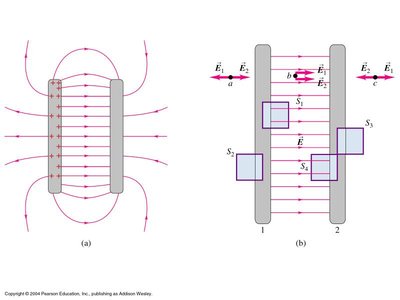
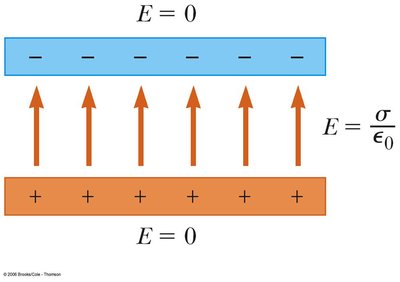
Field Between Oppositely Charged Parallel Plates
Two large parallel plates with charge densities \( +\sigma \) and \( -\sigma \).
Field between the plates is the sum of the fields from each plate.
Field outside the plates is zero (ideal case).
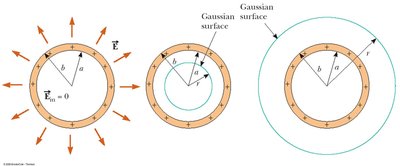
Electric Field of a Spherical Shell
Outside the shell: Field is as if all charge were concentrated at the center.
Inside the shell: Electric field is zero.
Electric Field of a Uniformly Charged Sphere
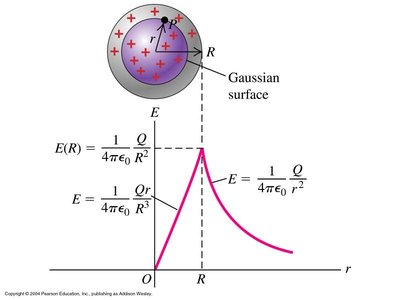
Charge \( Q \) distributed uniformly throughout a sphere of radius \( R \).
Outside the sphere (\( r > R \)):
Inside the sphere (\( r < R \)):
Summary Table: Electric Fields from Symmetric Charge Distributions
Configuration | Electric Field (E) | Where |
|---|---|---|
Point Charge | Outside charge | |
Infinite Line Charge | Radial, outside line | |
Infinite Plane Sheet | Both sides of sheet | |
Parallel Plates | Between plates | |
Spherical Shell | (inside), (outside) | Inside/outside shell |
Uniform Sphere | (inside), (outside) | Inside/outside sphere |
Key Points
Gauss’s Law is most useful for problems with high symmetry (spherical, cylindrical, planar).
It simplifies the calculation of electric fields by relating them to the enclosed charge.
Understanding the symmetry of the charge distribution is crucial for choosing the correct Gaussian surface.
Additional info: In practice, Gauss’s Law is also foundational for understanding conductors in electrostatic equilibrium, the behavior of capacitors, and the distribution of charge on surfaces.
