 Back
BackGauss's Law and Electric Flux: Applications and Concepts
Study Guide - Smart Notes
 Tailored notes based on your materials, expanded with key definitions, examples, and context.
Gauss's Law and Electric Flux
Introduction to Gauss's Law
Gauss's Law is a fundamental principle in electromagnetism, relating the net electric flux through a closed surface to the net charge enclosed by that surface. It is particularly useful for calculating electric fields in cases with high symmetry.
Gauss's Law Statement: The net electric flux through any closed surface is proportional to the net charge enclosed by that surface.
Mathematical Formulation:
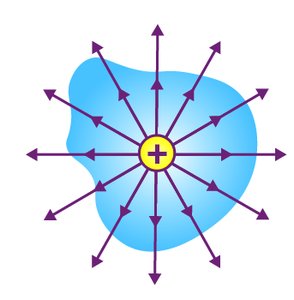
Electric Flux: The measure of the electric field passing through a given surface.
Calculating Electric Flux
Electric flux is calculated by integrating the electric field over a surface. For a point charge, the flux through a spherical surface is straightforward due to symmetry.
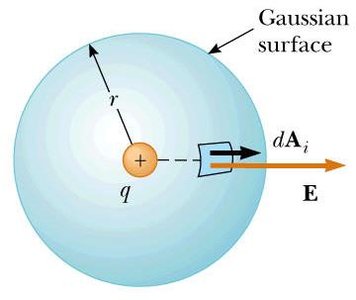
Flux through a Spherical Surface:
Example: For a positive charge q at the center of a sphere of radius r, the electric flux is .
Electric Flux through Non-Spherical Surfaces
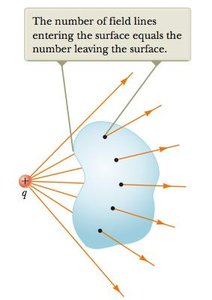
Gauss's Law applies to any closed surface, not just spheres. The net flux depends only on the net charge enclosed, regardless of the surface's shape.
Key Point: The net electric flux through any closed surface is proportional to the net charge enclosed by that surface.
Zero Net Charge: If the net charge inside the surface is zero, the net electric flux is zero.
Example: Electric Flux through a Cube in a Uniform Field
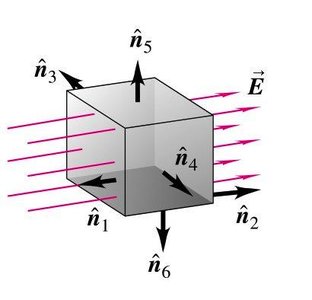
When a cube is placed in a uniform electric field, the net electric flux through the cube is zero if no charge is enclosed. This is because the flux entering one face is balanced by the flux leaving the opposite face.
Calculation:
Result: for a cube in a uniform field with no enclosed charge.
Charge Densities
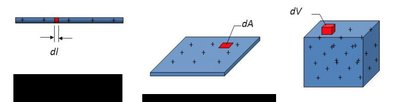
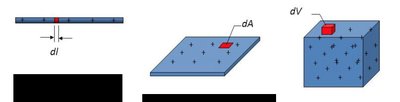
Charge density describes how charge is distributed in space. There are three types: linear, surface, and volume charge densities.
Linear Charge Density (λ): [C/m],
Surface Charge Density (σ): [C/m2],
Volume Charge Density (ρ): [C/m3],
Applications of Gauss's Law
Electric Field of an Infinite Line of Charge
Gauss's Law is especially useful for calculating the electric field of symmetric charge distributions, such as an infinite line of charge.
Setup: Consider an infinite line of charge with linear charge density λ.
Gaussian Surface: A cylindrical surface is chosen for symmetry.
Result:
Example: The electric field at distance r from the line is inversely proportional to r.
Electric Field of an Infinite Plane of Charge
For an infinite plane with surface charge density σ, Gauss's Law provides a simple expression for the electric field.
Setup: An infinite plane with surface charge density σ.
Gaussian Surface: A cylindrical surface perpendicular to the plane.
Result:
Example: The electric field is constant and does not depend on the distance from the plane.
Summary Table: Charge Densities
The following table summarizes the three types of charge densities:
Type | Symbol | Formula | Units |
|---|---|---|---|
Linear | λ | C/m | |
Surface | σ | C/m2 | |
Volume | ρ | C/m3 |
Key Takeaways
Gauss's Law is a powerful tool for calculating electric fields in symmetric situations.
The net electric flux through a closed surface depends only on the net charge enclosed.
Charge densities (linear, surface, volume) are essential for describing charge distributions.
Choosing the appropriate Gaussian surface simplifies calculations using Gauss's Law.
