 Back
BackCh. 24 Gauss’s Law and Electric Flux: Structured Study Notes
Study Guide - Smart Notes
 Tailored notes based on your materials, expanded with key definitions, examples, and context.
Chapter 24: Gauss’s Law
Introduction to Gauss’s Law
Gauss’s law is a fundamental principle in electromagnetism, relating the electric flux through a closed surface to the net charge enclosed within that surface. It is more general than Coulomb’s law and forms one of Maxwell’s equations, which govern electricity and magnetism.
Gauss’s Law Statement: The electric flux through a closed surface is proportional to the enclosed charge.
Mathematical Form:
Applications: Useful for calculating electric fields of symmetric charge distributions (spheres, cylinders, planes).
Symmetry in Charge Distributions
Symmetry simplifies the calculation of electric fields using Gauss’s law. The electric field must reflect the symmetry of the charge distribution.
Planar Symmetry: Translation parallel to the plane, rotation about perpendicular lines, reflection in the plane. Result: Electric field is uniform and perpendicular to the surface.
Cylindrical Symmetry: Translation and rotation about the axis, reflection in planes containing/perpendicular to the axis. Result: Electric field is radial.
Spherical Symmetry: Rotation about any axis through the center, reflection in planes containing the center. Result: Electric field is radial.
Electric Flux
Electric flux quantifies the amount of electric field passing through a surface. It is analogous to the flow of air or water through a loop.
Definition:
Area Vector: Perpendicular to the surface, magnitude equals the area.
Flux through Closed Surfaces: Positive when field points out, negative when field points in.
Calculating Electric Flux
For non-uniform fields or curved surfaces, the flux is calculated using surface integrals.
Surface Integral:
Flux is zero if the electric field is tangent to the surface.
Flux is maximized when the field is perpendicular to the surface.
Gaussian Surfaces
A Gaussian surface is an imaginary closed surface used to apply Gauss’s law. The choice of surface depends on the symmetry of the charge distribution.
Useful Gaussian Surfaces: Match the symmetry of the field (e.g., spheres for point charges, cylinders for line charges).
Area Vector Convention: Always points outward for closed surfaces.
Gauss’s Law for Point Charges and Multiple Charges
Gauss’s law applies to any closed surface, regardless of its shape, as long as the total enclosed charge is considered.
Point Charge: (independent of radius)
Multiple Charges: , where is the sum of all enclosed charges.
Charge Outside Surface: Does not contribute to the flux.
Applications of Gauss’s Law
Gauss’s law is especially useful for finding electric fields in symmetric situations.
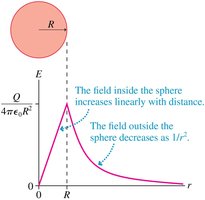
Sphere of Charge: Outside, field is as if all charge were at the center.
Infinite Plane of Charge: , where is surface charge density.
Line of Charge: , where is linear charge density.
Conductors in Electrostatic Equilibrium
Gauss’s law reveals important properties of conductors in electrostatic equilibrium.
Excess Charge: Resides on the surface.
Interior Field: Zero inside the conductor.
External Field: Perpendicular to the surface.
Faraday Cage: Conducting enclosures block external electric fields, providing shielding.

Example Calculations
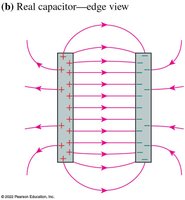
Parallel-Plate Capacitor: Uniform field between plates, flux depends on area and angle.
Field Strength at Surface of Charged Sphere:
Field Inside Uniformly Charged Sphere: Increases linearly with distance from center.
Summary Table: Symmetry and Electric Field Direction
Symmetry | Transformation | Field Direction |
|---|---|---|
Planar | Translation, rotation, reflection | Uniform, perpendicular to surface |
Cylindrical | Translation, rotation, reflection | Radial |
Spherical | Rotation, reflection | Radial |
Key Equations
Electric Flux:
Gauss’s Law:
Field Outside Sphere:
Field of Infinite Plane:
Field of Line Charge:
Important Concepts
Flux is a measure of field lines passing through a surface.
Gauss’s law is powerful for symmetric charge distributions.
Conductors shield their interiors from external fields (Faraday cage effect).
