 Back
BackGauss’s Law and Electric Flux: Structured Study Notes
Study Guide - Smart Notes
 Tailored notes based on your materials, expanded with key definitions, examples, and context.
Chapter 22: Gauss’s Law
Electric Flux and Area Vector
Electric flux is a measure of the number of electric field lines passing through a given surface. The area vector \( \vec{A} \) is defined as having a magnitude equal to the area and a direction perpendicular (normal) to the surface.
Area Vector: \( \vec{A} = A \vec{n} \), where \( \vec{n} \) is the unit vector normal to the surface.
Electric Flux: The flux through a surface is given by the surface integral:
Magnetic Flux: Analogous to electric flux, defined as:
Uniform Field: If the electric field and area are constant,
Example: The flux is maximum when the field is perpendicular to the surface, zero when parallel, and intermediate otherwise.
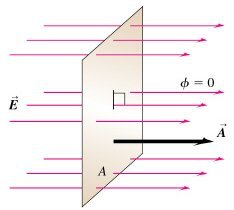
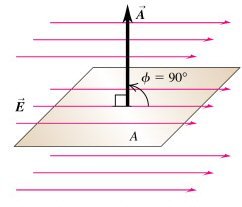
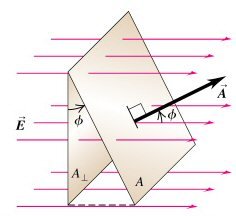
Physical Interpretation of Electric Flux
Electric flux can be visualized as the flow of electric field lines through a surface. The sign and magnitude of the flux depend on the orientation and the amount of charge enclosed.
Net Outward/Inward Flux: The direction of net flux depends on the sign of the enclosed charge.
Closed Surface: The total electric flux through a closed surface is related to the net charge inside.
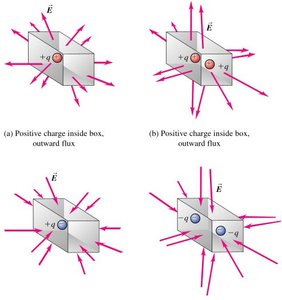
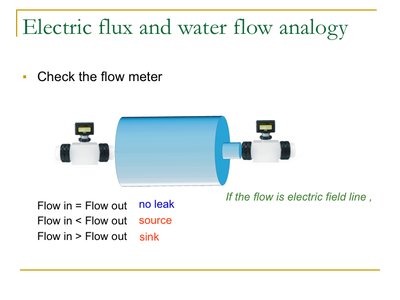
Electric Flux and Water Flow Analogy
Electric flux can be compared to water flow through a pipe. If the flow in equals the flow out, there is no net source or sink. If flow in is less than flow out, there is a source; if flow in is greater, there is a sink.
Analogy: Electric field lines behave like water flow, with sources and sinks corresponding to positive and negative charges.
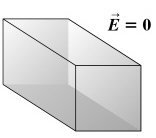
Cases of No Net Electric Flux
There are several scenarios where the net electric flux through a surface is zero.
Case 1: Electric field is zero everywhere inside the surface.
Case 2: The sum of charges inside the surface is zero (equal positive and negative charges).
Case 3: No charge is present inside the surface.
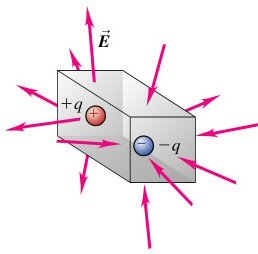
Charges Outside the Surface
Charges located outside a closed surface do not contribute to the net electric flux through that surface. Only charges enclosed by the surface affect the total flux.
Key Point: The net electric flux is independent of external charges.
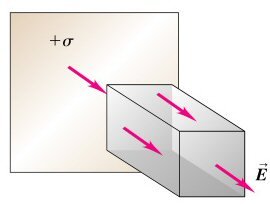
Proportionality of Electric Flux to Enclosed Charge
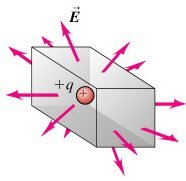
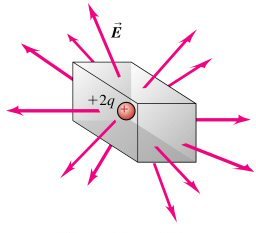
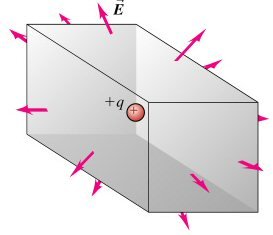
The net electric flux through a closed surface is directly proportional to the net charge enclosed within the surface and is independent of the size of the surface.
Key Point: The total flux depends only on the enclosed charge, not the surface's size or shape.
Summary of Electric Flux Properties
Net flux direction depends on the sign of the enclosed charge.
External charges do not affect net flux through a closed surface.
Net flux is proportional to the enclosed charge and independent of surface size.
Surface Integral and Non-Uniform Fields
If the electric field is not uniform over the area, the total flux is calculated using the surface integral:
For closed surfaces, the outward direction is considered positive.
Gauss’s Law
Gauss’s Law relates the net electric flux through a closed surface to the net charge enclosed by that surface. It is a fundamental law for calculating electric fields, especially in symmetric situations.
Gauss’s Law:
Permittivity of Free Space:
Example: Calculating flux for a point charge at the center of a sphere.
Applications of Gauss’s Law
Gauss’s Law is particularly useful for finding electric fields in systems with high symmetry.
Point Charge: The electric field at distance r from a point charge Q is
Charged Conducting Sphere: The field outside is as if all charge were concentrated at the center; inside, the field is zero.
Uniformly Charged Insulating Sphere: The field inside increases linearly with radius; outside, it decreases with the square of the radius.
Line Charge: For an infinite line of charge, the field at distance r is , where \( \lambda \) is charge per unit length.
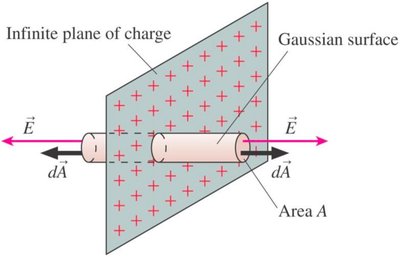
Infinite Plane Sheet: The field near an infinite sheet of charge is , where \( \sigma \) is charge per unit area.
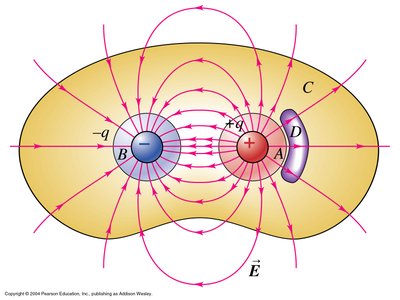
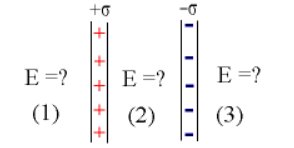
Parallel Conducting Plates: The field between oppositely charged plates is uniform.
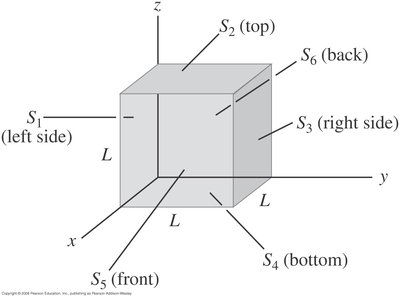
Charges on Conductors and Calculation of Total Charge
If the electric flux is known, the total charge enclosed can be calculated using Gauss’s Law.
Permittivity: Describes a material's ability to permit electric field lines.
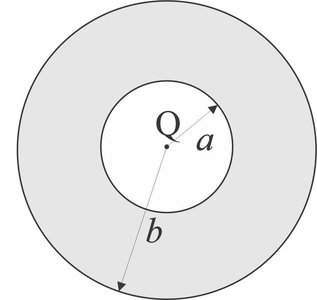
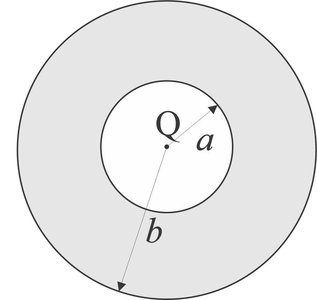
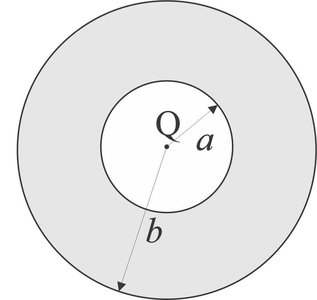
Example: Point Charge at the Center of a Conducting Shell
A point charge Q is placed at the center of a conducting spherical shell with total charge -3Q. The electric field everywhere can be found using Gauss’s Law.
Inside the shell, the field is determined by the central charge.
Outside the shell, the field is determined by the net charge (Q + (-3Q) = -2Q).
Summary Table: Gauss’s Law Applications
System | Electric Field (E) | Key Formula |
|---|---|---|
Point Charge | Radial, decreases with | |
Conducting Sphere | Zero inside, radial outside | (outside) |
Insulating Sphere | Linear inside, radial outside | (inside) |
Line Charge | Cylindrical symmetry | |
Plane Sheet | Uniform field |
Additional info: Table entries for insulating sphere and plane sheet are inferred for completeness.
