 Back
BackGauss’s Law and Electric Flux: Structured Study Notes
Study Guide - Smart Notes
 Tailored notes based on your materials, expanded with key definitions, examples, and context.
Chapter 22: Gauss’s Law
Introduction to Gauss’s Law
Gauss’s Law is a fundamental principle in electromagnetism, providing an alternative method to Coulomb’s Law for calculating electric fields. It is especially useful for highly symmetric charge distributions and is based on the inverse-square law of electric force between point charges. Gauss’s Law is also essential for understanding the behavior of conductors in electrostatic equilibrium.
Key Point: Gauss’s Law relates the electric flux through a closed surface to the net charge enclosed within that surface.
Key Point: The law is most convenient for symmetric geometries such as spheres, cylinders, and planes.
Key Point: It is crucial for verifying properties of conductors and understanding charge distribution.
Electric Flux
Definition and Calculation
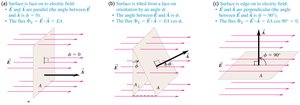
Electric flux quantifies the number of electric field lines passing through a given surface. It is mathematically defined as the surface integral of the electric field over the area, taking into account the angle between the field and the surface normal.
Formula:
Key Point: For a uniform electric field and a flat surface, where is the angle between the field and the surface normal.
Example: If the surface is parallel to the field, and . If perpendicular, .
Flux of Nonuniform Electric Field
For nonuniform fields, the flux is calculated by integrating the dot product of the electric field and the area element over the surface.
Formula:
Charge and Electric Flux
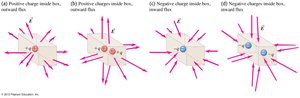
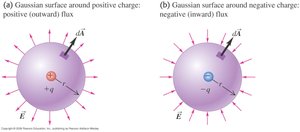
The direction of electric flux depends on the sign of the charge enclosed by the surface. Positive charge produces outward flux, while negative charge produces inward flux.
Key Point: Outward flux corresponds to positive charge; inward flux to negative charge.
Electric Flux Through a Disk
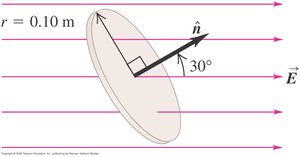
To evaluate the flux through a disk in a uniform electric field, consider the angle between the field and the disk’s normal. The flux is given by .
Example: For N/C, m, and , .
Gauss’s Law: Mathematical Statement
General Form of Gauss’s Law
Gauss’s Law states that the net electric flux through any closed surface is proportional to the net charge enclosed within that surface.
Formula:
Key Point: The flux is independent of the size of the closed surface; it depends only on the enclosed charge.
Positive and Negative Flux
Flux is positive if the enclosed charge is positive, and negative if the charge is negative. This is illustrated by the direction of field lines relative to the surface.
Key Point: The sign of the flux indicates the nature of the enclosed charge.
Applications of Gauss’s Law
Electric Flux Through a Cube
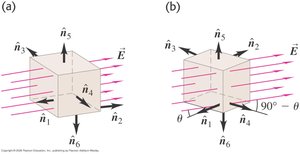
When a cube is placed in a uniform electric field, the flux through each face depends on the orientation of the face relative to the field.
Key Point: For faces perpendicular to the field, flux is maximized; for parallel faces, flux is zero.
Electric Flux Through a Sphere
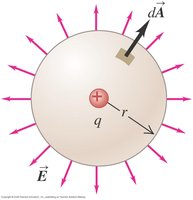
For a point charge at the center of a spherical surface, the electric flux through the sphere is independent of the sphere’s radius and depends only on the charge enclosed.
Formula:
Key Point: The area increases with , while the field decreases with , making the flux constant.
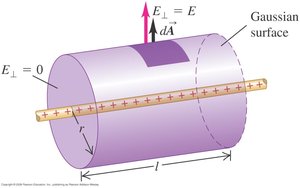
Field of a Line Charge
Gauss’s Law can be used to calculate the electric field produced by a line of charge by choosing a cylindrical Gaussian surface.
Formula: , where is the linear charge density.
Result:
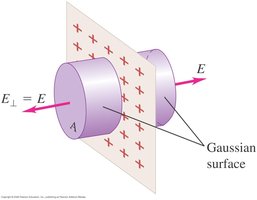
Field of a Sheet of Charge
For an infinite sheet of charge, the electric field is uniform and perpendicular to the surface. Gauss’s Law simplifies the calculation by using a pillbox Gaussian surface.
Formula: , where is the surface charge density.
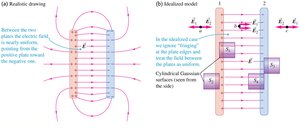
Field Between Two Parallel Conducting Plates
When two parallel plates are oppositely charged, the electric field between them is uniform and can be calculated using Gauss’s Law.
Formula: between the plates.
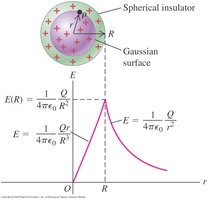
Field Inside and Outside a Uniformly Charged Sphere
For an insulating sphere uniformly filled with charge, the electric field inside and outside can be determined using a spherical Gaussian surface.
Inside (): , where is the charge density.
Outside ():
Properties of Conductors in Electrostatic Equilibrium
Key Properties
When a conductor is in electrostatic equilibrium, several important properties emerge:
Property 1: The electric field is zero everywhere inside the conducting material.
Property 2: Any excess charge resides entirely on the surface.
Property 3: The electric field just outside a charged conductor is perpendicular to the surface.
Property 4: On irregularly shaped conductors, charge accumulates at points with the smallest radius of curvature (sharp points).
Applications and Experimental Verification
Electrostatic Shielding
A conducting box, known as a Faraday cage, shields its interior from external electric fields. This principle is used in many practical applications to protect sensitive equipment.
Key Point: The electric field inside a closed conductor is zero.
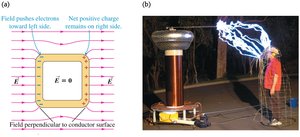
Testing Gauss’s Law Experimentally
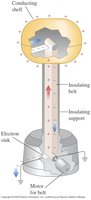
Faraday’s icepail experiment and the Van de Graaff generator are classic demonstrations confirming Gauss’s Law.
Key Point: These experiments show that charge resides on the surface and that the field inside a conductor is zero.
Summary Table: Gauss’s Law Applications
Geometry | Gaussian Surface | Electric Field Expression | Key Formula |
|---|---|---|---|
Point Charge | Sphere | ||
Line Charge | Cylinder | ||
Sheet of Charge | Pillbox | ||
Sphere (Uniform Charge) | Sphere | (outside) |
Conclusion
Gauss’s Law is a powerful tool for analyzing electric fields, especially in symmetric situations. Understanding electric flux, the properties of conductors, and the applications of Gauss’s Law is essential for mastering electrostatics in college-level physics.
