 Back
BackGauss's Law and Electric Flux: Symmetry and Applications
Study Guide - Smart Notes
 Tailored notes based on your materials, expanded with key definitions, examples, and context.
Gauss's Law
Fundamental Statement
Gauss's law is a cornerstone of electromagnetism, expressing a fundamental relationship between electric fields and the charges that produce them. It states that the electric flux through any closed surface is proportional to the total charge enclosed within that surface. This law is more general than Coulomb's law and forms the basis of one of Maxwell's equations.
Mathematical Formulation:
Electric flux () is the total amount of electric field passing through a surface.
Qin is the net charge enclosed by the surface.
\varepsilon_0 is the permittivity of free space.
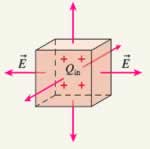
Example: The electric flux through a cube enclosing a charge is proportional to $Q_{in}$, regardless of the cube's orientation or size.
Symmetry in Charge Distributions
Importance of Symmetry
Symmetry simplifies the application of Gauss's law. For charge distributions with high symmetry, the electric field exhibits the same symmetry, making calculations straightforward. The three main types of symmetry are:
Planar symmetry: Found in infinite planes of charge.
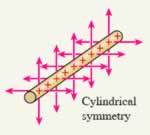
Cylindrical symmetry: Found in infinitely long charged rods or cylinders.
Spherical symmetry: Found in uniformly charged spheres.
Example: For a charged cylinder, the electric field radiates outward with cylindrical symmetry, making it easy to apply Gauss's law.
Electric Flux
Definition and Calculation
Electric flux quantifies the amount of electric field passing through a given surface. It is analogous to the flow of air or water through a loop. Flux can be calculated for both open and closed surfaces.
Formula:
For closed surfaces, the integral is taken over the entire surface.
For open surfaces, only the portion of the field passing through the surface is considered.
Example: Calculating the flux through a spherical surface surrounding a point charge yields the same result as through a cube or cylinder, provided the charge is enclosed.
Applying Gauss's Law
Strategy and Advantages
Gauss's law is particularly useful for finding electric fields in and around objects with high symmetry, such as spheres, cylinders, and planes. The process involves:
Choosing a Gaussian surface that matches the symmetry of the charge distribution.
Calculating the electric flux through this surface.
Relating the flux to the enclosed charge using Gauss's law.
This method is often simpler than using superposition, especially for symmetric charge distributions.
Properties of Conductors in Electrostatic Equilibrium
Key Properties Established by Gauss's Law
Gauss's law reveals several important properties of conductors when they are in electrostatic equilibrium:
Excess charge resides on the surface: Any extra charge is found only on the conductor's surface.
Zero electric field inside: The electric field within the conductor is zero.
External field perpendicular to surface: The electric field just outside the conductor is perpendicular to the surface.
Example: A hollow conducting sphere with excess charge will have all the charge on its outer surface, and the electric field inside the sphere will be zero.
Additional info: Gauss's law is foundational for understanding electric fields in both theoretical and practical contexts, including capacitors, shielding, and field mapping.
