 Back
BackGauss's Law and Electric Potential: Study Notes for Physics College Students
Study Guide - Smart Notes
 Tailored notes based on your materials, expanded with key definitions, examples, and context.
Chapter 22: Gauss's Law
Electric Flux
Electric flux quantifies the amount of electric field passing through a given surface. It is a fundamental concept for understanding how electric fields interact with physical boundaries.
Definition: Electric flux (\( \Phi_E \)) is the surface integral of the electric field over a closed surface.
Formula:
Significance: Flux is positive when field lines exit the surface, negative when they enter, and zero if the net field lines are balanced.
Calculation: For symmetric situations, flux can be calculated easily; otherwise, integration may be required.
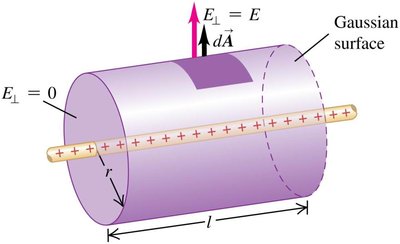
Example: Flux through a cylindrical surface around a line charge.
Gauss's Law
Gauss's law relates the net electric flux through a closed surface to the net charge enclosed by that surface. It is a powerful tool for calculating electric fields in situations with high symmetry.
Statement: The total electric flux through a closed surface equals the net charge inside divided by the electric constant (\( \epsilon_0 \)).
Formula:
When Useful: Gauss's law is most useful for problems with spherical, cylindrical, or planar symmetry.
Application Steps:
Choose a Gaussian surface matching the symmetry of the field.
Calculate the charge enclosed.
Evaluate the flux and solve for the electric field.

Field of a Uniform Line Charge
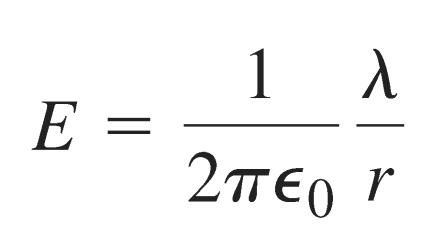
Gauss's law can be used to find the electric field produced by an infinitely long, thin wire with uniform charge per unit length (\( \lambda \)).
Assumptions: The field is uniform and radial along the side of the cylinder, zero at the end caps.
Area of Cylinder:
Electric Field:
Example: Calculating the field at distance \( r \) from the wire.
Field of an Infinite Plane
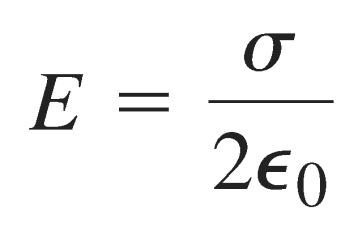
Gauss's law is also applicable to an infinite sheet of charge with uniform surface charge density (\( \sigma \)).
Electric Field:
Direction: The field is perpendicular to the surface.
Example: Calculating the field near a charged sheet.
Physical Interpretation of Gauss's Law
Gauss's law provides insight into the relationship between sources (charges) and the electric field. The divergence theorem connects the surface integral of the field to the volume integral of its sources.
Source/Sink Concept: Positive charges are sources, negative charges are sinks.
Zero Net Flux: If no charge is enclosed, net flux is zero.
Non-Zero Net Flux: If charge is enclosed, net flux is non-zero.

Conductors and Charge Distribution
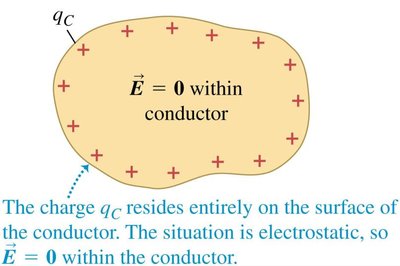
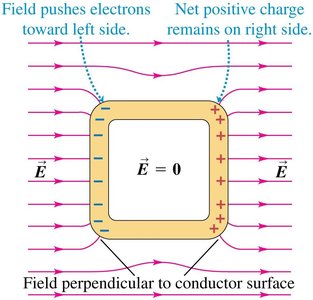
Conductors are materials where charges move freely. In static equilibrium, excess charge resides on the surface, and the electric field inside is zero.
Definition: Conductors are typically metals.
Charge Distribution: All excess charge moves to the surface.
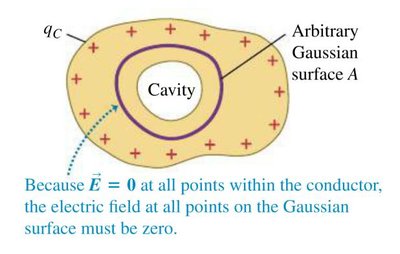
Field Inside: inside a conductor.
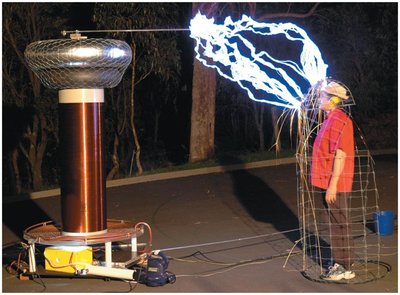
Electrostatic Shielding: Conductors can shield their interiors from external electric fields (Faraday cage effect).
Charges in Conductors with Cavities
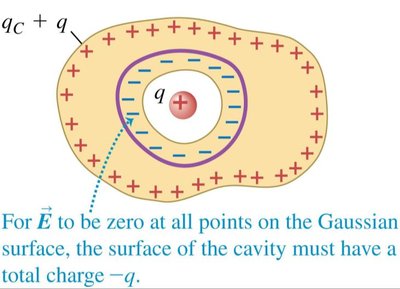
When a charge is placed inside a cavity within a conductor, induced charges appear on the cavity surface to maintain zero field inside the conductor.
Induced Charge: Surface of cavity acquires charge opposite to the internal charge.
Outer Surface: The outer surface acquires a charge equal to the internal charge to keep the conductor neutral.
Insulators and Charge Distribution
In insulators, charge is distributed throughout the volume, often uniformly. Gauss's law can be used to calculate the enclosed charge as density times volume.
Formula:
Application: Useful for calculating fields inside insulating solids.
Chapter 23: Electric Potential
Electric Potential Energy in a Uniform Field
Electric potential energy changes as a charge moves in an electric field. The work done by the field is path-independent for uniform fields.
Work Done:
Potential Energy Change:
Objects move to lower energy states naturally.
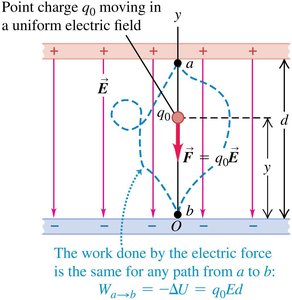
Positive and Negative Charges in Uniform Fields
The direction of movement relative to the field affects the work done and the change in potential energy.
Positive Charge: Moving with the field decreases potential energy; moving against increases it.
Negative Charge: Moving with the field increases potential energy; moving against decreases it.
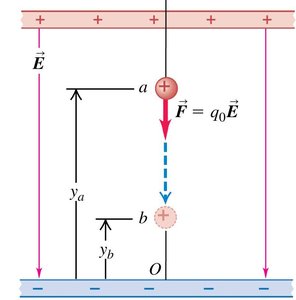
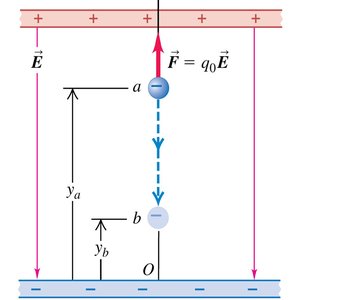
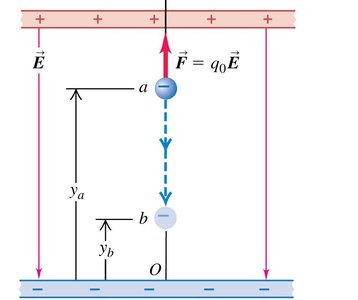
Electric Potential Energy of Point Charges
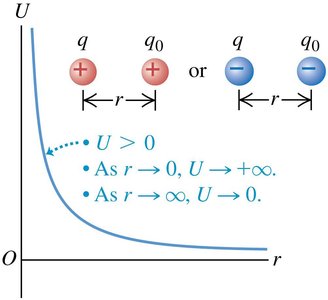
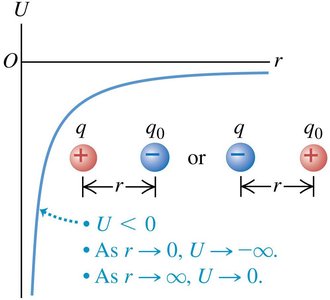
The electric potential energy between two point charges depends only on their separation.
Formula:
Sign: Positive for like charges (repulsive), negative for unlike charges (attractive).
Potential Energy is zero when charges are infinitely far apart.

Electric Potential Energy for Multiple Charges
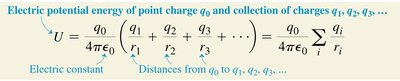
The potential energy of a system of charges is the sum of the potential energies between each pair.
Formula:
Application: Used for collections of point charges.
Electric Potential
Electric potential is the potential energy per unit charge. It is a scalar quantity and characterizes the electric field at every point.
Definition:
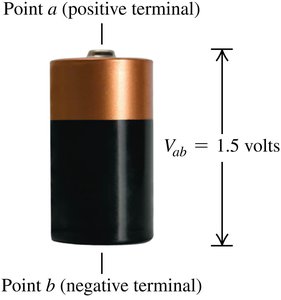
Difference: is the work done by the electric force when a unit charge moves from a to b.
Units: Volts (V), where 1 V = 1 J/C.
Example: The potential difference between battery terminals.
Summary Table: Gauss's Law Applications
Situation | Charge Distribution | Gaussian Surface | Electric Field |
|---|---|---|---|
Infinite Line | Linear (\( \lambda \)) | Cylinder | |
Infinite Plane | Surface (\( \sigma \)) | Box/Cylinder | |
Conductor | Surface | Any | inside |
Insulator | Volume | Sphere | Depends on density |
Additional info: Academic context was added to clarify the application steps for Gauss's law and the physical meaning of electric potential.
