Back
BackGauss’s Law and Its Applications in Electrostatics
Study Guide - Smart Notes
 Tailored notes based on your materials, expanded with key definitions, examples, and context.
Gauss’s Law
Introduction to Gauss’s Law
Gauss’s Law is a fundamental principle in electromagnetism that relates the electric flux passing through a closed surface to the total charge enclosed by that surface. It is especially useful for calculating electric fields in situations with high symmetry, such as spherical, cylindrical, or planar charge distributions.
Symmetry: Gauss’s Law exploits symmetry to simplify electric field calculations, avoiding complex integrals.
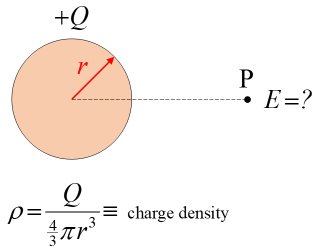
Application Example: Calculating the electric field outside a uniformly charged sphere using Gauss’s Law is much simpler than using direct integration.
Mathematical Definitions
Area Element as a Vector
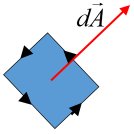
An infinitesimal flat area element, dA, is represented as a vector perpendicular to the surface. The magnitude of this vector is the area, and its direction is determined by the right-hand rule.
Direction: Outward normal for closed surfaces.
Notation: d\vec{A} is used to denote the area vector.
Concept of Flux
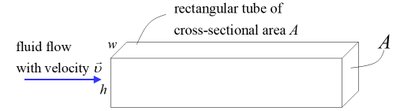
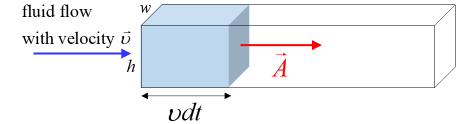
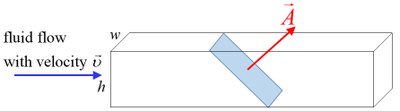
Flux quantifies the amount of a field (such as fluid velocity or electric field) passing through a surface. For a fluid flowing through a tube of cross-sectional area A with velocity \vec{v}, the flux is the volume of fluid passing through per unit time.
Formula for Fluid Flux:
Maximum Flux: Occurs when the velocity is perpendicular to the area.
Electric Flux
Electric flux through a surface is analogous to fluid flux and is defined as the number of electric field lines passing through a surface. For a constant electric field \vec{E} and a flat surface of area A:
Electric Flux Formula:
Interpretation: Proportional to the number of field lines crossing the surface.
Electric Flux of a Point Charge and Gauss’s Law
Electric Flux Through a Spherical Surface
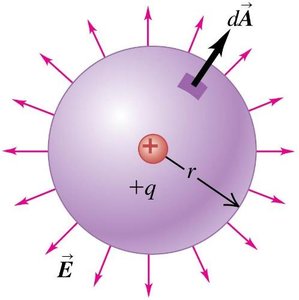
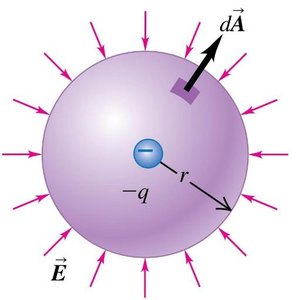
Consider a point charge q at the center of a spherical surface (Gaussian surface) of radius r. The electric field at the surface is:
Electric Field:
Flux Calculation:
General Statement of Gauss’s Law
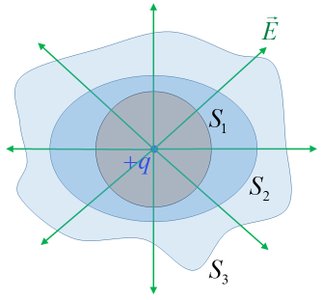
Gauss’s Law states that the net electric flux through any closed surface is equal to the total charge enclosed divided by the permittivity of free space:
Mathematical Form:
Charge Distribution: For continuous charge distributions,
SI Unit for Electric Flux: N·m2/C
Positive and Negative Flux
Sign of Electric Flux
The sign of the electric flux depends on the sign of the enclosed charge:
Positive Charge: Outward (positive) flux.
Negative Charge: Inward (negative) flux.
Applications of Gauss’s Law
Electric Flux Through Various Surfaces
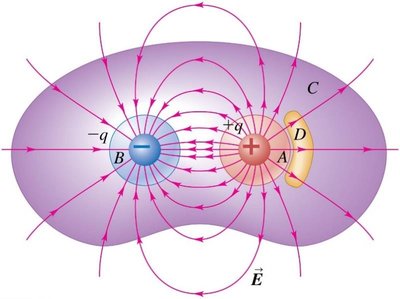
Gauss’s Law can be used to determine the electric flux through closed surfaces without direct integration, especially in symmetric cases. For example, the net flux through a surface enclosing equal positive and negative charges is zero.
Conductors and Insulators
Classification of Materials
Materials are classified based on their ability to conduct electric current:
Insulators: Electrons are tightly bound and cannot move freely (e.g., air, rubber, glass).
Conductors: Electrons are loosely bound and can move freely, allowing current to flow (e.g., silver, copper).
Semiconductors: Conductivity between that of conductors and insulators; small band gap (e.g., silicon).
Properties of Conductors in Electrostatics
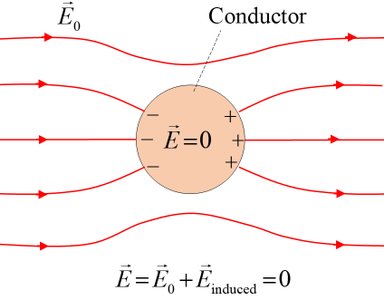
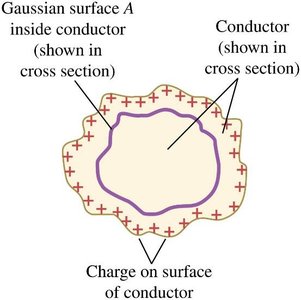
Zero Electric Field Inside: inside a conductor in electrostatic equilibrium.
Excess Charge on Surface: Any excess charge resides on the surface.
Surface as Equipotential: The electric field just outside is perpendicular to the surface; the surface is an equipotential.
Electrostatic Shielding
Shielding Effect of Conductors
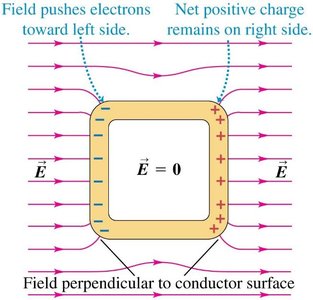
A conducting box placed in a uniform electric field will have zero electric field inside due to the redistribution of charges on its surface. This phenomenon is known as electrostatic shielding.
Induced Charges: The field of induced charges cancels the external field inside the conductor.
Application: Used in Faraday cages to protect sensitive equipment from external electric fields.