 Back
BackGeometric Optics: Mirrors and Lenses
Study Guide - Smart Notes
 Tailored notes based on your materials, expanded with key definitions, examples, and context.
Geometric Optics
Introduction to Geometric Optics
Geometric optics is the study of light propagation in terms of rays. It explains how devices such as mirrors and lenses form images by bending or reflecting light rays. Applications of geometric optics are found in daily life (mirrors, lenses, fiber optics) and in medicine (endoscopes, laser-based surgery).

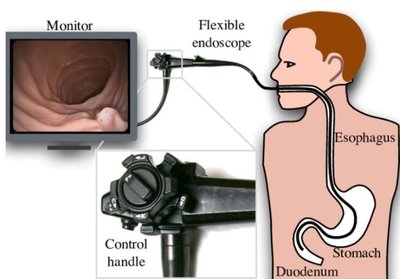
Reflection occurs when light bounces off a surface.
Refraction is the bending of light as it passes from one medium to another.
Mirrors and lenses are the primary tools for manipulating light in geometric optics.
This chapter covers:
Reflection from plane and spherical surfaces
Ray tracing and graphical methods for mirrors
Refraction at spherical surfaces and thin lenses
Graphical methods for lenses
Reflection at a Plane Surface
Image Formation by Plane Mirrors
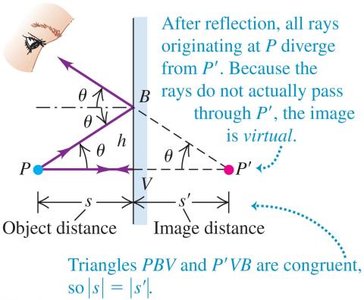
When light rays diverge from an object point and strike a plane mirror, they reflect according to the law of reflection. The reflected rays appear to originate from a point behind the mirror, forming a virtual image.
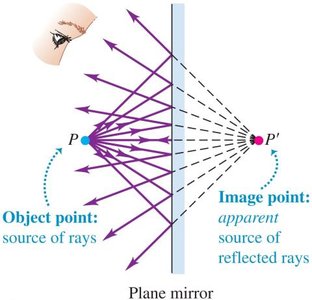
Object distance (s): Distance from the object to the mirror.
Image distance (s'): Distance from the image to the mirror (behind the mirror for a plane mirror).
Law of Reflection: Angle of incidence equals angle of reflection.
Virtual Image: The image appears behind the mirror; rays do not actually pass through this point.
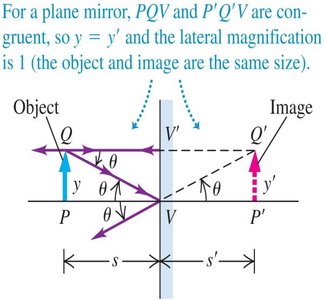
Magnification (m): , where is object height and is image height.
For a plane mirror: , (image is same size and upright).
Key Properties:
Image is always upright and laterally inverted (left-right reversal).
Image distance equals object distance (behind the mirror).
Reflection at a Spherical Surface
Concave and Convex Mirrors
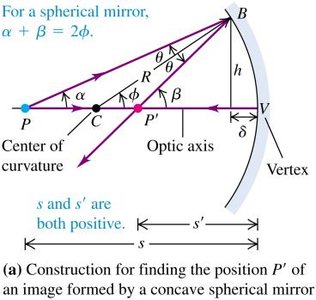
Spherical mirrors are segments of a sphere and can be either concave (reflective surface curves inward) or convex (reflective surface curves outward).
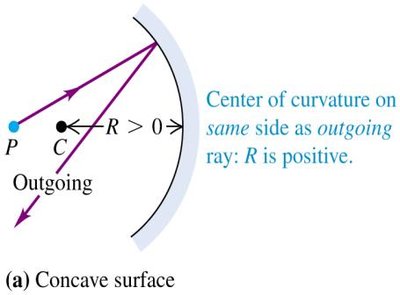
Center of Curvature (C): Center of the sphere of which the mirror is a part.
Vertex (V): Center of the mirror surface.
Optical Axis: Line passing through C and V.
Focal Point (F): Point where parallel rays converge (concave) or appear to diverge from (convex).
Focal Length (f): , where is the radius of curvature.
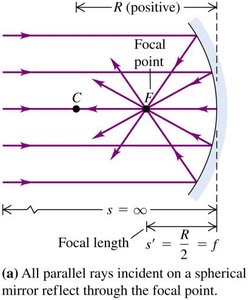
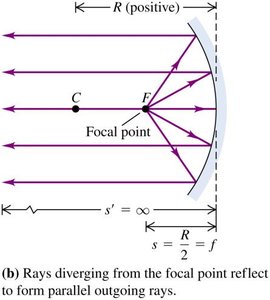
Spherical Mirror Equation:
Sign Conventions:
is positive for concave, negative for convex mirrors.
is positive for real objects, is positive for real images (same side as object).
Magnification:
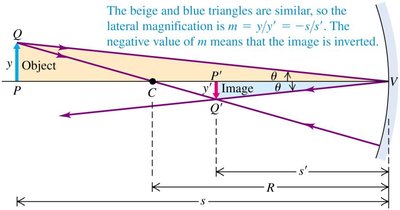
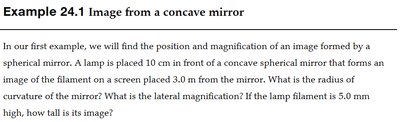
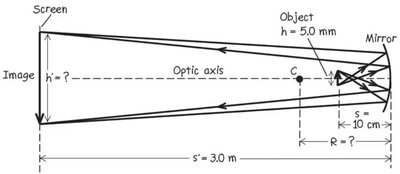
Example: Calculating image position and magnification for a lamp in front of a concave mirror.
Convex Mirrors
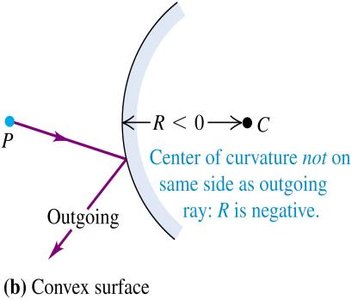
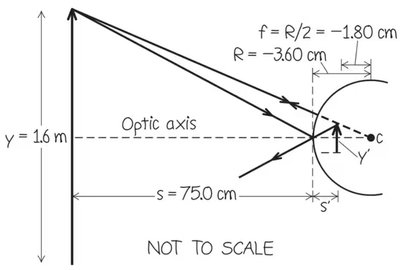
Convex mirrors have their reflective surface bulging outward. The center of curvature is on the opposite side from the outgoing rays, so is negative. Images formed are always virtual, upright, and reduced in size.
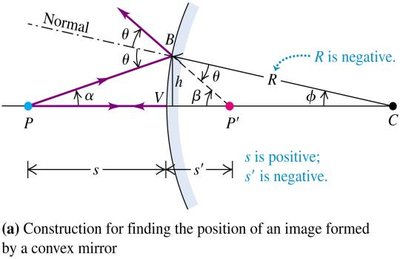
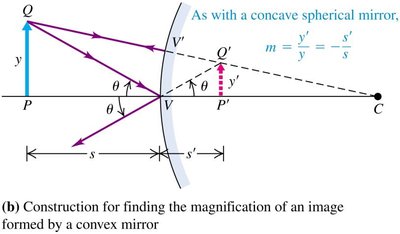
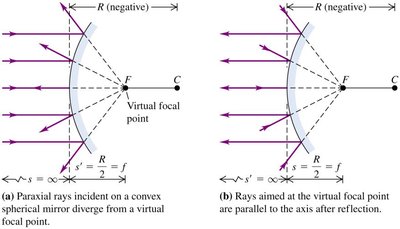
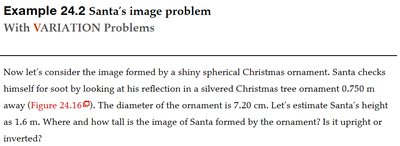
Example: Calculating the image of Santa in a shiny Christmas ornament (convex mirror).

Graphical Methods for Mirrors
Principal Rays and Image Construction
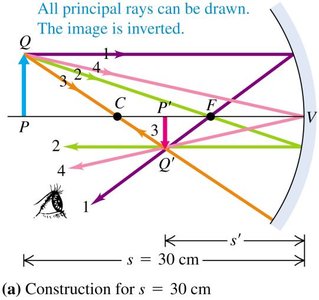
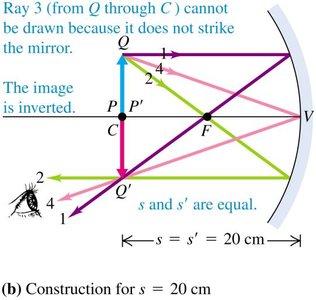
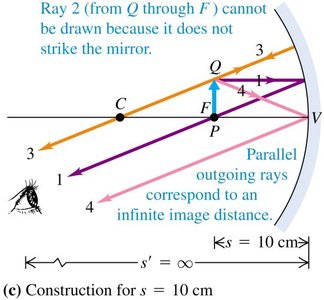
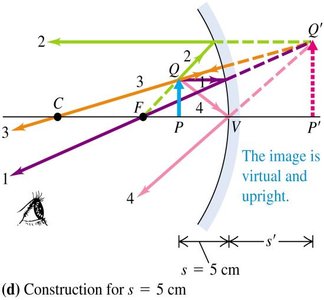
Ray diagrams are used to locate images formed by mirrors. Four principal rays are commonly used, but two are sufficient for image construction:
Ray parallel to axis reflects through focal point.
Ray through focal point reflects parallel to axis.
Ray through center of curvature reflects back on itself.
Ray to vertex reflects symmetrically about the axis.
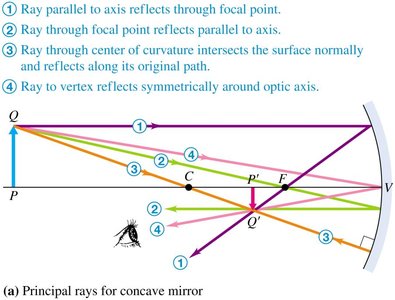
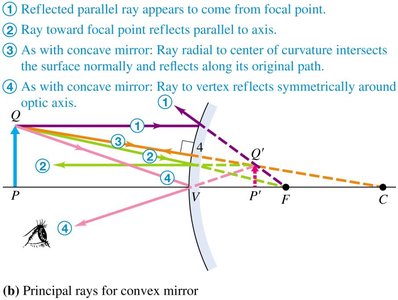
Image Properties:
Concave mirrors can form real or virtual images depending on object position.
Convex mirrors always form virtual images.
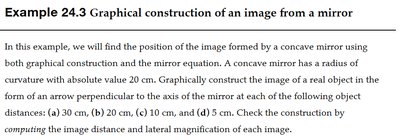
Example: Graphical construction of images for various object distances using a concave mirror.
Thin Lenses
Types of Lenses and Image Formation
A lens is an optical system with two refracting surfaces. Lenses are classified as converging (thicker at the center) or diverging (thicker at the edges).
Converging Lens: Parallel rays converge to a real focal point after passing through the lens. Focal length is positive.
Diverging Lens: Parallel rays diverge as if coming from a virtual focal point. Focal length is negative.
Thin Lens Equation:
= index of refraction of lens material
, = radii of curvature of lens surfaces
Magnification:
Sign Conventions:
is negative if center of curvature is toward incoming ray.
is positive if center of curvature is toward outgoing ray.
Image Properties:
Concave (diverging) lens: Image is always virtual.
Convex (converging) lens: Image can be real or virtual depending on object position.
Graphical Methods: Three principal rays are used for image construction, but two are sufficient.
Applications: Lenses are used in eyeglasses, cameras, microscopes, and contact lenses.
Examples: Problems involving calculation of image position and magnification for various lens types.
Additional info: For a complete understanding, students should practice ray diagrams and apply sign conventions consistently when solving problems involving mirrors and lenses.
