 Back
BackGeometric Optics: Refraction, Total Internal Reflection, and Thin Lenses
Study Guide - Smart Notes
 Tailored notes based on your materials, expanded with key definitions, examples, and context.
Index of Refraction
Definition and Physical Meaning
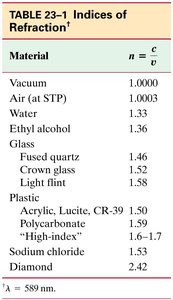
The index of refraction (n) of a medium quantifies how much light slows down when passing through that medium compared to its speed in a vacuum. It is defined as the ratio of the speed of light in vacuum (c) to the speed of light in the medium (v):
Vacuum: n = 1.0000 (light travels fastest)
Other materials: n > 1 (light slows down)
Different materials have different indices of refraction, affecting how much they bend light.
Refraction and Snell's Law
Refraction at a Boundary
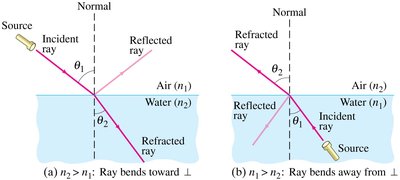
Refraction is the bending of light as it passes from one medium to another with a different index of refraction. The angle of refraction depends on the indices of refraction of the two media and the angle of incidence.
Incident ray: The incoming light ray striking the boundary.
Reflected ray: The ray that bounces off the boundary.
Refracted ray: The ray that passes into the second medium, bending at the interface.
Snell's Law
The relationship between the angles and indices is given by Snell's Law:
Where is the angle of incidence and is the angle of refraction.
If light enters a medium with higher n, it bends toward the normal; if lower n, it bends away.
Everyday Effects of Refraction
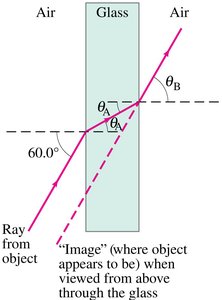
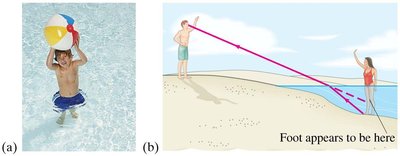
Refraction explains why objects partially submerged in water appear distorted or shifted from their actual position.
Total Internal Reflection and Fiber Optics
Critical Angle and Total Internal Reflection
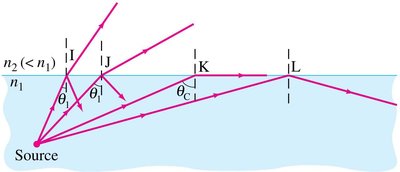
When light travels from a medium with higher n to one with lower n, there is a special angle of incidence called the critical angle (), beyond which all light is reflected back into the original medium. This phenomenon is called total internal reflection.
The critical angle is given by:

Applications: Binoculars and Fiber Optics
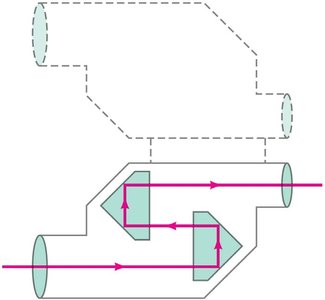
Binoculars: Use total internal reflection for efficient light transmission, achieving nearly 100% reflection.
Fiber optics: Light is guided through flexible fibers by repeated total internal reflection, allowing transmission even around bends.

Thin Lenses and Ray Tracing
Types of Thin Lenses
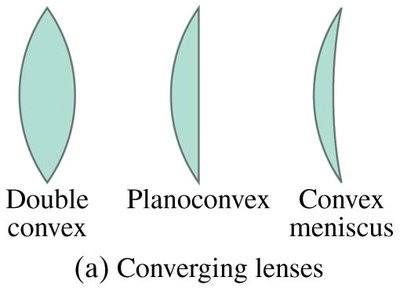
Thin lenses are optical devices whose thickness is small compared to their radius of curvature. They are classified as:
Converging lenses: Thicker at the center, focus parallel rays to a point (focal point).
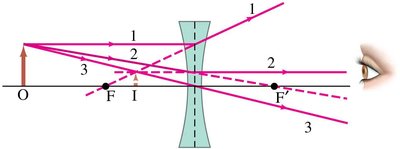
Diverging lenses: Thicker at the edges, cause parallel rays to spread out as if from a focal point.
Ray Diagrams for Lenses
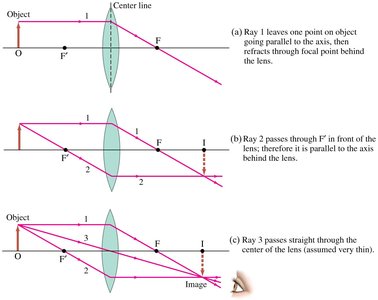
Ray tracing is used to locate the image formed by a lens. For a converging lens:
Ray 1: Parallel to axis, refracts through focal point on far side.
Ray 2: Through focal point on near side, refracts parallel to axis.
Ray 3: Through center of lens, continues straight (undeflected).
For a diverging lens, the same rays are used, but the image is upright and virtual.
Focal Length and Lens Power
The focal length (f) is the distance from the lens to the focal point. The power (P) of a lens is the inverse of its focal length (in meters):
Measured in diopters (D): 1 D = 1 m−1.
The Thin Lens Equation and Magnification
Thin Lens Equation
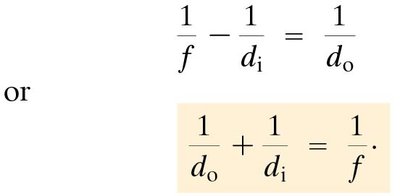
The relationship between object distance (), image distance (), and focal length () is given by the thin lens equation:
Magnification
The magnification (m) of a lens describes how much larger or smaller the image is compared to the object:
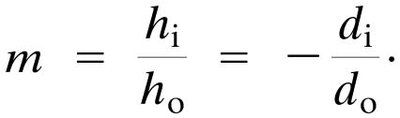
m > 0: Image is upright
m < 0: Image is inverted
Sign Conventions
Focal length is positive for converging lenses, negative for diverging lenses.
Object distance is positive if the object is on the side where light enters the lens.
Image distance is positive if the image is on the opposite side from the object.
Image height is positive if upright, negative if inverted.
Problem Solving Steps for Thin Lenses
Draw a ray diagram to locate the image.
Solve for unknowns using the thin lens equation and magnification formula.
Apply the correct sign conventions.
Check consistency with the ray diagram.
Summary Table: Indices of Refraction for Common Materials
Material | n |
|---|---|
Vacuum | 1.0000 |
Air (at STP) | 1.0003 |
Water | 1.33 |
Ethyl alcohol | 1.36 |
Glass (Fused quartz) | 1.46 |
Glass (Crown glass) | 1.52 |
Glass (Light flint) | 1.58 |
Plastic (Acrylic, Lucite, CR-39) | 1.50 |
Plastic (Polycarbonate) | 1.59 |
Plastic ("High-index") | 1.6–1.7 |
Sodium chloride | 1.53 |
Diamond | 2.42 |
Key Equations
Index of refraction:
Snell's Law:
Critical angle:
Thin lens equation:
Magnification:
Lens power: (in diopters, D)
Additional info: The above notes cover the essential concepts of geometric optics, including refraction, total internal reflection, and thin lenses, as relevant to a college-level physics course. The included images directly illustrate the physical principles, ray diagrams, and applications discussed in the text.
