 Back
BackOptic - Geometric Optics: Spherical Mirrors and Image Formation
Study Guide - Smart Notes
 Tailored notes based on your materials, expanded with key definitions, examples, and context.
Geometric Optics
Spherical Mirrors
Geometric optics studies the behavior of light as it interacts with mirrors and lenses. Spherical mirrors, which are segments of a sphere, are commonly used to form images in optical devices. There are two main types: concave (converging) and convex (diverging) mirrors.
Plane mirrors produce images that are the same size as the object and always erect.
Spherical mirrors can magnify or reduce the size of the image, depending on the object's position relative to the mirror.
Key Terms and Definitions
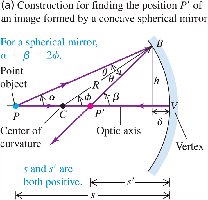
Radius of Curvature (R): The radius of the sphere from which the mirror is cut.
Center of Curvature (C): The center of the sphere; all points on the mirror are equidistant from C.
Vertex (V): The geometric center of the mirror's surface.
Optic Axis: The straight line passing through C and V.
Focal Point (F): The point where parallel rays converge (concave) or appear to diverge from (convex).
Magnification and Image Formation
The magnification (m) of a mirror is given by the ratio of the image height (y') to the object height (y):
Magnification equation:
When , the magnification is unity (image and object are the same size).
The image can be real or virtual, inverted or erect, depending on the object's position.
Mirror Equation
The relationship between the object distance (DO), image distance (DI), and focal length (f) for spherical mirrors is:
Mirror equation:
For spherical mirrors,
Alternative form:
Ray Diagrams for Concave Mirrors
Ray diagrams help visualize how images are formed by concave mirrors. The position, size, and nature of the image depend on the object's location relative to the mirror's focal point (F) and center of curvature (C).
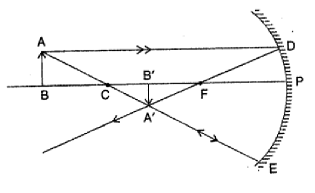
When the object is beyond C: Image is real, inverted, and diminished.
When the object is at C: Image is real, inverted, and same size as the object.
When the object is between C and F: Image is real, inverted, and enlarged.
When the object is at F: Image is formed at infinity.
When the object is between F and V: Image is virtual, erect, and enlarged.
Ray Diagram Example
The following diagram shows the formation of an image by a concave mirror when the object is placed beyond the center of curvature:
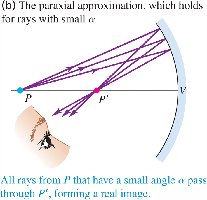
Paraxial Approximation and Real Images
For small angles (paraxial rays), all rays from a point object that strike the mirror close to the optic axis converge to a single point, forming a real image. This principle is fundamental in the design of telescopes and other optical instruments.
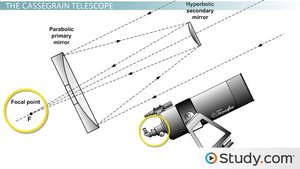
Applications: Reflecting Telescopes
Reflecting telescopes use concave mirrors to collect and focus light. Parabolic mirrors are used to avoid spherical aberration, and hyperbolic mirrors can further correct distortions.
Cassegrain Telescope: Uses a parabolic primary mirror and a hyperbolic secondary mirror to focus light efficiently.
Spherical Aberration
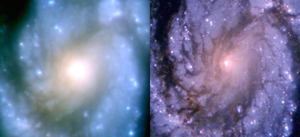
Spherical aberration occurs when rays striking the mirror far from the optic axis do not converge at the same point as paraxial rays, causing a blurred image. This was a problem in the early Hubble Space Telescope images, which was later corrected.
Refraction at a Spherical Surface and Astigmatism
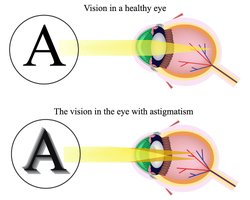
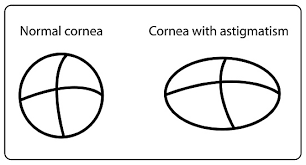
When light passes through a non-spherical (e.g., astigmatic) surface, it can focus at different points, leading to blurred or distorted vision. Astigmatism is corrected using toric lenses, which have different curvatures in different directions.
Summary Table: Image Formation by Concave Mirrors
The following table summarizes the position, size, and nature of images formed by a concave mirror for various object positions:
Object Position | Image Position | Image Size | Nature of Image |
|---|---|---|---|
At infinity | At F | Highly diminished, point-sized | Real and inverted |
Beyond C | Between F and C | Diminished | Real and inverted |
At C | At C | Same size | Real and inverted |
Between C and F | Beyond C | Enlarged | Real and inverted |
At F | At infinity | Highly enlarged | Real and inverted |
Between F and V | Behind the mirror | Enlarged | Virtual and erect |
Additional info:
Parabolic mirrors are preferred in high-precision optical instruments to eliminate spherical aberration.
Astigmatism is a common vision defect corrected by specially shaped lenses.
