 Back
Gravitational Force, Orbits, and Kepler’s Laws
Study Guide - Smart Notes
 Tailored notes based on your materials, expanded with key definitions, examples, and context.
Gravitational Force
Newton’s Law of Universal Gravitation
The gravitational force is a fundamental force of nature that acts between any two masses. It is always attractive and acts along the line joining the centers of the two masses.
Definition: The gravitational force between two point masses m1 and m2 separated by a distance r is given by:
G is the universal gravitational constant:
Direction: The force acts along the line joining the two masses.
Action-Reaction Pair: The force exerted by m1 on m2 is equal in magnitude and opposite in direction to the force exerted by m2 on m1 (Newton’s Third Law).
Example Calculation: Two supertankers, each of mass kg, 20 m apart:
Repeat for two people (70 kg each, 1 m apart):
Superposition Principle
When more than two masses are present, the total gravitational force on any one mass is the vector sum of the forces exerted by all other masses.
Mathematical Statement:
This is known as the principle of superposition.
Gravitational Force and Orbits
Gravitational Force as Centripetal Force
For a planet or satellite in a circular orbit, the gravitational force provides the necessary centripetal force to keep the object in orbit.
Equating Forces:
Orbital Velocity:
Orbital Period (T):
Or, more commonly,
Example: Calculate the period and speed of Earth in its orbit around the Sun (mean radius m, kg, kg).
Weight and Acceleration Due to Gravity
Weight Near a Planet’s Surface
The weight of an object is the gravitational force exerted on it by a planet. For Earth:
me: Mass of Earth ( kg)
re: Radius of Earth ( m)
Since , the acceleration due to gravity is:
g decreases with altitude:
g is a vector: It points toward the center of the Earth.
Distance from Center of Earth | g (m/s2) |
|---|---|
Surface (6.4 × 10⁶ m) | 9.8 |
Top of atmosphere (100 km above surface) | 9.53 |
Space station (400 km above surface) | 8.7 |
Satellite (35,000 km above surface) | 0.225 |
Example: Find the acceleration due to gravity on the surface of Mars ( kg, m):
Combined Gravitational Effects
When near more than one massive body (e.g., Earth and Moon), the total gravitational acceleration is the vector sum of the individual accelerations.
Example: As a spacecraft approaches the Moon, both Earth’s and Moon’s gravity must be considered.
Kepler’s Laws of Planetary Motion
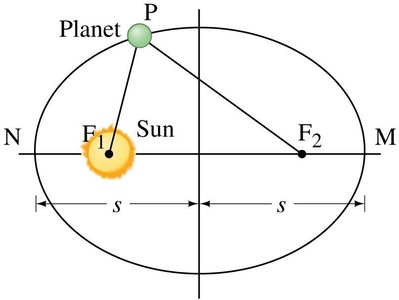
Kepler’s First Law (Law of Ellipses)
Each planet moves in an elliptical orbit with the Sun at one focus.
Ellipse: A closed curve where the sum of the distances from any point on the curve to two fixed points (foci) is constant.
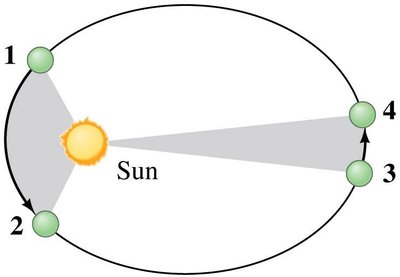
Kepler’s Second Law (Law of Equal Areas)
An imaginary line joining a planet and the Sun sweeps out equal areas during equal intervals of time. This means that a planet moves faster when it is closer to the Sun and slower when it is farther away.
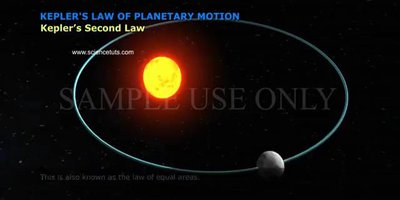
Application: Explains why seasons are not of equal length and why planets speed up and slow down in their orbits.
Summary Table: Gravitational Force and Orbits
Concept | Equation | Description |
|---|---|---|
Newton’s Law of Gravitation | Force between two masses | |
Orbital Velocity | Speed for circular orbit | |
Orbital Period | Time for one revolution | |
Acceleration due to Gravity | At or near a planet’s surface | |
Kepler’s First Law | Elliptical orbits | Sun at one focus |
Kepler’s Second Law | Equal areas in equal times | Variable orbital speed |
Additional info: The notes above expand on the original content by providing definitions, equations, and context for each concept, as well as examples and tables for clarity. Images are included only where they directly reinforce the explanation.
