 Back
BackGravitational Potential Energy and Work in Physics
Study Guide - Smart Notes
 Tailored notes based on your materials, expanded with key definitions, examples, and context.
Work & Energy
Gravitational Potential Energy
Gravitational potential energy is a form of mechanical energy associated with the position of an object in a gravitational field. It is especially important in problems involving vertical motion and energy conservation.
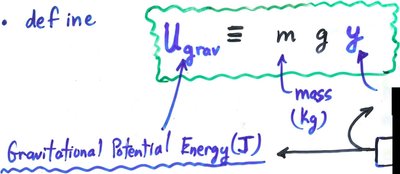
Definition: Gravitational potential energy is the energy stored in an object due to its position above the ground.
Formula: The gravitational potential energy of an object of mass at height in a uniform gravitational field is given by: where:
= mass of the object (kg)
= acceleration due to gravity ( on Earth)
= vertical position or height (m)
Units: Joules (J)
Application: Used to calculate the energy change when an object moves vertically in a gravitational field.
Work Done by Gravity
When an object moves vertically, gravity does work on the object, changing its gravitational potential energy. The work done by gravity depends on the change in height.
Formula: The work done by gravity as an object moves from an initial height to a final height is:
Interpretation: This equation shows that the work done by gravity is equal to the decrease in gravitational potential energy as the object moves downward.
Example: If a ball of mass falls from to , the work done by gravity is:

General Relationship: Work and Potential Energy
The work done by gravity can be expressed in terms of the change in gravitational potential energy. This relationship is fundamental in energy conservation problems.
Formula: where is the initial potential energy and is the final potential energy.
Significance: This equation highlights that the work done by gravity is equal to the loss in gravitational potential energy as the object moves from its initial to final position.
Application: This relationship is used in analyzing mechanical energy conservation and energy transfer in systems involving gravity.

