 Back
BackGravity, Satellites, and Tides: Study Notes for Chapter 9
Study Guide - Smart Notes
 Tailored notes based on your materials, expanded with key definitions, examples, and context.
Gravity
Newton's Law of Universal Gravitation
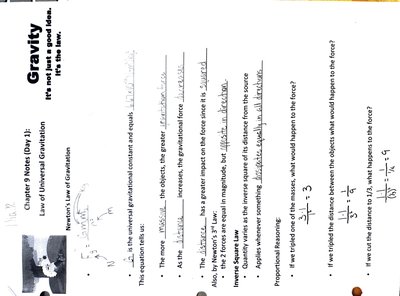
The Law of Universal Gravitation describes the attractive force between any two masses in the universe. This law is fundamental to understanding planetary motion, tides, and the behavior of celestial bodies.
Definition: Newton's Law of Universal Gravitation states that every mass attracts every other mass with a force that is directly proportional to the product of their masses and inversely proportional to the square of the distance between their centers.
Equation: Where:
F = gravitational force
G = universal gravitational constant ()
m_1, m_2 = masses of the two objects
r = distance between the centers of the masses
Inverse Square Law: The force decreases rapidly as the distance increases, since it is proportional to .
Proportional Reasoning:
If one mass is tripled, the force is tripled.
If the distance is cut to 1/3, the force increases by a factor of 9.
If the distance is tripled, the force decreases by a factor of 9.
Newton's Third Law: The gravitational force between two objects is equal in magnitude and opposite in direction for both objects.
Example: Calculate the gravitational force between a 50 kg student and the Earth (mass of Earth kg, radius m):
Key Points:
Gravity is a universal force, but only noticeable when masses are very large.
Gravity is always attractive.
Satellites & Tides
Satellites
A satellite is any object that orbits another object in space, such as the Earth or the Moon. The motion of satellites is governed by gravity and requires a specific speed to maintain orbit.
Definition: An object orbiting the Earth is a satellite.
Orbital Speed: Requires a speed of about 8 km/s to stay in low Earth orbit.
Orbit Shape: Planets and moons orbit in ellipses, not perfect circles.
Tides
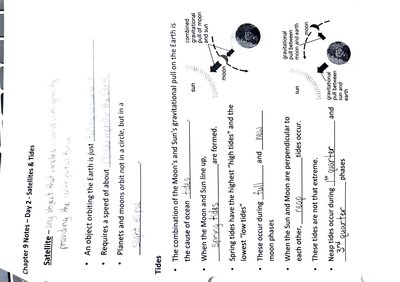
Tides are the periodic rise and fall of ocean levels caused primarily by the gravitational pull of the Moon and the Sun on the Earth. The alignment of these celestial bodies determines the type and magnitude of tides.
Spring Tides: Occur when the Moon and Sun are aligned (new and full moon phases). These tides have the highest high tides and lowest low tides due to the combined gravitational pull.
Neap Tides: Occur when the Moon and Sun are at right angles (quarter moon phases). These tides are less extreme.
Cause: The combination of the Moon's and Sun's gravitational pull on the Earth causes ocean tides.
Example: During spring tides, the gravitational forces of the Moon and Sun reinforce each other, leading to greater tidal ranges. During neap tides, their forces partially cancel, resulting in smaller tidal ranges.
Stars & Gravity
Stellar Equilibrium and Collapse
Stars maintain a balance between inward gravitational force and outward pressure from nuclear fusion for most of their life. When fusion ceases, gravity causes the core to contract.
Stellar Equilibrium: For about 90% of its life, a star is balanced between gravity and pressure.
Collapse: If the core contains more than about 3 solar masses, no known force can stop the collapse, leading to a black hole.
Singularity: A point where mass is concentrated to nearly infinite density and almost zero radius.
Black Hole: The region around the singularity where no light can escape is called the event horizon.
Schwarzschild Radius: The radius of the event horizon, given by: Where is the mass of the object and is the speed of light.
Perturbation: The deviation of an orbiting object's path due to the gravitational force of another object.
Example: The discovery of Neptune was made by analyzing the perturbation of Uranus's orbit.
Key Points:
Black holes form when massive stars collapse beyond the Schwarzschild radius.
The escape velocity of a black hole exceeds the speed of light.
