 Back
BackGuided Study: Energy Conservation and Forces on a Curved Ramp
Study Guide - Smart Notes
 Tailored notes based on your materials, expanded with key definitions, examples, and context.
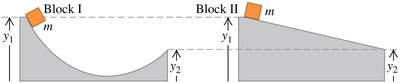
Q1. Throcky skateboards from rest down a curved, frictionless ramp. He moves through a quarter-circle with radius m. Throcky and his skateboard have a total mass of kg. (a) Find his speed at the bottom of the ramp. (b) Find the normal force that acts on him at the bottom of the curve.
Background
Topic: Conservation of Energy and Circular Motion Forces
This question tests your understanding of how mechanical energy is conserved in the absence of friction, and how to analyze forces (specifically the normal force) at the bottom of a curved path using concepts from circular motion.
Key Terms and Formulas
Conservation of Mechanical Energy: In a frictionless system, the sum of kinetic and potential energy remains constant.
Gravitational Potential Energy:
Kinetic Energy:
Normal Force in Circular Motion: At the bottom of a curve,
Radius of Curve:
Step-by-Step Guidance
Start by identifying the initial and final energies. At the top, Throcky is at rest, so his kinetic energy is zero and his potential energy is maximum.
At the bottom of the ramp, all the initial potential energy is converted into kinetic energy (since the ramp is frictionless).
Write the energy conservation equation: where is the vertical drop. For a quarter-circle, .
Rearrange the equation to solve for :
For part (b), use the formula for normal force at the bottom of a curve: , where is the speed you found in part (a).
Try solving on your own before revealing the answer!
Final Answer:
(a) m/s
(b) N
All the gravitational potential energy is converted to kinetic energy at the bottom, and the normal force includes both the weight and the centripetal force required for circular motion.
