 Back
BackGuided Study: Lens Types and Identification
Study Guide - Smart Notes
 Tailored notes based on your materials, expanded with key definitions, examples, and context.
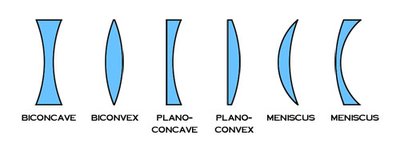
Q1. Circle any of the lenses below that could be the lens described above (diverging lens with focal length -12 mm).
Background
Topic: Types of Lenses in Geometrical Optics
This question tests your ability to identify different types of lenses based on their shapes and properties, specifically focusing on diverging lenses (which have negative focal lengths).
Key Terms and Concepts:
Diverging Lens: A lens that spreads out light rays that are initially parallel. These lenses have a negative focal length.
Converging Lens: A lens that brings parallel light rays together to a point. These lenses have a positive focal length.
Lens Shapes: Common diverging lenses include biconcave and plano-concave. Converging lenses include biconvex and plano-convex.
Step-by-Step Guidance
Recall that a diverging lens is thinner at the center than at the edges. Look for lens shapes that match this description in the diagram.
Identify the biconcave and plano-concave lenses in the image. These are the classic diverging lens shapes.
Ignore the biconvex and plano-convex lenses, as these are converging lenses (thicker at the center).
Consider the meniscus lenses: some meniscus lenses can be diverging if the center is thinner than the edges. Check the curvature to decide if any meniscus lens is diverging.
Try solving on your own before revealing the answer!
