 Back
BackHarmonic Motion and Waves: Fundamental Concepts and Applications
Study Guide - Smart Notes
 Tailored notes based on your materials, expanded with key definitions, examples, and context.
Harmonic Motion and Waves
Introduction to Harmonic Motion
Harmonic motion is a type of periodic motion where an object moves back and forth about an equilibrium position. This concept is foundational in physics, describing systems ranging from mechanical oscillators to electromagnetic waves.
Equilibrium Position: The central point around which oscillations occur.
Periodic Motion: The motion repeats itself at regular intervals, known as the period.
Examples: Mass-spring systems, pendulums, and LC circuits.
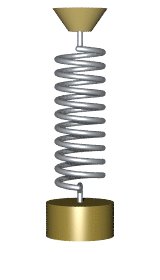
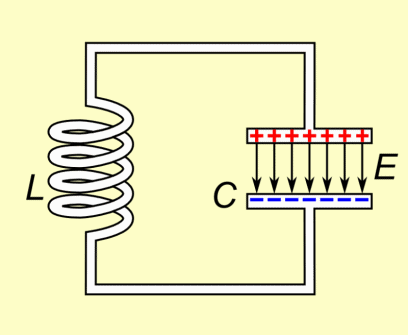
Simple Harmonic Oscillators
Simple harmonic oscillators are systems where the restoring force is directly proportional to the displacement and acts in the direction opposite to that of displacement.
Spring-Mass System: The period of oscillation is given by: where m is the mass and k is the spring constant.
Pendulum: The period is: where L is the length and g is the acceleration due to gravity.
LC Circuit: The period is: where L is inductance and C is capacitance.
Harmonic Motion as Projection of Rotational Motion
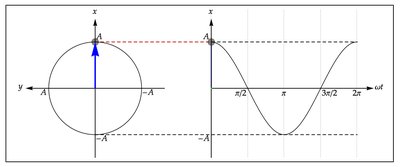
Harmonic motion can be visualized as the projection of uniform circular motion onto one axis. This analogy helps in understanding the sinusoidal nature of oscillations.
Shadow of Turning: The projection of a point moving in a circle at constant speed onto a diameter traces out simple harmonic motion.
Mathematical Representation: The displacement as a function of time can be written as: or where A is amplitude, \omega is angular frequency, and \phi is phase.
Sinusoidal Waves and Mathematical Description
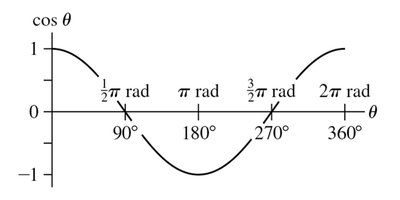
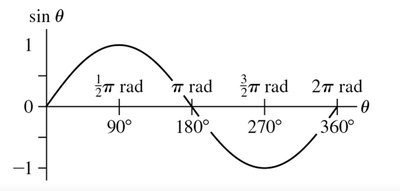
Sinusoidal waves are described by sine and cosine functions, which are periodic and repeat every radians. The cosine and sine functions are related by a phase shift of radians (90°).
Cosine and Sine Relationship:
Periodicity: and for integer n.
Basic Wave Properties
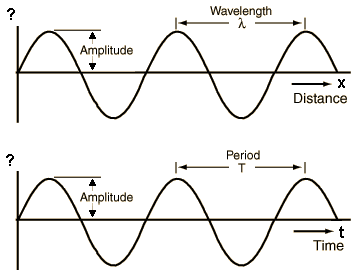
Waves are characterized by several key properties, including amplitude, wavelength, period, and frequency. These properties are fundamental to understanding wave behavior in various physical systems.
Amplitude (A): The maximum displacement from the equilibrium position.
Wavelength (\(\lambda\)): The distance between two identical points in adjacent cycles of a wave.
Period (T): The time taken to complete one cycle.
Frequency (f): The number of cycles passing a point per second (measured in Hz).
Relationship: and
Wave Motion and Distance Traveled
When a block attached to a spring is released from rest at maximum displacement, it travels a total distance of four times the amplitude in one complete cycle (from +A to -A and back).
Total Distance in One Cycle:
Example: If amplitude is 2 cm, total distance traveled in one cycle is 8 cm.
Independence of Period and Wavelength
The period (T) and wavelength (\(\lambda\)) of a wave are independent variables. A wave with a given wavelength can have different periods, and vice versa.
Example: A wave of wavelength 1 m may pass a point in 1 s, 2 s, or 10 s.
Example: A wave of period 1 s may have a wavelength of 1 m, 2 m, or 10 m.
Frequency and Period Calculations
Frequency and period are inversely related. Calculating these quantities is essential for analyzing wave phenomena.
Formulas:
Example Calculations:
10 waves per second: Hz, s
0.5 wave per second: Hz, s
10 crests & troughs in 4 s: Hz, s
Wave Speed
The speed of a wave is determined by the product of its frequency and wavelength. This relationship is fundamental to all types of waves, including sound, light, and water waves.
Formula:
Example Calculations:
Wavelength 1 m, frequency 1 Hz: m/s
Wavelength 2 m, frequency 1 Hz: m/s
Wavelength 1 m, frequency 0.5 Hz: m/s
Wavelength 1 m, frequency 2 Hz: m/s
Wavelength 10 m, frequency 0.5 Hz: m/s
Standing Waves and Reflection
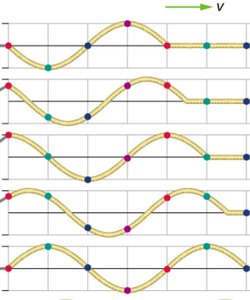
Standing waves are formed by the superposition of two identical waves traveling in opposite directions. Nodes are points of zero amplitude, while antinodes are points of maximum amplitude.
Nodes: Points where the medium does not move.
Antinodes: Points where the amplitude is maximum.
Wave Speed on a String: where T is tension and \rho is linear density.
Summary Table: Key Wave Quantities
Quantity | Symbol | Unit | Formula |
|---|---|---|---|
Amplitude | A | m (meters) | - |
Wavelength | \(\lambda\) | m (meters) | - |
Period | T | s (seconds) | |
Frequency | f | Hz (1/s) | |
Wave Speed | v | m/s |
Additional info: The notes also reference the projection of harmonic motion from rotational motion, the mathematical equivalence of sine and cosine functions, and the independence of period and wavelength. These are foundational concepts for understanding oscillatory and wave phenomena in physics.
