Back
BackHeat and the First Law of Thermodynamics: Study Notes
Study Guide - Smart Notes
 Tailored notes based on your materials, expanded with key definitions, examples, and context.
Heat and the First Law of Thermodynamics
Introduction to Thermodynamics
Thermodynamics is the branch of physics that deals with the study of energy, its transformations, and its relation to matter. It primarily focuses on macroscopic systems and uses state variables to describe the condition of a system at any given time. Most substances can exist in three common phases of matter: solid, liquid, and gas.
Phases of Matter
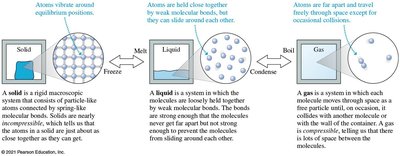
Solid: Particles are closely packed and vibrate around fixed positions. Solids have definite shape and volume.
Liquid: Particles are close but can slide past each other, allowing liquids to flow and take the shape of their container while maintaining a definite volume.
Gas: Particles are far apart and move freely, filling the entire volume of their container.
Temperature and Thermometers
Measuring Temperature
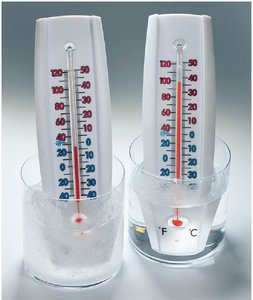
Temperature (T) is a fundamental state variable related to the thermal energy of a system. It can be measured using any physical property that changes with temperature, such as the expansion of a liquid in a thermometer or the pressure of a gas at constant volume.
Constant-Volume Gas Thermometer
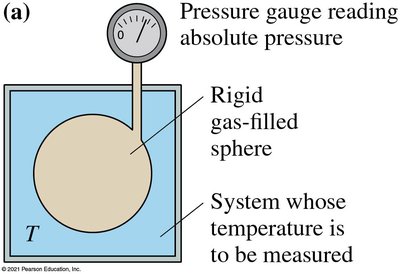
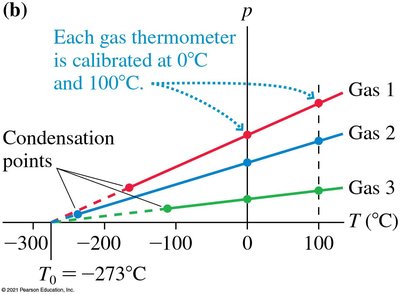
A constant-volume gas thermometer measures temperature by observing the change in pressure of a gas kept at constant volume. The pressure increases linearly with temperature, and extrapolates to zero at absolute zero (−273°C).
Pressure-Temperature Relationship
There is a linear relationship between pressure and temperature for gases at constant volume.
All gases reach zero pressure at the same temperature, known as absolute zero (T0 = −273°C).
Absolute Temperature Scale (Kelvin Scale)
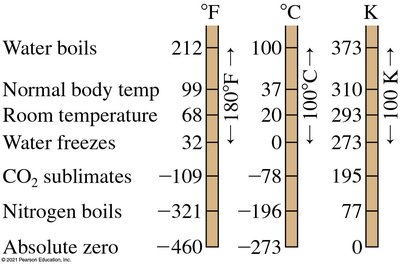
The Kelvin scale is the SI unit for temperature, starting at absolute zero. The conversion between Celsius and Kelvin is:
Heat and Thermal Energy
Definition of Heat
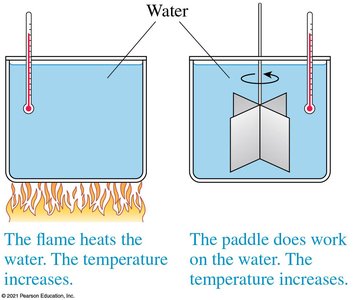
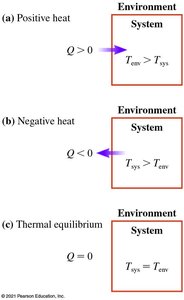
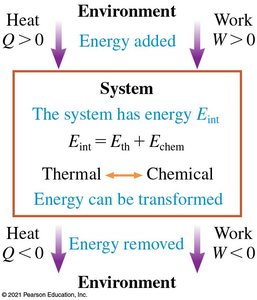
Heat (Q) is energy transferred between a system and its environment due to a temperature difference. It is not a property of the system, but a process of energy transfer. Heat can be added by direct heating or by doing work (e.g., stirring water with a paddle).
Thermal Energy vs. Heat
Thermal energy is the energy of a system due to the motion of its atoms and molecules; it is a state variable.
Heat is the energy transferred due to temperature difference; it is not a state variable.
The First Law of Thermodynamics
Internal Energy and the First Law
The internal energy (Eint) of a system is the sum of its thermal and chemical energy:
The first law of thermodynamics states that the change in internal energy is equal to the sum of heat added to the system and the work done on the system:
Thermal Expansion
Linear Expansion
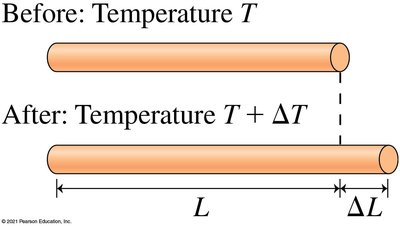
When objects are heated, they expand. The fractional change in length for small temperature changes is given by:
where is the coefficient of linear expansion.
Special Properties of Water
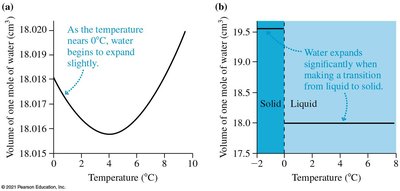
Water expands upon freezing due to its molecular structure. This property has important consequences, such as bursting pipes and floating ice.
Specific Heat and Heat of Transformation
Specific Heat
The specific heat (c) is the amount of energy required to raise the temperature of 1 kg of a substance by 1 K. The heat required for a temperature change is:
Heat of Transformation
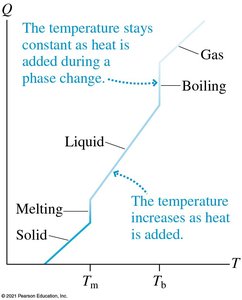
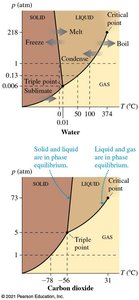
During a phase change, the temperature remains constant while energy is absorbed or released. The heat of transformation (L) is the energy required for a phase change per unit mass:
Heat of fusion (Lf): solid ↔ liquid
Heat of vaporization (Lv): liquid ↔ gas
Phase Diagrams
A phase diagram shows the state of a substance as a function of temperature and pressure. It includes regions for solid, liquid, and gas, and indicates phase transitions such as melting, boiling, and sublimation.
Calorimetry
Principle of Calorimetry
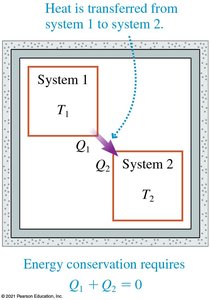
Calorimetry is the measurement of heat transfer based on temperature changes. When two systems interact thermally, the energy lost by one is gained by the other:
Mechanisms of Heat Transfer
Conduction
Conduction is the transfer of heat through a material due to a temperature gradient. The rate of heat transfer is:
where is the thermal conductivity, is the cross-sectional area, is the temperature difference, and is the length.
Convection
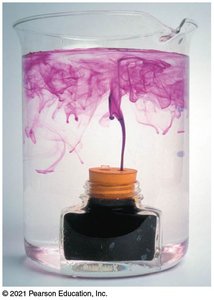
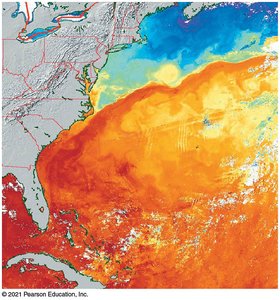
Convection is the transfer of heat by the movement of fluids (liquids or gases). Heated fluid rises while cooler fluid sinks, creating a circulation pattern.
Radiation
Radiation is the transfer of energy by electromagnetic waves. All objects emit thermal radiation, and the rate of emission is given by the Stefan-Boltzmann law:
where is the emissivity, is the Stefan-Boltzmann constant (), is the surface area, and is the temperature in kelvins.
Thermoregulation in Organisms
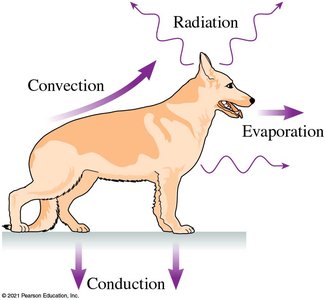
Endothermic animals (mammals and birds) regulate their body temperature using mechanisms such as convection, radiation, and evaporation. Insulation (fur, feathers, fat) helps reduce heat loss.