 Back
BackHeat, Heat Capacity, and Phase Changes
Study Guide - Smart Notes
 Tailored notes based on your materials, expanded with key definitions, examples, and context.
Heat and Energy Transfer
Definition of Heat
Heat (Q) is defined as the non-mechanical transfer of energy between two systems (or between a system and its surroundings) due to a temperature difference. When two bodies at different temperatures are brought into thermal contact, energy flows from the hotter to the colder body until thermal equilibrium is reached.
Heat is not a property of a system; it refers to energy in transit, not energy contained within an object.
Temperature is a property of a system and can be measured for any part of an object.
Heat transfer results in a change in the temperature (and internal energy) of a system.
Key Point: It is incorrect to ask, "How much heat is contained in this object?" Heat only describes energy transfer due to temperature difference.
Heat as Energy in Transit
Heat always refers to the process of energy transfer, not a static quantity. For example, when heat is added to or removed from a system, the system's temperature changes as a result of this energy transfer.
Quantity of Heat and Its Measurement
Experimental Evidence: Joule's Experiments
James Joule conducted experiments in the 19th century to demonstrate the relationship between mechanical work and heat. He showed that the temperature of water could be increased either by doing mechanical work (such as stirring with paddle wheels) or by direct heating from a hotter body. The temperature rise was found to be directly proportional to the amount of work done.
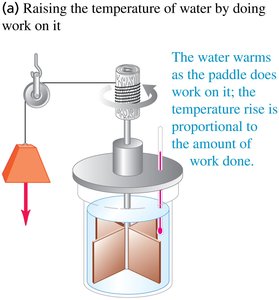
Conclusion: Heat is a form of energy, and its transfer can be measured by the resulting temperature change.
Units of Heat
Calorie (cal): The amount of heat required to raise the temperature of 1 gram of water from 14.5°C to 15.5°C.
British Thermal Unit (BTU): Common in some engineering contexts.
Joule (J): The SI unit of energy. 1 cal = 4.184 J
Heat Capacity
Specific Heat Capacity
The specific heat capacity (c) of a material is the amount of heat required to raise the temperature of 1 kilogram of the material by 1 kelvin (K). It is a material-specific property and is measured in units of J kg-1 K-1.
Formula: The heat required to change the temperature of a mass m by ΔT is given by:
Different materials have different specific heat capacities; for example, water has a high specific heat capacity, making it resistant to temperature changes.
Molar Heat Capacity
Sometimes, it is more convenient to use the number of moles (n) rather than mass. The molar heat capacity (C) is the amount of heat required to raise the temperature of 1 mole of a substance by 1 kelvin. It is measured in J mol-1 K-1.
Formula:
To convert from specific heat to molar heat capacity: where M is the molar mass (kg/mol).
Comparison of Specific Heats and Molar Heat Capacities
The table below compares the specific heat capacities and molar heat capacities of various substances at constant pressure. Water (liquid) has an unusually high specific heat, which is important for climate and biological systems. This property is due to water's molecular structure and hydrogen bonding.
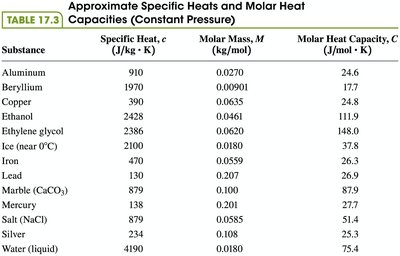
Substance | Specific Heat, c (J/kg·K) | Molar Mass, M (kg/mol) | Molar Heat Capacity, C (J/mol·K) |
|---|---|---|---|
Aluminum | 910 | 0.0270 | 24.6 |
Beryllium | 1970 | 0.00901 | 17.7 |
Copper | 390 | 0.0635 | 24.8 |
Ethanol | 2480 | 0.0461 | 114.0 |
Ethylene glycol | 2386 | 0.0620 | 148.0 |
Ice (near 0°C) | 2100 | 0.0180 | 37.8 |
Iron | 450 | 0.0559 | 25.2 |
Lead | 130 | 0.207 | 26.9 |
Marble (CaCO3) | 880 | 0.100 | 88.0 |
Mercury | 138 | 0.201 | 27.7 |
Salt (NaCl) | 879 | 0.0585 | 51.4 |
Silver | 234 | 0.108 | 25.3 |
Water (liquid) | 4190 | 0.0180 | 75.4 |
Example: To calculate the heat required to raise the temperature of 2 kg of water by 10 K:
Additional info: Water's high specific heat is crucial for moderating Earth's climate and for biological organisms, as it allows water to absorb or release large amounts of heat with little temperature change.
