 Back
Heat, Phase Changes, and Thermal Conductivity: PHYS157 Study Notes
Study Guide - Smart Notes
 Tailored notes based on your materials, expanded with key definitions, examples, and context.
Heat and Phase Changes
Specific Heat and Latent Heat
Heat is a form of energy transfer that can change the temperature or phase of a substance. The amount of heat required depends on whether the substance undergoes a temperature change or a phase change.
Specific Heat (c): The amount of heat required to raise the temperature of 1 kg of a substance by 1 K (or 1°C). Formula:
Latent Heat (L): The amount of heat required to change the phase of 1 kg of a substance without changing its temperature. Formula:
Molar Heat Capacity (C): The heat required to raise the temperature of 1 mole of a substance by 1 K. Formula:
Latent Heat of Fusion (Lf): Used for melting/freezing.
Latent Heat of Vaporization (Lv): Used for boiling/condensing.
Key Point: Temperature does not change during a phase change.
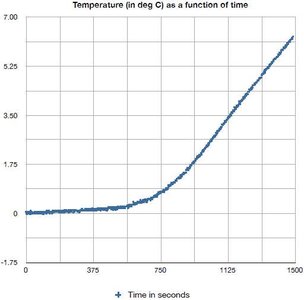
Temperature vs. Time Graphs in Heating Experiments
When heat is supplied to a substance, its temperature changes over time. During phase changes, the temperature remains constant even as heat is added.
Example: Heating ice water at a constant power shows a plateau in the temperature vs. time graph during melting.
Calculation: To estimate the mass of ice melted, use where is the latent heat of fusion.
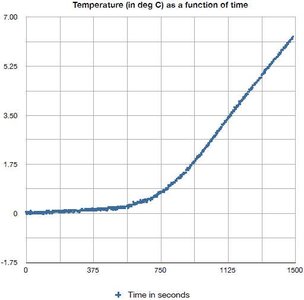
Why is the graph curved? The curve can result from poor mixing, non-uniform temperature, or changing heat capacity as the phase changes.
Heat Added During Phase Changes
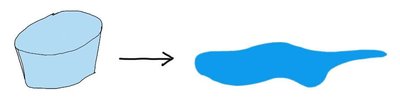
To calculate the total heat added when heating ice from below 0°C to water above 0°C, consider each stage:
Heating ice:
Melting ice:
Heating water:
Total Heat:

Thermal Properties of Materials
Specific Heat and Material Choice
Different materials have different specific heats, affecting how quickly they change temperature when absorbing or losing heat.
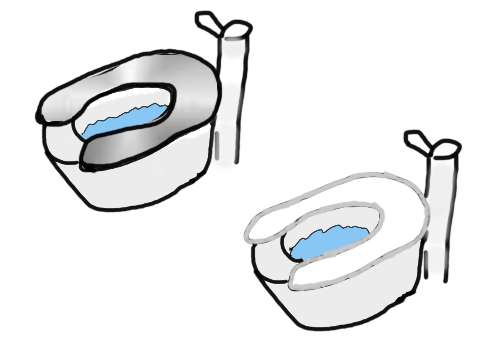
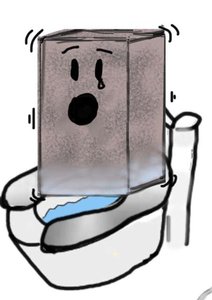
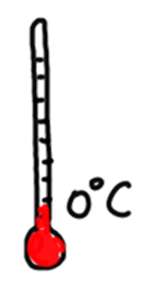
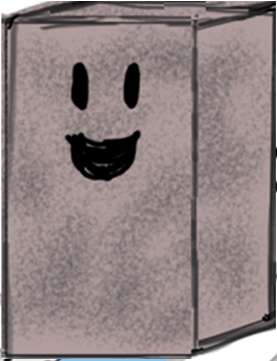
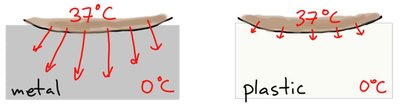
Example: Metal vs. plastic toilet seats at 0°C. Metal (lower c) feels colder because it absorbs heat from your skin faster.
Key Point: The sensation of cold is due to the rate of heat transfer, not just the temperature.
Thermal Conductivity
Heat Transfer Mechanisms
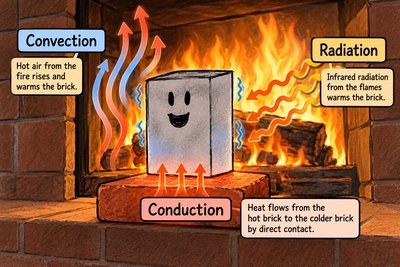
Heat can move through materials by conduction, convection, or radiation. The rate of heat transfer by conduction depends on the material's thermal conductivity.
Conduction: Direct transfer of heat through a material.
Convection: Transfer of heat by movement of fluids.
Radiation: Transfer of heat by electromagnetic waves.
Thermal Conductivity Equation
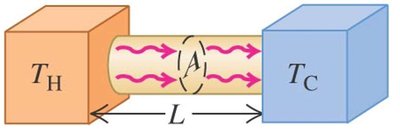
The heat current (rate of heat flow) through a material is given by:
Formula:
Variables:
H: Heat current (J/s)
k: Thermal conductivity (W/m·K)
A: Cross-sectional area (m²)
: Temperature difference (K or °C)
L: Length (m)
Doubling Area: Increases heat current.
Doubling Length: Decreases heat current.
Thermal Conductivity of Common Substances
Materials vary widely in their ability to conduct heat. Metals are good conductors, while materials like wood and styrofoam are insulators.
Substance | Thermal Conductivity (W/m·K) |
|---|---|
Silver | 406 |
Copper | 385 |
Aluminum | 205 |
Wood | 0.12 – 0.04 |
Concrete | 0.8 |
Fiberglass | 0.04 |
Styrofoam | 0.027 |
Equilibrium and Heat Transfer
When objects of different specific heats and thermal conductivities are placed in contact with a heat source, their rates of temperature change and final equilibrium temperatures depend on these properties.
Key Point: Objects with higher thermal conductivity reach equilibrium faster.
Key Point: All objects in thermal contact with a large heat reservoir will eventually reach the same final temperature.
Heat Current in Composite Systems
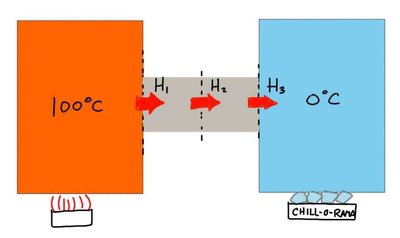
In systems where heat flows through multiple surfaces or materials, the heat current is constant in steady-state conditions if the system is isolated.
Example: Heat flows from a hot object (100°C) to a cold object (0°C) through an intermediate material. The heat current through each interface is equal: .
Summary Table: Key Formulas
Process | Formula |
|---|---|
Heating (no phase change) | |
Phase change | |
Heat current (conduction) |
Additional info:
During phase changes, energy is used to break molecular bonds rather than increase temperature.
Thermal conductivity is a material property and does not depend on mass or temperature directly.
In practical applications, insulators are used to reduce heat loss, while conductors are used to transfer heat efficiently.
