 Back
Heat, Specific Heat, and Thermal Equilibrium: Physics with Calculus Study Notes
Study Guide - Smart Notes
 Tailored notes based on your materials, expanded with key definitions, examples, and context.
Heat and Thermal Energy
Definition of Heat
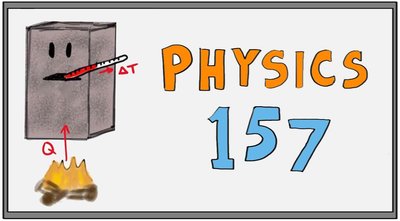
Heat (Q) is the amount of energy transferred between systems or objects due to a difference in temperature. It is measured in Joules (J). Heat transfer results in changes in the internal energy of a material, often manifesting as a change in temperature.
Heat (Q): Energy transferred due to temperature differences.
Temperature (T): A measure of the average kinetic energy of the particles in a substance.
Thermal Equilibrium: When two objects in thermal contact reach the same temperature and no net heat flows between them.
Unit: Joule (J)
Thermal Expansion and Constraints
When materials are heated, they expand. The total change in length (∆Ltot) of a system can be due to both thermal expansion and mechanical stress. In systems with rigid walls or attached objects, constraints must be satisfied by the individual expansions.
Thermal Expansion:
Mechanical Stress:
Total Change:
Constraint Example: For four attached objects, (no separation).
Specific Heat and Heat Capacity
Specific Heat
The specific heat (c) of a material is the amount of energy required to raise the temperature of 1 kg of the material by 1 K. It is a material property and varies between substances.
Formula:
Units:
Interpretation: Higher specific heat means more energy is needed to change temperature.

Molar Heat Capacity
The molar heat capacity (C) is the energy required to raise the temperature of 1 mole of a substance by 1 K. It is useful for comparing substances on a per-mole basis.
Formula:
Units:
Relation: is per mass, is per mole.
Comparison Table: Specific Heat and Molar Heat Capacity
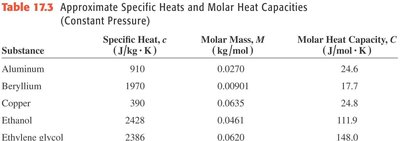
The table below compares the specific heats and molar heat capacities of common substances at constant pressure.
Substance | Specific Heat, c (J/kg·K) | Molar Mass, M (kg/mol) | Molar Heat Capacity, C (J/mol·K) |
|---|---|---|---|
Aluminum | 910 | 0.0270 | 24.6 |
Beryllium | 1970 | 0.00901 | 17.7 |
Copper | 390 | 0.0635 | 24.8 |
Ethanol | 2428 | 0.0461 | 111.9 |
Ethylene glycol | 2386 | 0.0620 | 148.0 |
Heat Transfer and Thermal Equilibrium
Heat Transfer Between Two Objects
When two objects of equal mass but different initial temperatures are placed in thermal contact and insulated from the environment, heat flows from the hotter to the colder object until equilibrium is reached. The final temperature depends on their specific heats.
Equilibrium Temperature: Not always the average; depends on specific heats.
Example: Two 1-kg objects, T1=100ºC, T2=0ºC, c1=300 J/kg·K, c2=900 J/kg·K.
Calculation: Solve for .

Graphical Representation of Heat Transfer
Temperature vs. energy transfer graphs show how temperature changes as heat is added. The slope is inversely proportional to the specific heat: higher specific heat yields a smaller slope.
Formula:
Interpretation: Steeper slope means lower specific heat.

Microscopic Interpretation of Heat Capacity
Why Heat Capacity Varies
The heat capacity of a material depends on its molecular structure. For simple materials, most energy goes into increasing kinetic energy. For more complex materials, energy is also absorbed by rotational and vibrational modes, requiring more heat to achieve the same temperature change.
Temperature: Proportional to average kinetic energy of molecules.
Complex Materials: Energy is distributed among translational, rotational, and vibrational modes.
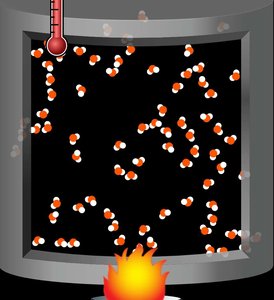
Simulation: States of Matter and Heat Transfer
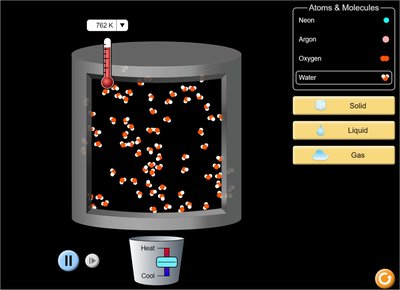
PhET Simulation
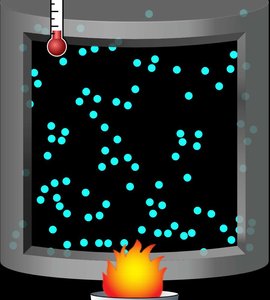
Simulations can help visualize how heat affects the state of matter and the motion of molecules. As heat is added, molecules move faster and may change state (solid, liquid, gas).
Application: Understanding heat transfer and phase changes.
Example: Water molecules in a container heated to different temperatures.
Summary
Heat is energy transferred due to temperature differences.
Specific heat and molar heat capacity quantify how much energy is needed to change temperature.
Thermal equilibrium is reached when two objects in contact have the same temperature.
Microscopic structure affects heat capacity.
Simulations and graphs help visualize heat transfer and temperature changes.
