 Back
Heat, Specific Heat, and Thermal Equilibrium: Physics with Calculus Study Notes
Study Guide - Smart Notes
 Tailored notes based on your materials, expanded with key definitions, examples, and context.
Heat and Thermal Energy
Definition and Concept of Heat
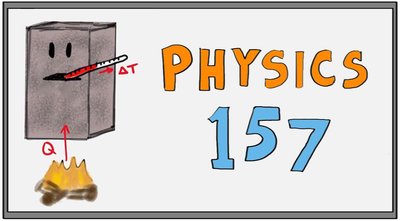
Heat (Q) is the amount of energy transferred between systems or objects due to a difference in temperature. It is measured in Joules (J) and is a fundamental concept in thermodynamics and thermal physics.
Heat transfer occurs when two objects at different temperatures are brought into contact.
Thermal equilibrium is reached when both objects attain the same temperature.
Heat is not a substance, but a process of energy transfer.
Thermal Expansion and Constraints
When materials are heated, they expand. The total change in length (∆Ltot) of a system can be due to both thermal expansion and mechanical stress.
Thermal expansion: where is the coefficient of linear expansion, is the original length, and is the change in temperature.
Mechanical stress: where is force, is area, and is Young's modulus.
For a system of connected objects, the sum of individual expansions must satisfy the constraint: (if rigid walls prevent separation).
Specific Heat and Heat Capacity
Specific Heat
The specific heat (c) of a material is the amount of heat required to raise the temperature of 1 kg of the material by 1 K.
Units: J/(kg·K)
Formula: where is heat added, is mass, is specific heat, and is temperature change.
Materials with higher specific heat require more energy to change their temperature.


Molar Heat Capacity
The molar heat capacity (C) is the amount of heat required to raise the temperature of 1 mole of a substance by 1 K.
Units: J/(mol·K)
Formula: where is the number of moles, is molar heat capacity.
Relationship: is for mass, is for moles.

Table: Specific Heats and Molar Heat Capacities
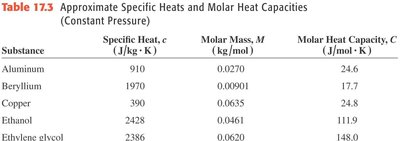
The table below compares specific heat and molar heat capacity for various substances at constant pressure.
Substance | Specific Heat, c (J/kg·K) | Molar Mass, M (kg/mol) | Molar Heat Capacity, C (J/mol·K) |
|---|---|---|---|
Aluminum | 910 | 0.0270 | 24.6 |
Beryllium | 1970 | 0.00901 | 17.7 |
Copper | 390 | 0.0635 | 24.8 |
Ethanol | 2428 | 0.0461 | 111.9 |
Ethylene glycol | 2386 | 0.0620 | 148.0 |
Heat Transfer and Thermal Equilibrium
Thermal Equilibrium Between Two Objects
When two objects of equal mass but different initial temperatures are placed in thermal contact and insulated from the environment, heat flows from the hotter to the cooler object until equilibrium is reached.
The final equilibrium temperature depends on the masses and specific heats of the objects.
If both objects have the same mass and specific heat, the final temperature is the average of the initial temperatures.
If specific heats differ, the final temperature is weighted by the heat capacities.

Calculation Example: Final Equilibrium Temperature
Given two 1-kg objects, one at 100ºC (c1 = 300 J/kg·K) and one at 0ºC (c2 = 900 J/kg·K), the final equilibrium temperature can be found by setting the heat lost by the hot object equal to the heat gained by the cold object:
Let be the final temperature.
Heat lost:
Heat gained:
At equilibrium:
Set up the equation:
Solve for :
Equation:

Factors Affecting Heat Capacity
Microscopic Explanation
The heat capacity of a material depends on its molecular structure and the types of energy storage available. For simple materials, most energy goes into translational motion. For more complex materials, energy is also stored in rotational and vibrational modes, increasing the heat capacity.
Temperature is proportional to the average kinetic energy of molecules.
More degrees of freedom (rotations, vibrations) mean more energy is needed to raise temperature.
Summary Table: Key Formulas
Concept | Formula | Units |
|---|---|---|
Specific Heat | J/(kg·K) | |
Molar Heat Capacity | J/(mol·K) | |
Thermal Expansion | m | |
Mechanical Stress | m |
Applications and Simulations
PhET Simulation: States of Matter
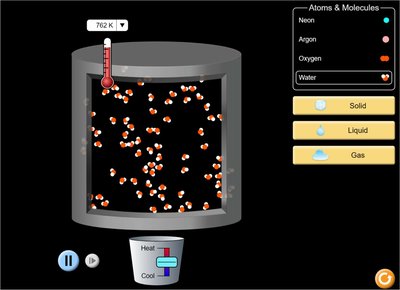
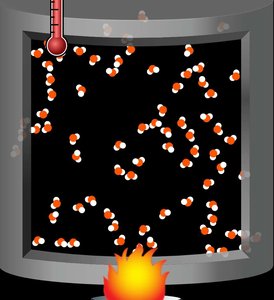
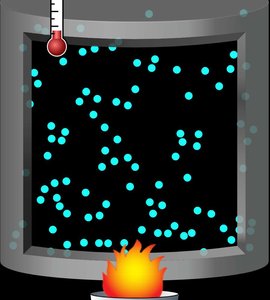
Interactive simulations, such as the PhET States of Matter, help visualize how heat affects molecular motion and phase changes.
Heating increases molecular kinetic energy.
Phase changes (solid, liquid, gas) occur as energy is added.
Conclusion
Understanding heat, specific heat, and heat capacity is essential for analyzing energy transfer and temperature changes in physical systems. These concepts are foundational for further study in thermodynamics and thermal properties of matter.
