Back
BackImpulse, Momentum, and Collisions: A Comprehensive Study Guide
Study Guide - Smart Notes
 Tailored notes based on your materials, expanded with key definitions, examples, and context.
Impulse and Momentum
Introduction to Collisions
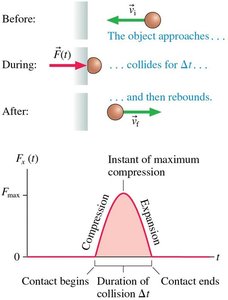
Collisions are short-duration interactions between two objects, often resulting in significant changes in velocity over a brief time interval. These interactions are central to understanding impulse and momentum in physics.
Impulsive Force: A large but short-lived force exerted during a collision.
Deformation: Objects may deform during collision, indicating they are not ideal particles but elastic bodies.
Example: A tennis racket striking a ball demonstrates an impulsive force and deformation of the ball.

Force During a Collision
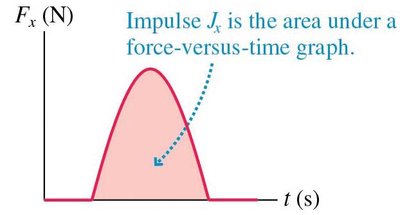
During a collision, the force exerted is not constant but varies with time. The maximum force occurs at the instant of maximum compression. The force-time graph helps visualize the interaction, showing the duration and magnitude of the force.
Newton's Second Law and Momentum
Newton's Second Law relates force, mass, and acceleration. For collisions, it is useful to express the law in terms of momentum:
Momentum (\(\vec{p}\)): Defined as the product of an object's mass and velocity.
Momentum is a vector quantity (direction matters).
Unit: kg·m/s
Impulse
Impulse quantifies the effect of a force acting over a time interval:
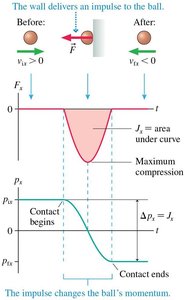
Impulse (\(J_x\)): The integral of force over the time interval of the collision.
Unit: N·s (equivalent to kg·m/s)
Impulse is equal to the area under the force-time curve.
Alternate Form of Newton's Second Law
Newton's Second Law can be written in terms of momentum:
This form is more general and applies even when mass changes (e.g., rockets expelling fuel).
Impulse-Momentum Theorem
The impulse delivered to an object equals the change in its momentum:
A force in the x-direction changes only the x-component of momentum.
Average Force and Impulse
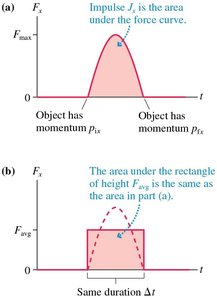
When the force during a collision is complicated, we use the average force to simplify calculations:
The area under the force-time curve (impulse) is equal to the area of a rectangle with height \(F_{avg}\) and width \(\Delta t\).
Comparison: Energy Principle vs. Momentum Principle
Both energy and momentum principles are used to analyze the effects of forces:
Energy Principle:
Momentum Principle:
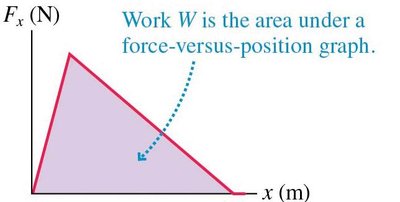
Conservation of Momentum
Momentum Conservation in Collisions
When two objects collide and no external forces act on them, the total momentum of the system is conserved. This is a direct consequence of Newton's Third Law (action-reaction pairs).
Total Momentum:
Conservation Law:
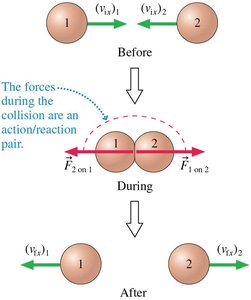
Momentum of a System of Particles
For a system of N interacting particles, the total momentum is the vector sum of individual momenta:
Only external forces can change the total momentum of the system.
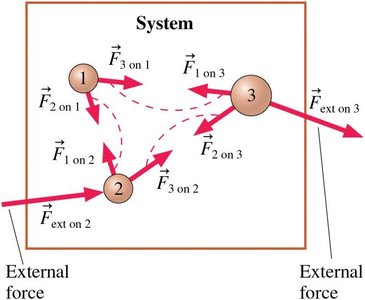
Law of Conservation of Momentum
If the net external force on a system is zero (isolated system), the total momentum remains constant:
Internal interactions can change individual momenta, but not the total.
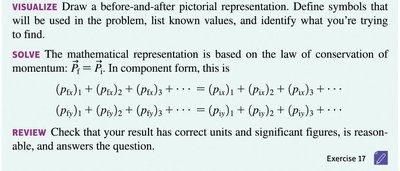
Problem-Solving Strategy: Conservation of Momentum
To solve momentum conservation problems:
Clearly define the system.
Draw before-and-after diagrams.
Apply the conservation law to each component.
Check units and reasonableness of the result.
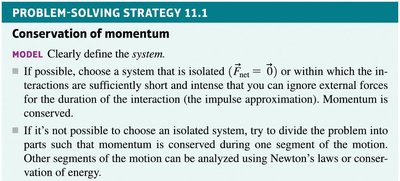
Choosing a System
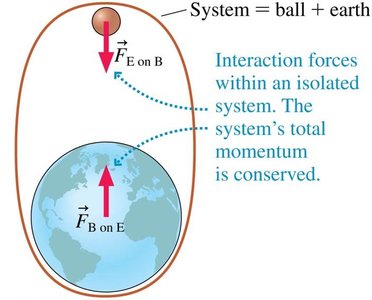
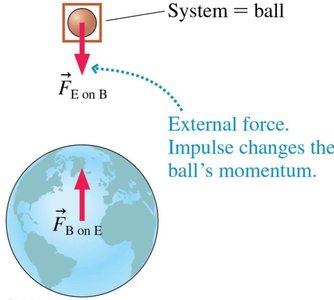
The choice of system affects whether momentum is conserved. For example, if only the ball is considered, gravity is an external force and momentum is not conserved. If the ball and Earth are both included, gravity is internal and momentum is conserved.
Types of Collisions
Perfectly Inelastic Collisions
In a perfectly inelastic collision, two objects stick together after colliding and move with the same final velocity. Momentum is conserved, but mechanical energy is not (some is transformed into thermal energy).
Equation:
Example: A dart embedding in a dartboard.
Perfectly Elastic Collisions
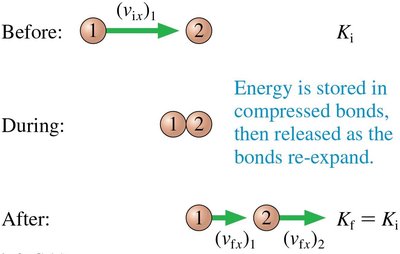
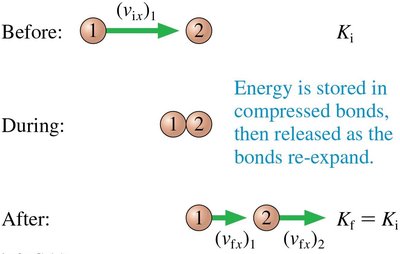
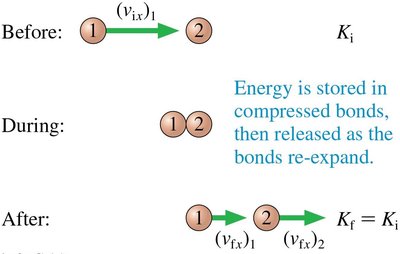
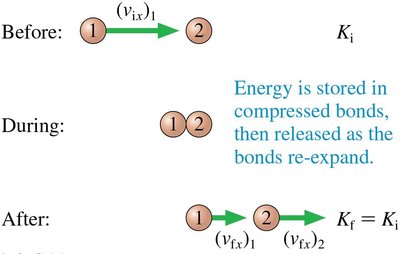
In a perfectly elastic collision, objects bounce apart with no loss of kinetic energy. Both momentum and kinetic energy are conserved.
Equations:
Special case (object 2 initially at rest):
Special Cases of Elastic Collisions
Case A: , (momentum is transferred from ball 1 to ball 2)
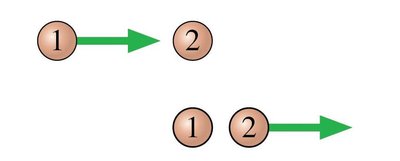
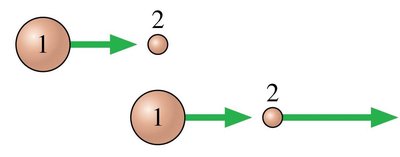
Case B: , (ball 1 continues, ball 2 moves faster)
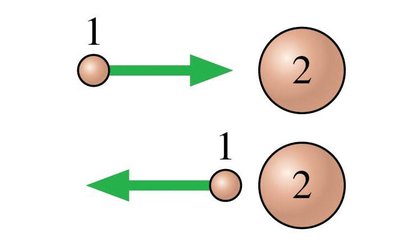
Case C: , (ball 1 rebounds, ball 2 remains at rest)
Explosions
An explosion is a brief, intense interaction where objects move apart. If no external forces act, momentum is conserved. Examples include radioactive decay and rocket propulsion.
Momentum in Two Dimensions
Momentum is a vector, so conservation must be applied to each component independently:
Each component must be conserved separately.
Summary Table: Types of Collisions
Type of Collision | Momentum Conserved? | Kinetic Energy Conserved? | Example |
|---|---|---|---|
Perfectly Inelastic | Yes | No | Dart embedding in dartboard |
Perfectly Elastic | Yes | Yes | Billiard balls colliding |
Appendix: Derivation of Final Velocities in Elastic Collisions
By solving the conservation equations for momentum and kinetic energy, the final velocities for a perfectly elastic collision (object 2 initially at rest) are: