 Back
BackImpulse, Momentum, and Collisions: Principles and Applications
Study Guide - Smart Notes
 Tailored notes based on your materials, expanded with key definitions, examples, and context.
Impulse and Momentum
Introduction to Collisions
Collisions are short-duration interactions between two objects, often resulting in significant changes in velocity over a brief time interval. These interactions are central to understanding impulse and momentum in physics.
Impulsive Force: A large but short-lived force exerted during a collision, such as when a tennis racket strikes a ball.
Deformation: Colliding objects often deform, absorbing and releasing energy during the interaction.
Time Interval: Collisions are not instantaneous; they occur over a finite, though brief, time interval.
Example: A tennis ball compresses against a racket before rebounding.

Impulse and Force-Time Graphs
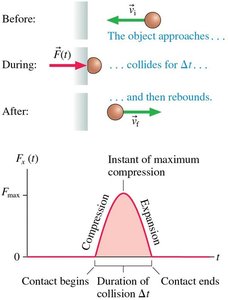
During a collision, the force exerted is typically not constant but varies with time. The area under the force-time curve represents the impulse delivered to the object.
Impulse (J): The product of force and the time interval over which it acts, or the area under the force-time graph.
Mathematical Definition:
Units: Newton-seconds (N·s), equivalent to kg·m/s.
Example: The force curve during a ball's collision with a wall shows a peak at maximum compression.
Momentum
Momentum is a vector quantity defined as the product of an object's mass and velocity. It is a fundamental concept for analyzing motion, especially in collisions.
Definition:
Direction: Momentum points in the direction of velocity.
Units: kg·m/s
Component Form: Momentum can be broken into x and y components for problem solving.
Newton's Second Law and Momentum
Newton's Second Law can be expressed in terms of momentum, providing a more general form applicable to systems with changing mass.
General Form:
Interpretation: Force is the rate of change of momentum with respect to time.
Application: Useful for analyzing systems like rockets, where mass changes over time.
Impulse-Momentum Theorem
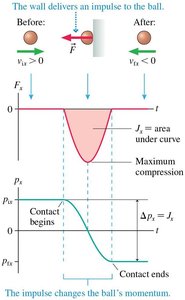
The impulse delivered to an object equals the change in its momentum. This principle is central to understanding how forces affect motion during collisions.
Mathematical Statement:
Component Specific: A force in the x-direction changes only the x-component of momentum.
Example: A ball rebounding from a wall experiences a negative impulse, reversing its momentum.
Average Force and Impulse
When the force during a collision is complicated, the average force over the collision duration can be used to calculate impulse.
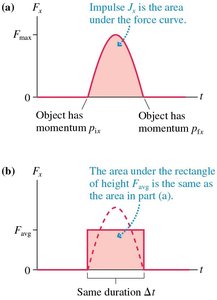
Average Force: is the constant force that would deliver the same impulse over the same time interval.
Impulse Calculation:
Graphical Representation: The area under the actual force curve equals the area of a rectangle with height and width .
Conservation of Momentum
Principle of Conservation of Momentum
In an isolated system (no net external force), the total momentum remains constant before and after an interaction, such as a collision.
Mathematical Statement:
Isolated System: A system with zero net external force ().
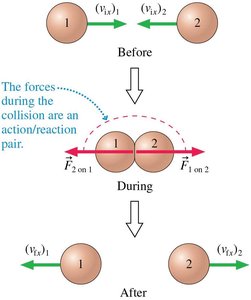
Internal Forces: Forces between objects within the system do not affect the total momentum.
Example: Two colliding objects exert equal and opposite forces on each other (Newton's Third Law).
Momentum of a System of Particles
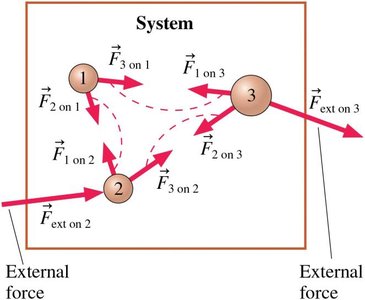
The total momentum of a system is the vector sum of the momenta of all particles. Only external forces can change the system's total momentum.
Total Momentum:
Change in Momentum:
Internal Forces: Cancel out due to Newton's Third Law.
Problem-Solving Strategy: Conservation of Momentum
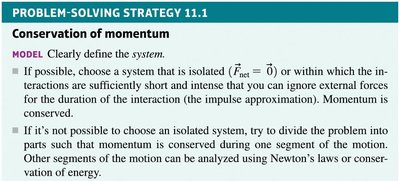
To solve momentum conservation problems, clearly define the system, visualize before-and-after scenarios, and apply the conservation law to each component.
Define the System: Choose an isolated system if possible.
Visualize: Draw before-and-after diagrams, define symbols, and list known values.
Apply Conservation: and
Review: Check units, significant figures, and reasonableness of the result.
Choosing a System
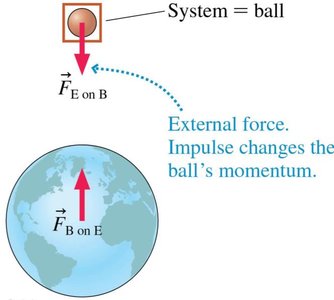
The choice of system affects whether momentum is conserved. If all relevant forces are internal, the system is isolated and momentum is conserved.
Example: A ball dropped from a height—if the system is just the ball, gravity is external; if the system is ball plus Earth, gravity is internal and momentum is conserved.
Types of Collisions
Perfectly Inelastic Collisions
In a perfectly inelastic collision, two objects stick together after colliding and move with a common velocity. Momentum is conserved, but mechanical energy is not.
Equation:
Energy: Some kinetic energy is transformed into thermal energy or deformation.
Example: A dart embedding in a dartboard.
Perfectly Elastic Collisions
In a perfectly elastic collision, both momentum and kinetic energy are conserved. Objects bounce apart without loss of energy.
Momentum Conservation:
Kinetic Energy Conservation:
Special Case (Object 2 at Rest):
Examples: Billiard balls, Newton's cradle.

Special Cases of Elastic Collisions
Equal Masses (): , (momentum is transferred from one object to the other).
: , (the heavier object continues almost unaffected).
: , (the lighter object rebounds, the heavier remains nearly stationary).
Explosions
An explosion is a brief, intense interaction where objects move apart. If no external forces act, momentum is conserved.
Examples: Radioactive decay (alpha particle emission), rocket propulsion.
Momentum in Two Dimensions
Vector Nature of Momentum
Momentum is a vector, so conservation must be applied to each component independently in two-dimensional problems.
Component Equations:
Application: Each direction (x and y) must be analyzed separately to ensure total momentum is conserved.
Appendix: Derivation of Final Velocities in Elastic Collisions
Solving for Final Velocities
By applying conservation of momentum and kinetic energy, the final velocities after a perfectly elastic collision (with one object initially at rest) are derived as:
These results are foundational for analyzing collisions in physics.
